
Organising a large buffet
You’re looking for a rusk base for a large number of guests. The pack size and the number of rusks you want to put out will determine how many packs you need.


Start by working out how many guests you’ll have and how many rusks you’d like to offer each person. Then compare the pack sizes to decide how many packs you’ll need. Plain rusks can be your starting point, with wholemeal rusks as an optional alternative. Whether you choose a familiar brand or another variety, always check the ingredients and allergen information.
You’re looking for a rusk base for a large number of guests. The pack size and the number of rusks you want to put out will determine how many packs you need.
You’re putting out rusks and toppings, and want to be able to check the ingredients and allergens listed on the current packaging for each variety you offer.
You’re considering offering wholemeal rusks alongside plain ones. In that case, it’s not just the type of rusk that matters, but also whether you can keep the different packs and toppings separate on the buffet.
First, work out how much you’ll need for the number of guests. Then decide which varieties will have their own place on the buffet, and keep the information about each type of rusk and topping together.
| What to consider | What to check when buying | Who it matters to |
|---|---|---|
| Quantity and pack size | Check how many rusks are in each pack and decide how many you want to put out per guest. | For a buffet with lots of guests, I want to put out enough rusks without opening more packs than necessary. This is the main consideration for around 50% of consumers. |
| Allergen information | Check the current labels on both the rusks and the toppings, and keep the information for each variety to hand. | If I’m offering rusks with different toppings, I want to be able to tell guests which allergens are in their chosen option. This is the main concern for around 30% of consumers. |
| Choosing between varieties | Decide whether you’d like to offer a wholemeal variety alongside plain rusks, and check the description on the packaging you choose. | Alongside plain rusks, I want to offer guests a clearly identifiable second type. Around 20% of consumers give variety the highest priority. |
Not every pack contains the same number of rusks. So the number of packs alone doesn’t tell you how many guests you can cater for.
Decide in advance how many rusks you want to offer and check the quantity on every pack you choose.
The information on a pack of rusks won’t tell you which allergens are in the toppings. According to the Netherlands Food and Consumer Product Safety Authority, anyone serving unpackaged food to consumers must provide information about the allergens it contains where the food is offered.
Check the rusks and toppings separately. If you’re serving the buffet as a caterer or other food provider, keep the allergen information available at the display.
According to the Netherlands Nutrition Centre, baker’s salt contains iodine, but bakers aren’t required to use it. So you can’t assume that every type of rusk is made with this salt.
Don’t assume which salt has been used based on the product category; check the ingredients list for the rusk you’ve chosen.
The brands mentioned offer different types of rusks. The right pack for your buffet depends on the quantity you need, the variety you’d like to offer and the current product information.
The AH own brand offers plain and wholemeal rusks for anyone looking to compare the two types.
PLUS offers plain rusks and a deluxe plain variety with seeds.
Bolletje offers a range of branded varieties, including Echte Beschuit and Bakkers-beschuit.
Goud Gebakken is an ALDI own brand offering plain and wholemeal rusks.
These Joybuy products are Bolletje varieties in packs of 10 or 13. Choose the type you’d like to offer, work out how many packs you’ll need, and check the current ingredients and allergen information before putting them out.
 No image available
A seeded variety to offer alongside plain rusks. The pack contains 10 pieces; check the current label for ingredients and allergens.
 No image available
A wholemeal variety to put out alongside plain rusks. The pack contains 10 pieces; check the current packaging for ingredients and allergens before serving.
 No image available
A wholemeal option if you’d also like to plan the quantity per pack for a second variety. This pack contains 13 pieces; check the current ingredient and allergen information.
 No image available
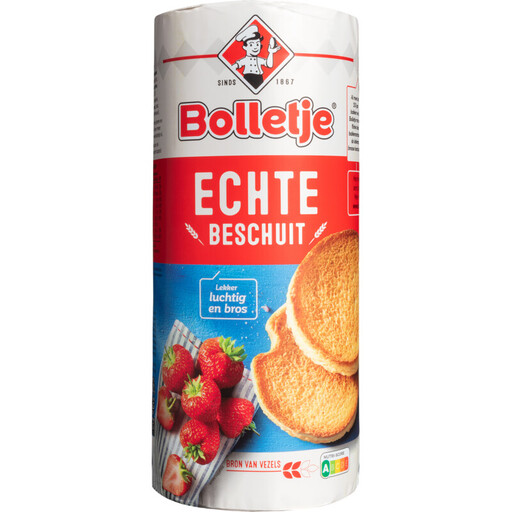
A classic type of rusk for serving with toppings. The pack contains 13 pieces; check the current label for this variety too, and check the toppings separately.
Yes, if you’re a caterer or other food provider serving unpackaged food to consumers. According to the Netherlands Food and Consumer Product Safety Authority, information about the allergens present must be available where the food is offered. Check both the rusks and each type of topping.
Don’t assume they are. Check the ingredient and allergen information on the current packaging for the rusks you’ve chosen, as well as for the toppings. A plain variety doesn’t, in itself, tell you whether it contains gluten-containing cereals.
You can’t assume that all rusks do. The Netherlands Nutrition Centre says that baker’s salt contains iodine, but bakers aren’t required to use it. So check the ingredients list for the variety you’ve chosen.
A plain variety may be enough if you don’t want to offer a second type. If you’d also like to serve guests wholemeal rusks, keep them clearly separate and have the ingredient and allergen information for both varieties to hand.