For a child’s tea break, first check the allergens on the packaging and any rules set by their school or after-school club: the plain, wholemeal and multiseed rusks covered here all list gluten. If rusks are allowed, plain ones make a simple base for toppings or fruit. Compare wholemeal and multiseed options if fibre and ingredients matter more to you. If you’re taking them with you, bear in mind that rusks are brittle, and check the pack size if you’re looking for a particular quantity.
Who might find this choice relevant?
Parents checking school rules
You’ll want to check the latest allergen information and any rules set by the school or after-school club before packing rusks. The varieties covered here list gluten; depending on the product, egg or sesame may also be relevant.
Families comparing fibre content
You’re comparing plain rusks with wholemeal or multiseed varieties by their fibre content per 100 g, while also checking that the ingredients and flavour suit your child. Jumbo lists 11 g of fibre per 100 g for Bolletje Wholemeal Rusks.
Families looking for a simple option
You’re looking for rusks to serve with suitable toppings or fruit at tea time, without a strong seed flavour. Even with plain rusks, check the allergen information: Albert Heijn and Jumbo list ingredients including wheat and egg for the plain products covered here.
What should you look for when choosing?
Start with allergens and any school rules. Then compare the nutritional information, your child’s preferences and how practical the packaging is.
| What to consider |
What to check when buying |
Who is this most important for? |
| Allergens and school rules |
Read the allergen information on the current packaging and check the rules set by the school or after-school club. |
If my child needs to avoid gluten or their group has allergy rules, I want to know whether these rusks are suitable before considering the flavour. This is the top priority for around 36% of consumers. |
| Fibre and variety |
Compare fibre per 100 g and decide whether you want plain, wholemeal or multiseed rusks; check the ingredients too. |
I want to choose a wholemeal or higher-fibre option, so I pay more attention to the nutritional information than to a mild flavour. Around 29% of consumers give fibre top priority. |
| Flavour and texture |
Check whether the rusks are plain or contain seeds, and choose a variety your child will enjoy. |
If a child prefers simple rusks, I want the flavour and texture to suit tea time. This is the first thing around 21% of consumers consider. |
| Storage and taking them with you |
Check the number of rusks, the weight and the storage instructions; protect them from moisture and breakage while travelling. |
If I’m taking rusks with me, what matters most is that they arrive whole and dry. Around 14% of consumers put this practical consideration first. |
Common mistakes
-
Assuming all rusks contain the same allergens
The products covered here list gluten, but other allergens vary by variety. For example, PLUS lists sesame for Bolletje High-Fibre Multiseed Rusks.
Read the information on the packaging you’re buying, and check the rules set by the school or after-school club if you’re taking the rusks in.
-
Treating wholemeal and multiseed as the same thing
Fibre content and an ingredients list tell you different things. Jumbo lists 11 g of fibre per 100 g for Bolletje Wholemeal Rusks; PLUS lists ingredients including sesame for Bolletje High-Fibre Multiseed Rusks.
Compare nutritional information per 100 g, then check the ingredients and allergens for the specific variety.
-
Assuming rusks contain iodine because they list salt
Baker’s salt has iodine added, but an ingredients list that only says ‘salt’ doesn’t tell you what type of salt was used in a particular product.
If this matters when choosing a product, check the packaging for baker’s salt or iodised salt, or ask the manufacturer.
-
Leaving it until packing to think about how brittle they are
Rusks can break while you’re out or lose their crunch if they get damp. Pack sizes also vary in the number of rusks and their weight.
Check how many rusks are in the pack, store opened rusks in a dry, sealed container and take a portion with you in a sturdy, dry tub.
Brands compared
Bolletje
The product information covered here includes Bolletje wholemeal rusks and high-fibre multiseed rusks. Compare these varieties separately.
- Jumbo lists 11 g of fibre per 100 g for Bolletje Wholemeal Rusks.
- PLUS lists sesame for Bolletje High-Fibre Multiseed Rusks; check the allergens for each variety.
Albert Heijn
AH Plain Rusks are an own-brand option to compare if you’re looking for plain rusks.
- Albert Heijn lists 125 g and 13 servings for this variety.
- The product information lists wheat, rye and egg. Check the current packaging, including for the possible presence of other allergens.
Jumbo
The product information covered here includes both Jumbo Plain Rusks and Robust Multigrain Rusks.
- Jumbo lists 3.1 g of fibre per 100 g for its Plain Rusks.
- Jumbo lists ingredients including sesame, spelt, rye and barley as allergens for its Robust Multigrain Rusks.
PLUS
PLUS Plain Rusks are an own-brand option to compare with other plain varieties.
- PLUS lists a 125 g pack and 3.1 g of fibre per 100 g for this variety.
- The product information lists wheat and egg, and also mentions the possible presence of other gluten-containing cereals.
Rusks on Joybuy
These products offer two options for a child’s tea break: wholemeal and plain rusks. First, check which allergens and school rules apply to you; then compare the variety and pack size.
 Image unavailable
Bolletje wholemeal rusks, 13 pieces
A wholemeal option to compare if fibre matters to you.
For a child’s tea break, check the latest allergen information for gluten, wheat and egg, and make sure the product complies with the rules set by the school or after-school club.
View on Joybuy
 Image unavailable
Bolletje dark wholemeal rusks, 10 pieces
A dark wholemeal option to consider if the ingredients and flavour suit your child.
Check the latest allergen information, including details of gluten-containing cereals and sesame, before packing these rusks.
View on Joybuy
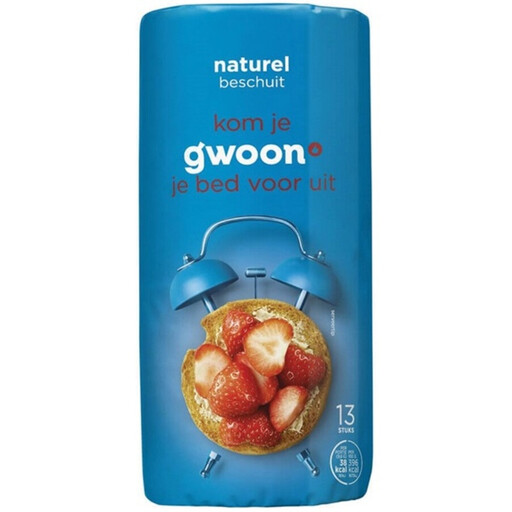 Image unavailable
g'woon plain rusks, 125 g
A plain option if you’re looking for a simple base for tea time.
Before serving, check the packaging for gluten-containing cereals, wheat, egg and milk, and bear in mind the rules set by the school or after-school club.
View on Joybuy
Frequently asked questions
Are the rusks covered here gluten-free?
No. The varieties covered from AH, Jumbo, PLUS and Bolletje list wheat or gluten-containing cereals. If a child needs to avoid gluten, don’t choose any of these varieties. Check that an alternative is labelled gluten-free on the packaging.
Do all rusks contain iodine from baker’s salt?
Don’t assume so just because the ingredients list includes ‘salt’. Iodine is added to baker’s salt, so if this matters to your choice, check whether the packaging mentions baker’s salt or iodised salt, or ask the manufacturer.
How can I take rusks with me without them breaking or going soft?
Store opened rusks in a dry, sealed container and carry a portion in a sturdy, dry tub. Keep moist toppings separate until you’re ready to eat.


