
Families who serve rusks regularly
If rusks are often on the table, you’ll want to know how many each pack contains and which variety you’re buying.


Plain rusks are a straightforward choice for a simple teatime with children. If you’re mainly comparing varieties for their fibre content, check the nutritional information for wholegrain rusks per 100 g. If the rusks are going to school or childcare, check the current label and the venue’s allergen policy before packing them.
If rusks are often on the table, you’ll want to know how many each pack contains and which variety you’re buying.
You’re considering wholegrain rusks for the same teatime and want to compare their fibre content and ingredients with those of plain rusks.
You need to consider the allergens listed on the current label as well as the school or childcare setting’s policy.
If the rusks are for school or childcare, check the allergens and local policies first. Then compare the varieties on the features that matter for your teatime.
| What to consider | What to check when buying | Who it matters to |
|---|---|---|
| Quantity per pack | Check the number of rusks and the net weight: they don’t describe the same thing. | For regular teatimes, I want to know how many rusks are in a pack. For around 50% of consumers, the quantity for regular use is the top priority. |
| Wholegrain and fibre | Compare the ingredients and the number of grams of fibre per 100 g. | I want to consider a wholegrain variety for the same occasion, so I check the nutritional information. This is the most important factor for around 30% of consumers. |
| Allergens and packing | Read the current label and pack the rusks in line with the school or childcare setting’s policy. | If I’m packing rusks for a child with a relevant dietary restriction, I need to know which ingredients are allowed. This is the top priority for around 20% of consumers. |
The standard varieties reviewed list cereals containing gluten, and some also list egg or sesame. This may affect the choice for a child with a relevant dietary restriction.
Read the label on the pack you’re actually sending in and follow the policy of the school or childcare setting.
Wholegrain rusks and seeded rusks can differ in their ingredients, fibre content and allergens; sesame may be relevant in some seeded varieties.
Compare the nutritional information per 100 g and check the allergens for the specific variety.
Information about bakers’ salt alone doesn’t tell you how much iodine is in the pack of rusks you’re buying.
For a question about a specific product, check the label or ask the manufacturer for information about that variety.
Albert Heijn offers AH plain rusks and AH wholegrain rusks.
Jumbo offers plain and wholegrain rusks for anyone looking to compare the varieties.
PLUS offers plain rusks and a separate wholegrain variety with seeds.
Bolletje offers Echte beschuit (traditional rusks), as well as wholegrain varieties.
ALDI lists Goud Gebakken plain and wholegrain rusks in its range.
Lidl lists plain, wholegrain and multigrain rusks.
These Bolletje varieties give you a choice of wholegrain rusks, seeded rusks and a standard variety. When choosing, compare the number of rusks and always check the current label if they’re going to school or childcare.
 Image unavailable
For anyone looking to compare a wholegrain variety for teatime. The pack contains 13 rusks; check the allergens on the current label before packing them.
 Image unavailable
A dark wholegrain variety for anyone comparing the ingredients in different rusks. The pack contains 10 rusks; make sure packing them complies with the label and the school or childcare setting’s policy.
 Image unavailable
For anyone looking for seeded rusks to enjoy at teatime. The pack contains 10 rusks; if you have a relevant dietary restriction, read the allergen information for this variety.
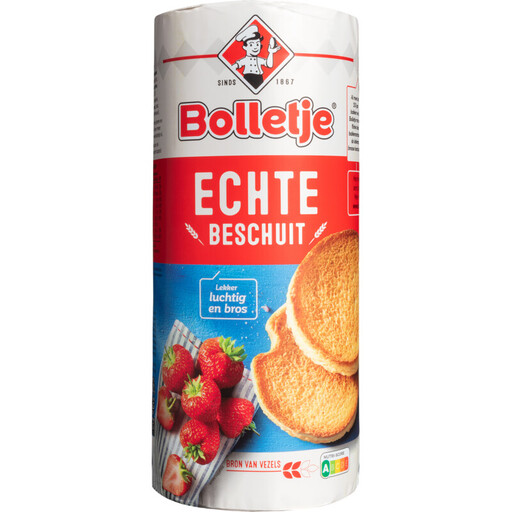 Image unavailable
A standard rusk variety for a simple teatime. The pack contains 13 rusks; check the ingredients and the school or childcare setting’s policy before packing them.
Compare the ingredients, fibre per 100 g and the number of rusks per pack. According to Albert Heijn’s product information, AH wholegrain rusks contain 9 g of fibre per 100 g; also check the allergens on the specific pack.
The standard rusks reviewed aren’t suitable: they list cereals containing gluten. Only choose a suitable product after checking the current label, and take the school or childcare setting’s policy into account.
Seal the pack well after opening and store the rusks somewhere dry. This helps prevent moisture from making them less crisp.
You can’t assume that from the product name or a general reference to bakers’ salt. Check the label for the variety in question or ask the manufacturer for product-specific information.