
Families with different preferences
If one person prefers plain rusks and another likes wholemeal, you can serve both. Before you buy, also think about what you’ll do with any pack you’ve opened.


If your guests have different preferences, you can serve plain and wholemeal rusks side by side rather than choosing one type for everyone. When comparing wholemeal options, check the fibre and salt per 100 g. If any guests have allergies, always check the ingredients and allergens on the pack you’re serving.
If one person prefers plain rusks and another likes wholemeal, you can serve both. Before you buy, also think about what you’ll do with any pack you’ve opened.
You’re looking for a wholemeal option, but don’t want to judge by colour alone. Compare the nutritional information on the packs you’re considering, especially fibre and salt per 100 g.
The products reviewed include cereals containing gluten and egg; varieties with seeds may also contain sesame. Always read the label on each variety you plan to serve.
First, decide whether your guests need a choice between plain and wholemeal. Then compare the packs for nutritional information, allergens and the number of rusks you want to serve.
| What to consider | What to check when buying | Who it matters to |
|---|---|---|
| Choice at the table | Decide whether you want to serve both plain and wholemeal rusks, and check how many pieces are in each pack. | If my guests have different preferences, I don’t want everyone to have to eat the same type. Around 36% of consumers put having this choice first. |
| Wholemeal and fibre | Check whether the pack says wholemeal and compare fibre per 100 g. If the rusks are different sizes, also check the amount per rusk. | When I want to serve wholemeal, I want to know exactly what I’m buying and how the options compare nutritionally. Around 29% of consumers give this top priority. |
| Allergens | Read the ingredients and allergen information on the current pack, including any mention of egg, cereals containing gluten and sesame. | If a guest has an allergy, I want to check what I can safely offer on each pack. For around 21% of consumers, this is their main concern. |
| Pack size and availability | Check the pack weight or number of pieces, and whether it’s currently available at the shop where you’re buying your groceries. | If I’m shopping for several guests, I want to know I can buy enough rusks without having lots left over. This matters most to around 14% of consumers. |
Nutritional information can vary between varieties. Albert Heijn lists 9 g of fibre and 0.48 g of salt per 100 g for AH Wholemeal Rusks; for PLUS Wholemeal Rusks with Seeds, PLUS lists 10.6 g of fibre and 0.8 g of salt per 100 g.
Compare like for like on the current packs, and consider separately whether seeds and a different texture will suit your guests.
Sesame can be a relevant allergen in rusks with lots of seeds. Other varieties reviewed also list egg or cereals containing gluten. Choosing wholemeal says nothing about whether a product is suitable for someone with an allergy.
Ask your guests about allergies and check the pack of the exact variety you’re serving. If necessary, keep a suitable, checked alternative separate.
A product you’ve picked out for dinner may be temporarily unavailable at your shop. This matters especially if you want to serve two specific varieties side by side.
Check availability shortly before you buy, and decide in advance which other plain or wholemeal variety would meet your needs.
Bolletje offers plain Echte Beschuit and wholemeal varieties, including a dark variety with oats and seeds.
AH Wholemeal Rusks are a standard wholemeal option in a 140 g pack.
Jumbo offers standard wholemeal rusks and an organic wholemeal variety.
PLUS offers both standard wholemeal rusks and a larger wholemeal variety with seeds and kernels.
Goud Gebakken is ALDI’s own-brand wholemeal rusk, with 13 pieces per pack.
Lidl offers a 140 g wholemeal rusk as a supermarket product.
These three products include a dark wholemeal variety, a standard wholemeal variety and plain rusks. The right combination depends on your guests’ preferences and allergies.
 No image available
A wholemeal option for guests who like rusks with oats and seeds. The pack contains 10 pieces.
The product information lists 8.8% oat flakes and 5.8% seeds. Check the current allergen information before serving this variety.
 No image available
A standard wholemeal option for guests who aren’t looking for rusks with seeds. The pack contains 13 pieces.
Compare fibre on the current pack, per 100 g or per clearly stated serving. Also check the allergen information for your guests.
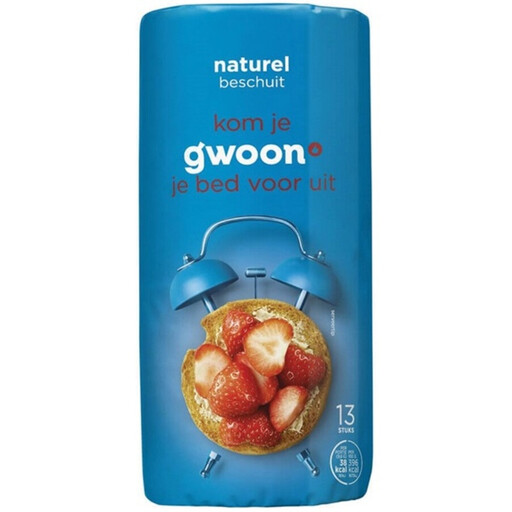 No image available
A plain rusk option to serve alongside wholemeal rusks when your guests have different preferences. The pack weighs 125 g.
Check the pack for the number of pieces, and read the ingredients and allergen information before serving.
No. Buying two varieties makes sense mainly if you know your guests have different preferences. If everyone likes the same type, you can choose one variety and check the pack to see how many pieces you’ll need.
No, colour alone doesn’t tell you that. Check the product name and ingredients list. According to the Netherlands Nutrition Centre, a product can only be called wholemeal if it’s made entirely from wholemeal flour.
Check the allergen information on every pack you serve. The plain and wholemeal varieties reviewed include egg and cereals containing gluten, among other allergens; varieties with seeds may also list sesame. Make sure you distinguish between ‘contains’ and ‘may contain’.
Follow the storage instructions on the pack and seal an opened pack well, keeping it somewhere dry. For the wholemeal rusks reviewed, Albert Heijn recommends storing them in a sealed tin after opening; PLUS advises protecting its variety from moisture and heat.