
Caterers catering for different tastes
Want to offer guests both a light rusk and a familiar wholemeal option, rather than serving everyone the same grain flavour and texture.


For a mixed conference audience, serving a light rusk alongside a standard wholemeal rusk is a practical combination. Guests can choose between two different grain profiles without making the core selection too large. Add a darker seeded option only if that extra choice suits your guests and you can keep track of the ingredients and allergen information for each product.
Want to offer guests both a light rusk and a familiar wholemeal option, rather than serving everyone the same grain flavour and texture.
Want to check which flour has been used on the packaging and how much fibre the chosen option contains per 100 g, rather than judging by its colour.
Need up-to-date product information for both the rusks and the toppings at an open buffet. Pay particular attention to declarations of cereals containing gluten, eggs and, where applicable, sesame.
First decide which light and wholemeal rusks you want to serve together at the buffet. Then check the ingredients, nutritional information, pack size and allergens for each exact product before considering adding a third option.
| What to consider | What to check when buying | Who it matters to |
|---|---|---|
| Choosing between light and wholemeal | Compare the first ingredients listed for both options. Bolletje lists wheat flour for its Original Rusks; wholemeal wheat flour is the first ingredient in the PLUS wholemeal rusks reviewed. | When I’m catering for guests with different preferences, I don’t want one strong grain flavour to be the only option. For around 42% of consumers, that freedom of choice would be the main purchasing concern. |
| Wholemeal ingredients and fibre | Check which flour is used and compare the fibre content per 100 g on the current packaging. For its wholemeal rusks reviewed, PLUS lists 7,7 g of fibre per 100 g. | For me, a wholemeal option should be identifiable from its ingredients and nutritional information, not just its darker colour. Around 33% of consumers would consider this first. |
| Allergens when serving | Record the ingredients and allergen information for each product and keep it available at an open buffet. The Netherlands Food and Consumer Product Safety Authority requires allergen information for non-prepacked foods. | When I serve rusks and toppings unpackaged, I want to be able to give guests accurate information before they choose. For around 25% of consumers, this would be the main purchasing requirement. |
A dark seeded rusk doesn’t serve the same purpose as a light rusk. Bolletje lists wheat flour as the first ingredient in its Original Rusks, while the dark wholemeal option reviewed also contains oats and seeds.
For a mixed group, start with a light rusk and a standard wholemeal rusk. Consider the seeded option only as an additional choice.
The PLUS and Jumbo wholemeal options reviewed list ingredients including wheat and egg. Sesame is also relevant for the dark Bolletje option reviewed.
Check the current packaging for each exact product. Only choose a separate alternative for a guest with a relevant allergy after checking that product’s own information.
Guests must be able to get information about allergens in non-prepacked foods. The Netherlands Food and Consumer Product Safety Authority sets requirements for providing this information.
Gather the details for your chosen rusks and toppings before serving, and make sure the information is available at the buffet.
Pack weight and the number of pieces are different details. For example, the PLUS pack reviewed is listed as 125 g, while the Jumbo and Goud Gebakken packs reviewed each contain 13 pieces.
Work out how many rusks you want to serve, then compare pack sizes and confirm availability with your chosen supplier.
These brands offer specific options you can compare when choosing a light and a wholemeal rusk to serve together. The ingredients and nutritional values refer to the product named in each case.
Offers both Original Rusks and wholemeal options, including a dark variety with seeds.
The standard wholemeal rusks reviewed are a useful benchmark for the wholemeal half of the buffet selection.
The wholemeal rusks reviewed contain 13 pieces per pack.
Wholemeal rusks from ALDI Netherlands, with 13 pieces per pack.
These products suit a selection that pairs a light rusk with a wholemeal option; the dark wholemeal variety is a possible extra choice. Compare the current packaging and allergen information before putting your buffet together.
 Image unavailable
A wholemeal option to serve alongside a light rusk.
The product name states that the pack contains 13 pieces. Check the allergens on the current packaging before serving at an open buffet.
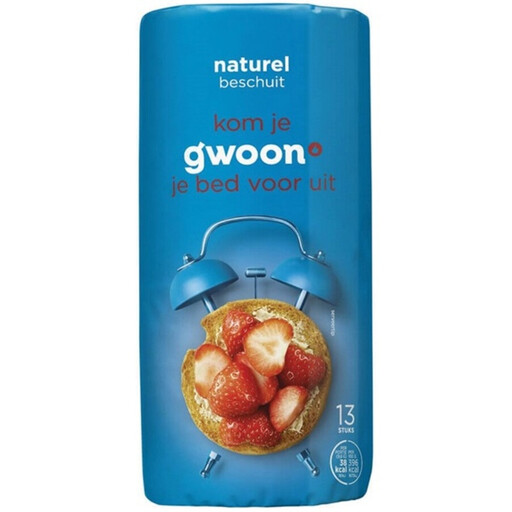 Image unavailable
A plain option to serve alongside wholemeal rusks.
The product name states 125 g. Before serving, check the allergens on the current packaging, particularly the milk declaration.
 Image unavailable
A dark wholemeal option to consider as an extra choice alongside light and standard wholemeal rusks.
The product name states that the pack contains 10 pieces. Check the ingredients and allergens for this exact option before serving.
Yes. According to the Netherlands Food and Consumer Product Safety Authority, information about 14 allergens must be available for non-prepacked foods. For cereals containing gluten, you must make clear which cereals are involved. Make sure information for both the rusks and the toppings is available at the buffet, and check the NVWA’s requirements if you’re providing the information verbally.
Not simply because they’re labelled ‘wholemeal’. The PLUS and Jumbo wholemeal rusks reviewed list ingredients including wheat and egg. Check the current allergen information for every option you choose, and assess any possible alternative separately.
Follow the storage instructions on your chosen pack and protect opened rusks from moisture. For one Bolletje wholemeal option reviewed, Joybuy recommends storing it in a cool, dry place away from direct sunlight and heat sources.