
Organisers catering for different tastes
If you’re not sure what all your guests like to eat, serving plain rusks on one plate and wholegrain rusks on another gives them more choice than offering just one type.


For a Christmas market with a range of different tastes, the clearest option is to offer plain and wholegrain rusks separately. That way, guests can choose according to taste or their preference for wholegrain. Check the nutritional information and allergens on the packaging of each variety you buy.
If you’re not sure what all your guests like to eat, serving plain rusks on one plate and wholegrain rusks on another gives them more choice than offering just one type.
For these guests, the ‘wholegrain’ label and the fibre content per 100 g are useful details to compare on the packaging. According to the Netherlands Nutrition Centre, wholegrain cereal products contain more fibre than comparable white varieties.
At a shared table, it should be clear which label belongs to which type of rusk. For example, Albert Heijn lists wheat, cereals containing gluten and egg for AH Wholegrain Rusks; Bolletje lists wheat, rye and egg for Echte Beschuit.
First decide whether you want to offer both plain and wholegrain rusks. Then compare the wholegrain claim, fibre per 100 g and allergens on each pack. Choosing wholegrain doesn’t automatically make a rusk suitable for someone who needs to avoid wheat or gluten.
| What to consider | What to check when buying | Who is this most important for? |
|---|---|---|
| Taste and texture | If guests have different preferences, choose one plain and one wholegrain variety and serve them separately. | If guests expect both light and wholegrain rusks, I don’t want to serve everyone just one type. For around 45% of consumers, taste and texture come first. |
| Wholegrain and fibre | Check for the ‘wholegrain’ label and compare fibre on the same basis: per 100 g. | I want to offer wholegrain rusks and see how much fibre the chosen variety contains. Around 33% of consumers give this the highest priority. |
| Allergens | Read the allergen information on every pack you buy and keep the packaging next to the corresponding plates. | If a guest has a food allergy, I want to know which rusks are on each plate and prevent the different types from coming into contact. This is the main concern for around 22% of consumers. |
Colour and visible seeds don’t tell you whether a rusk is wholegrain. According to the Netherlands Nutrition Centre, the term ‘wholegrain’ refers to the wholegrain flour used.
Look for the label on the pack and compare fibre using the nutritional information per 100 g.
Plain and wholegrain rusks can contain different ingredients. Warnings on the label can also vary from product to product.
Check each pack individually, keep the labels by the table and use separate plates and tongs if you want to prevent the varieties from coming into contact.
You can’t tell whether a product contains iodine-enriched baker’s salt just from the product category ‘rusks’.
If this matters to your choice, check the ingredients on the specific pack or ask the manufacturer about that variety.
Bolletje offers both Echte Beschuit and a wholegrain variety, so you can look for two different options from the same brand.
Albert Heijn’s rusk range includes plain and wholegrain varieties.
Jumbo’s rusk range includes plain and wholegrain varieties, as well as options with grains or seeds.
Goud Gebakken is an ALDI option for anyone specifically looking for wholegrain rusks.
Lidl lists a 140 g wholegrain rusk as one of its own-brand products.
These products give you two wholegrain varieties and one plain option, so you can serve each type separately at a Christmas market. If a guest has an allergy, always check the pack you buy.
 Image unavailable
A separate wholegrain option for guests who prefer it.
Jumbo lists 11 g of fibre per 100 g for Bolletje Wholegrain Rusks, with wheat, gluten and egg as allergens. Check the label on the pack you’ve bought before serving.
 Image unavailable
Another wholegrain option if you don’t want to serve only plain rusks.
The product name states that the pack contains 10 pieces. Check the current ingredients for this variety, including the listed grains and sesame, and look out for any cross-contamination warnings.
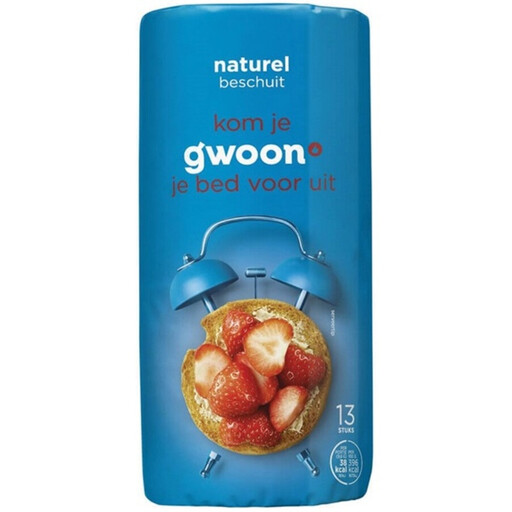 Image unavailable
A plain option to serve alongside a wholegrain variety for guests who prefer a lighter rusk.
If any guests have allergies, check the current label carefully, including for milk and other allergens.
No. Colour and seeds aren’t reliable indicators, so check whether the pack says ‘wholegrain’. According to the Netherlands Nutrition Centre, a product can only be described as wholegrain if it is made entirely from wholegrain flour.
Put the two types on separate plates and keep their packaging nearby. Using a separate pair of tongs for each plate and clearly labelling each product helps guests see which rusks they’re choosing and which label goes with them.
You can’t make that claim about rusks as a whole category. Albert Heijn lists wheat, cereals containing gluten and egg for AH Wholegrain Rusks; Bolletje lists wheat, rye and egg for Echte Beschuit. Check the current label for every variety you choose, including any cross-contamination warnings.
Keep rusks dry and seal any opened pack tightly. Follow the storage advice on the packaging of the variety you buy, and make sure the rusks don’t get damp on the serving table.
Don’t assume they do. If iodine-enriched baker’s salt is important to your choice, check the ingredients of the specific product or ask the manufacturer for information about that variety.