
Buyer for group lunches
You regularly buy food for several children and want to match pack sizes to the number of planned lunch occasions.


Rusks with chocolate sprinkles shouldn’t automatically become a daily lunch staple at a nursery. Healthy Childcare recommends choosing foods from the Wheel of Five as often as possible; according to the Netherlands Nutrition Centre, chocolate sprinkles are high in sugar and saturated fat. If your food policy allows chocolate sprinkles occasionally, choose the rusks and topping separately, and check the current packaging against your allergen protocol.
You regularly buy food for several children and want to match pack sizes to the number of planned lunch occasions.
You’re looking for a regular lunch routine that follows the Wheel of Five as closely as possible, and you assess separately whether chocolate sprinkles have a place in it occasionally.
Before serving, you need to check that the exact rusks and chocolate sprinkles meet the requirements for the children at your setting. Depending on the variety, you may need to consider cereals containing gluten, milk and soya, among other allergens.
First, decide whether chocolate sprinkles are permitted under your food policy. Then check both packs for allergens and choose quantities that suit the planned lunch occasions.
| Consideration | What should you check? | Who is this most relevant to? |
|---|---|---|
| Portion planning | Compare the size of the chocolate sprinkles pack with the number of planned portions. For the rusks, count the number of pieces in each pack. | When I’m buying for a group, I want to choose pack sizes that suit the planned lunch occasions. Around 42% of consumers prioritise this kind of portion planning. |
| Food policy | Check whether sweet toppings are allowed and how often. Assess a possible wholemeal rusk base separately from the chocolate sprinkles. | When setting up a regular lunch routine, I want to know whether chocolate sprinkles fit in or will only be served occasionally. Around 33% of consumers put this policy decision first. |
| Allergen protocol | Read the current ingredients and allergen information for both the rusks and the chocolate sprinkles, and compare it with your setting’s requirements. | When I need to take recorded allergies into account, I must check the exact varieties before serving them. This check is the top priority for around 25% of consumers. |
According to the Netherlands Nutrition Centre, wholegrain products contain more fibre than non-wholegrain alternatives. That doesn’t change how chocolate sprinkles should be assessed as a topping: the Centre highlights their sugar and saturated fat content.
Assess the rusks and chocolate sprinkles separately. Agree as part of your food policy whether sweet toppings will be served, and when.
Allergens vary between products and varieties. Albert Heijn’s product information lists wheat and egg, among other ingredients, in its wholemeal rusks; Jumbo lists milk and soya in Venz Dark Chocolate Sprinkles.
Check the current labels on both products every time you choose them, and follow your setting’s allergen protocol.
The own-label range includes both wholemeal rusks and dark chocolate sprinkles.
The own-label range includes milk chocolate sprinkles and dark chocolate sprinkles in 600 g packs.
ALDI lists Kiekeboe Dark Chocolate Sprinkles and Goud Gebakken wholemeal rusks as separate products.
De Ruijter is an option if you’re looking for a particular variety of chocolate sprinkles.
Venz offers Dark Chocolate Sprinkles in a 400 g pack, among other products.
Lidl lists wholemeal rusks and milk chocolate sprinkles as separate products.
These products are separate wholemeal rusks and chocolate toppings, not a complete lunch. Only choose a combination if chocolate sprinkles are permitted under your food policy and both packs meet your allergen protocol.
 No image available
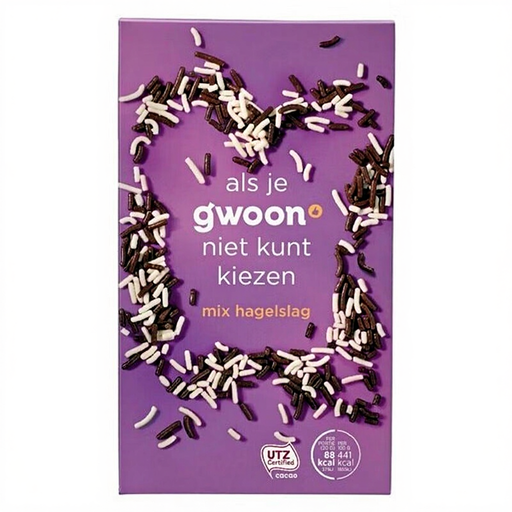
A variety of chocolate sprinkles for a lunch occasion when sweet toppings are allowed; choose your rusks separately. Before serving, check the current pack for milk and wheat.
 No image available
Dark chocolate sprinkles for occasional use if your setting’s policy allows them; rusks are a separate choice. Check the current pack for milk and soya.
 No image available
A wholemeal rusk base for a planned group lunch; choose the topping separately. Check the current pack for cereals containing gluten and sesame.
 No image available
A wholemeal rusk base with a piece count that helps you plan lunch portions; chocolate sprinkles are not included. Check the current pack for wheat, egg and any sesame warning.
 No image available
These chocolate sprinkles are a separate topping. Check that the variety is suitable for serving on rusks, and read the current pack for milk and soya.
Not automatically as a daily staple. Healthy Childcare recommends choosing foods from the Wheel of Five as often as possible, while the Netherlands Nutrition Centre highlights the sugar and saturated fat in chocolate sprinkles. Decide as part of your food policy whether sweet toppings will be served occasionally.
Before serving, read the current ingredients and allergen information on both packs, and compare it with your setting’s protocol. According to the Netherlands Food and Consumer Product Safety Authority, allergens must be clearly listed on the label. Don’t rely on descriptions such as ‘dark’ or ‘wholegrain’ alone.
Follow the storage instructions and use-by or best-before date on the exact pack for both products. Albert Heijn recommends keeping its wholemeal rusks in a cool, dark, dry place and storing them in a sealed tin after opening. For its dark chocolate sprinkles, it recommends a cool, dark and dry place. Check the instructions again whenever you choose a different variety.