
Hosts who want the seeds to stand out
You’re looking for rusks with seeds you can see alongside the chocolate sprinkles. Check which seeds the variety contains and look at the allergen information before setting out the platter.


If you want visible seeds on a platter of rusks with chocolate sprinkles, choose multiseed rusks. If a wholemeal base is your priority, look for an explicit wholemeal claim rather than relying on the seeds or colour alone. Dark wholemeal rusks with seeds can combine both. Before serving, check the ingredients of both the rusks and the chocolate sprinkles, and use the nutritional information on the packaging you choose to decide how much topping to serve.
You’re looking for rusks with seeds you can see alongside the chocolate sprinkles. Check which seeds the variety contains and look at the allergen information before setting out the platter.
You want to pair a sweet topping with rusks that are explicitly described as wholemeal. Compare the fibre content per 100 g on the packaging, too.
If guests need to avoid certain allergens, assess the rusks and the chocolate sprinkles separately. For the varieties described here, allergens to look out for include cereals containing gluten, sesame, milk and soya.
Before your Halloween party, decide whether seeds, a wholemeal base or the ingredients in the complete topped rusk matter most to you. Then check the labels on both products.
| What to look for | What to check when buying | Who it matters to |
|---|---|---|
| Seeds and presentation | Check which seeds are listed and whether sesame appears among the allergens. | If I want the seeds to be visible on my party platter, I need to know what’s actually in the rusks. This is the priority for around 40% of consumers considering rusks with chocolate sprinkles for Halloween. |
| Wholegrains and fibre | Look for an explicit wholemeal claim and compare fibre on the same basis, per 100 g. | I’d rather choose the rusk base first and the sweet topping afterwards; a dark colour or a multiseed name isn’t enough. This wholemeal and fibre preference is the priority for around 30% of these consumers. |
| Ingredients in the complete snack | Read the current ingredients lists and allergen information for both the rusks and the chocolate sprinkles. | When I’m serving guests, I want to be able to check both packs rather than just the rusks. Around 30% of these consumers make checking the ingredients their priority. |
Seeds tell you about the added ingredients, not necessarily the grain base. For the Bolletje Multiseed rusks described by Joybuy, wheat flour is listed first in the ingredients; Jumbo describes the Bolletje Dark Wholemeal variety it reviewed as having a wholemeal base.
Look for an explicit wholemeal claim and compare the fibre content per 100 g if those qualities matter more to you than the seed mix.
According to the Netherlands Nutrition Centre, using iodised baker’s salt is not compulsory in the Netherlands. So terms such as multiseed, wholemeal or organic don’t tell you which salt is used in a particular rusk.
Check the ingredients list on the pack if the type of salt matters to your choice.
The rusks and chocolate sprinkles may contain different allergens. The rusk examples described here include wheat and sesame; the Venz milk chocolate sprinkles reviewed contain milk and soya.
Read the current allergen information on both packs before serving the topped rusks.
For the Venz milk chocolate sprinkles it reviewed, Jumbo lists 14 g of sugars per 20 g serving. That figure applies to these chocolate sprinkles and this serving size, not to chocolate sprinkles in general.
Use the nutritional information for the topping you actually choose to decide how much to serve.
For these brands, compare the specific rusk or chocolate sprinkle variety. A brand name alone won’t tell you which grain base, seeds or allergens to expect.
The range shown by Jumbo includes Bolletje wholemeal, dark wholemeal and multiseed rusks.
Albert Heijn offers multiseed rusks and several wholemeal varieties in its rusk range.
Venz is a relevant option here for chocolate sprinkles to put on your rusks.
These rusks give you different options for serving rusks with chocolate sprinkles: a wholemeal variety with seeds, a wholemeal variety with no seed mix listed, and multiseed varieties. Choose your chocolate sprinkles separately and check the ingredients on both packs.
 No image available
A good choice if you want both a wholemeal base and seeds on your party platter.
For this variety, Jumbo lists 100% wholemeal, 5.8% seeds and 10 g of fibre per 100 g.
Check the current packaging for cereals containing gluten and sesame; the chocolate sprinkles need a separate ingredient check.
 No image available
A good fit if you’re choosing wholemeal rusks and visible seeds are less important.
The pack contains 13 pieces. Check the latest ingredient information for wheat, egg and any sesame warning.
Choose the chocolate sprinkles separately and check their allergen information, too.
 No image available
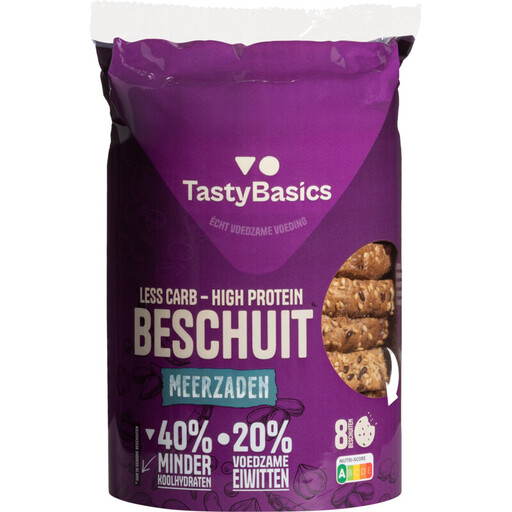
A multiseed option if you want a variety of seeds in the rusks on your party table.
The pack is labelled 184 g. Only compare fibre values when the nutritional information uses the same basis, such as per 100 g.
Check the latest allergen information for these rusks and for the chocolate sprinkles you choose.
 No image available
A good fit for a party platter where visible seeds in the rusks are the main reason for your choice.
For this variety, Joybuy lists sunflower seeds, linseed, sesame seeds and pumpkin seeds, among others, and gives the fibre content as 10 g per 100 g.
Wheat flour is listed first in the ingredients, so don’t assume it has a wholemeal base from the name. Check the allergens on both packs, too.
No. The name ‘multiseed’ doesn’t confirm that the grain base is wholemeal. For the Bolletje Multiseed rusks described here, wheat flour is listed first in the ingredients; if you want a wholemeal option, look for an explicit claim on the packaging.
Read the allergen information for both the rusks and the chocolate sprinkles. The rusk varieties described here include cereals containing gluten and sesame, while the Venz milk chocolate sprinkles reviewed contain milk and soya. Always check the current packaging of the products you choose.
No. This isn’t guaranteed by their Dutch origin or by a wholemeal, multiseed or organic label. The Netherlands Nutrition Centre says bakers aren’t required to use iodised baker’s salt; check the ingredients list to find out which type of salt is used in a particular rusk.
Add the topping shortly before serving if you want the rusks to stay crisp. Until then, store them in a dry place and reseal any opened packaging according to the instructions on the pack.
Choose a serving size and use the nutritional information for the chocolate sprinkles you’re actually serving. For the Venz milk chocolate sprinkles it reviewed, Jumbo lists 14 g of sugars per 20 g serving; a different variety or serving size will have different nutritional values.