
Everyday breakfast eaters
You regularly eat rusks for breakfast or lunch and want a staple variety in a pack size that suits how you use them.


If you eat rusks every day, plain rusks are a sensible starting point if you don’t have a particular preference for wholemeal or seeded varieties. Choose one explicitly labelled wholemeal if that matters to you, or compare seeded varieties by their ingredients and nutritional information. Whatever you choose, check the allergens on the packaging.
You regularly eat rusks for breakfast or lunch and want a staple variety in a pack size that suits how you use them.
You look for an explicit wholemeal label or compare the fibre content per 100 g. A seeded variety isn’t automatically wholemeal.
You’re looking for rusks with kernels or seeds and pay attention to the ingredients, size and potential allergens such as sesame.
Start with when you’ll eat them and the pack size, then compare the wholemeal labelling, nutritional information and ingredients of the specific variety.
| What to consider | What should you check? | Who is this most important for? |
|---|---|---|
| Everyday use | Check the number of rusks and the pack weight. | If I eat rusks often, I want a staple pack with contents I can easily gauge. For around 42% of consumers, this practical everyday choice comes first. |
| Wholemeal and fibre | Look for the wholemeal label and compare fibre per 100 g. | If I want to eat wholemeal, I want the packaging to say so clearly; when it comes to fibre, I check the nutritional information. Around 25% of consumers give this top priority. |
| Seeds and texture | Check which kernels and seeds are listed in the ingredients and look at the number of rusks. | I’d rather choose rusks with seeds or in a different size than a plain variety. For around 17% of consumers, this preference is the deciding factor. |
| Ingredients and allergens | Check the current allergen information and compare salt per 100 g. | If I need to avoid certain ingredients or keep an eye on salt, I read the label of each variety separately. This is the first consideration for around 16% of consumers. |
Rolls and packs can vary in weight and number of rusks. So the front of the pack doesn’t immediately tell you how many you’re getting.
Compare the stated contents and number of rusks before choosing a variety for everyday use.
Seeds or a stated fibre content don’t automatically make rusks wholemeal. The Netherlands Nutrition Centre distinguishes between the wholemeal label and other product characteristics.
Look specifically for ‘wholemeal’ if that’s what you want, and use the fibre value per 100 g for a separate comparison.
The plain and seeded varieties described may contain ingredients such as wheat, egg and sesame, depending on the product.
Read the ingredients and allergen information on the current packaging, especially if you need to avoid an ingredient.
Bolletje offers plain rusks, as well as wholemeal and seeded varieties, so you can compare different types from the same brand.
The AH own brand offers plain and wholemeal rusks as two distinct staple options.
Jumbo offers plain and wholemeal rusks, as well as Robuust Meergranen rusks.
PLUS offers a roll of plain rusks and a luxury seeded variety.
Goud Gebakken offers wholemeal rusks for shoppers looking for this label in store.
Lidl lists a 140 g pack of wholemeal rusks for in-store purchase.
This selection includes seeded rusks, wholemeal varieties and a standard variety. Compare the number of rusks or the pack weight where stated, and check the current ingredient information before you choose.
 Image unavailable
A seeded variety for anyone looking for something different from standard rusks. The pack contains 10 rusks; check the ingredients if you need to avoid sesame or other ingredients.
 Image unavailable
One to consider if you’re looking for wholemeal rusks. The pack contains 10 rusks; compare the nutritional information and check the ingredients of your chosen variety.
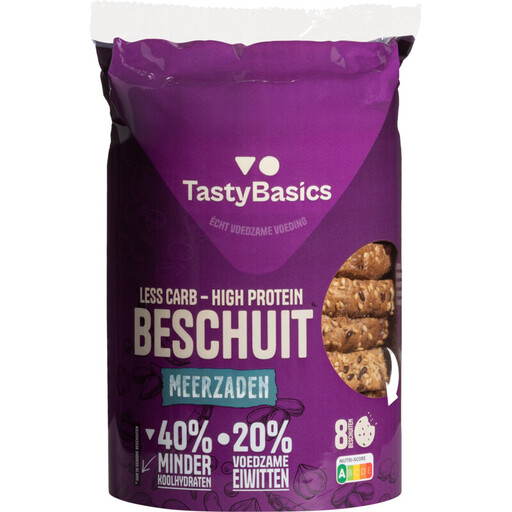 Image unavailable
A multiseed variety for comparing ingredients and pack size. The stated weight is 184 g; check the current packaging if egg, sesame or particular grains are a concern for you.
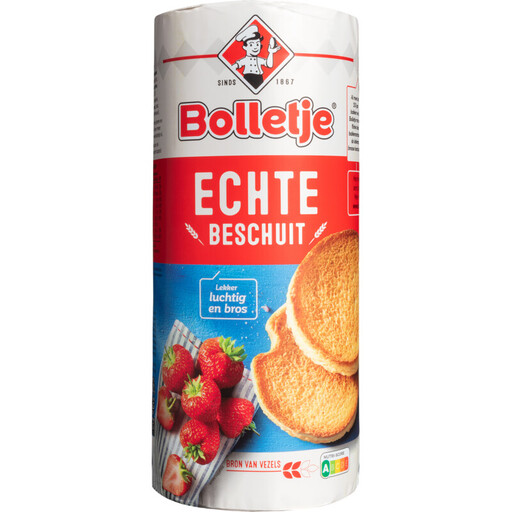 Image unavailable
A standard variety to consider if you’re looking for Bolletje rusks to add your favourite toppings to. The pack contains 13 rusks; check the ingredients if you have an allergy or specific dietary preference.
 Image unavailable
A wholemeal variety for anyone who wants to take the type of grain into account when choosing. The pack contains 13 rusks; also check the nutritional information and allergens on the packaging.
No. Seeds and the wholemeal label describe different characteristics. The Netherlands Nutrition Centre states that, for a product to be labelled ‘wholemeal’, the flour used must be entirely wholemeal. So check the label on the specific pack.
It depends on the variety: the products described may contain wheat, egg and sesame, among other ingredients. Check the current ingredient and allergen information every time you buy, even if you’ve previously bought a different type of rusk from the same brand.
You can’t tell from the product type alone. If iodine matters to you, check the ingredient information for the specific rusks.
Seal the packaging well after opening and keep the rusks away from moisture. Jumbo recommends storing its plain variety in a cool, dry and dark place; follow the instructions on the packaging for your product.