
Everyday shopper looking for plain rusks
You want a standard rusk for breakfast or a snack. The pack size and number of rusks make it easier to compare products.


If you’re shopping on a tight budget, plain own-brand rusks are a sensible place to start. Compare the net weight and number of rusks before weighing up different packs. Choose wholemeal or seeded rusks if that’s the type you’re looking for. If you have allergies or other dietary preferences, always check the latest label.
You want a standard rusk for breakfast or a snack. The pack size and number of rusks make it easier to compare products.
You want to stick with wholemeal rusks, so you look beyond the packaging at the product name, ingredients and nutritional information.
You might be looking for seeded rusks, or checking for egg and cereals containing gluten. In that case, the information on the latest label will help you decide.
Start with the type of rusk you want to eat. Then compare the pack sizes, and check the label if the ingredients or an allergen matter to you.
| What to consider | What should you check? | Who is this important for? |
|---|---|---|
| Pack size | Check the net weight and number of rusks; packs of different sizes aren’t directly comparable. | If I eat plain rusks often, I want to know how many are in a pack. Around 50% of consumers put this comparison first. |
| Wholemeal or seeded | Read the product name and ingredients list to distinguish plain, wholemeal and seeded varieties. | I’d rather choose a wholemeal variety or seeded rusks than a standard pack of plain ones. For around 30% of consumers, this is their main concern. |
| Ingredients and storage | Check the allergens and nutritional information on the packaging, and follow the storage instructions. | If I have an allergy or a specific dietary preference, I need to know what the rusks contain and how to store them. This is a priority for around 20% of consumers. |
A pack labelled as containing 13 rusks and one labelled 125 g don’t give you the same information about pack size.
Check both the net weight and the number of rusks on the packaging before comparing packs.
These product descriptions refer to different characteristics. Seeds alone don’t tell you the full nutritional value.
Decide which feature you’re looking for, then check the ingredients and nutritional information for that specific variety.
Rusks may contain cereals containing gluten or egg, among other ingredients. The recipe varies by product and may change.
If you have allergies or specific dietary preferences, check the latest packaging before buying.
According to the Netherlands Nutrition Centre, bakers aren’t required to use baker’s salt. So the product category alone won’t tell you whether the rusks contain iodine from baker’s salt.
Check the ingredients list or ask the manufacturer about the specific product if this matters to your choice.
These brands offer plain, wholemeal and seeded varieties with different ingredients and pack sizes. Compare the specific pack rather than just the brand name.
Bolletje offers Echte Beschuit and a multiseed variety, among other products.
Albert Heijn sells its own plain and wholemeal rusks, as well as other varieties.
Jumbo sells its own plain rusks alongside rusks from other brands.
Lidl lists 125 g plain rusks as a store product.
ALDI lists plain and wholemeal rusks from Goud Gebakken.
PLUS sells its own plain rusks and a wholemeal variety with seeds.
This plain variety is a good choice if you’re looking for an everyday staple. Check the packaging for the ingredients that matter to you.
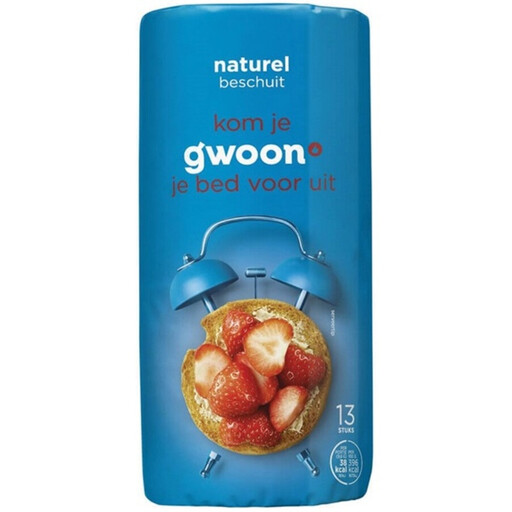 Image unavailable
A plain variety for anyone looking for standard rusks for breakfast or to eat with a topping.
Pack size: 125 g. If you have allergies, check the ingredients and allergens on the latest packaging.
Check both the net weight and the number of rusks. Jumbo and PLUS each list their plain rusks at 125 g; ALDI lists Goud Gebakken Naturel as containing 13 rusks. Check the weight on the packaging so you can compare those packs on the same basis too.
Keep rusks away from moisture and heat, and store the pack somewhere cool and dry. Also follow any additional storage instructions on the packaging for your variety.
No, don’t assume they do. According to the Netherlands Nutrition Centre, bakers aren’t required to use baker’s salt. Check the ingredients list or ask the manufacturer about the specific product.
Check the ingredients and allergens on the latest packaging for the specific rusks. Bolletje lists cereals containing gluten and egg among the ingredients in Echte Beschuit; this doesn’t tell you anything about other varieties or brands. Check whether a product is labelled vegan, too.