
Lunch shoppers on a tight weekly budget
You want rusks as a simple base for toppings and check how many pieces or how many grams are in a pack. For example, Albert Heijn and ALDI both list plain rusks in packs of 13.


Plain rusks are a good choice for a simple lunch with toppings when the amount in the pack is your main priority. Choose wholemeal if the stated fibre content matters to you, or seeded rusks if size and texture are more important. Compare the weight and number of rusks, and check the current label for ingredients and allergens.
You want rusks as a simple base for toppings and check how many pieces or how many grams are in a pack. For example, Albert Heijn and ALDI both list plain rusks in packs of 13.
You often have rusks for lunch and want to compare the nutritional information for wholemeal varieties. Jumbo and PLUS list 7,7 g of fibre per 100 g for their specified wholemeal rusks; Jumbo lists 11 g per 100 g for Bolletje Wholemeal.
You want a change of size or texture for a lunch with toppings. PLUS describes its seeded wholemeal rusks as a larger variety containing seeds and kernels; also check the ingredients and allergens on the specific pack.
First decide whether the amount in the pack, fibre content or texture matters most for your lunch. Then compare the packaging and nutritional information of the varieties that suit you.
| What to consider | What should you check? | Who is this important for? |
|---|---|---|
| Amount in the pack | Compare the weight and number of rusks; the same number of pieces does not necessarily mean the same weight. | If I often make a simple lunch with toppings, I want to know how many rusks are in the pack. For around 50% of consumers, the amount in the pack is the main consideration when choosing. |
| Wholemeal and fibre | Read the product name and compare the fibre per 100 g in the nutritional information. | If I regularly have rusks for lunch, I want to make an informed choice between plain and wholemeal. Around 30% of consumers say wholemeal and fibre content are their top priorities. |
| Size and seeds | Check the description of the size, ingredients and allergens for the variety you choose. | For rusks with generous toppings, I prefer a larger variety or a different texture. This is the main consideration for around 20% of consumers. |
The number of pieces does not always tell you how much the pack weighs. This can make two packs seem more alike than they really are.
Check both the number of pieces and the weight on the packaging.
Fibre content varies from product to product. Jumbo and PLUS list 7,7 g per 100 g for the specified wholemeal own-brand varieties, while Jumbo lists 11 g per 100 g for Bolletje Wholemeal.
Compare the fibre per 100 g for each specific variety you are considering.
A product page does not guarantee that the pack you want will be available when you shop. Jumbo lists its wholemeal rusks as temporarily unavailable.
Check availability at the shop where you plan to order or visit.
In 2008, the Government Gazette described an agreement promoting the use of iodised baker’s salt, with some exceptions. This does not tell you which type of salt is used in every individual pack of rusks.
If the type of salt used matters to you, read the ingredients list on the pack you choose.
Offers plain, wholemeal and multigrain rusks, among other varieties; compare the specific product rather than judging the brand as a whole.
The own-brand range includes plain and wholemeal rusks, giving you a choice of varieties in one shop.
The own-brand range includes plain and wholemeal rusks, among other varieties.
The own-brand range includes both wholemeal rusks and a separate seeded wholemeal variety.
Offers plain and wholemeal rusks under the Goud Gebakken name.
The range includes wholemeal rusks, among other products.
This selection includes seeded and wholemeal rusks as a base for a lunch with toppings. Check the amount listed for each pack, and refer to the current packaging if ingredients or allergens are important to your choice.
 Image unavailable
An option to consider if you’re looking for seeded rusks to top for lunch.
The product name states that the pack contains 10 pieces. Check the ingredients and allergens on the current label.
 Image unavailable
Worth considering if you want wholemeal rusks as a base for toppings.
The product name states that the pack contains 10 pieces. Compare the nutritional information on the packaging with that of other wholemeal packs.
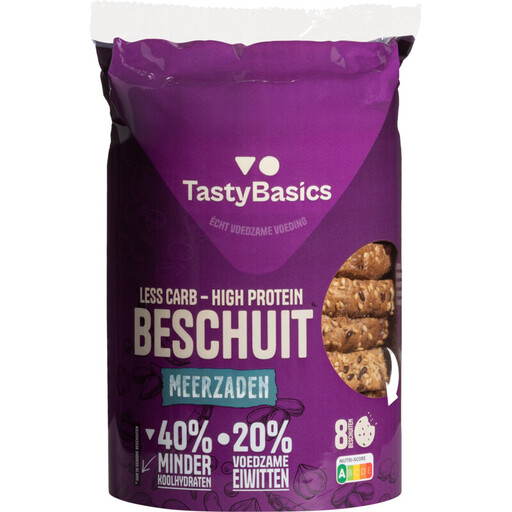 Image unavailable
An option for anyone who wants to compare seeded rusks for lunch.
The product name states that the pack weighs 184 g. Check the label for the ingredients and allergens in this variety.
 Image unavailable
A wholemeal option for a lunch with toppings.
The product name states that the pack contains 13 pieces. Compare the fibre content with other packs using the nutritional information per 100 g on the current packaging.
Check both the weight and the number of pieces. This shows you whether two packs contain the same amount of rusks, even if they look similar at first glance.
You need to compare the fibre content of each product. Jumbo and PLUS list 7,7 g of fibre per 100 g for their specified wholemeal own-brand varieties; for another pack, check the nutritional information on its packaging.
It depends on the variety. Joybuy’s product information lists wheat, egg and sesame, among other things, for Bolletje Wholemeal; check the current allergen information on the packaging of every pack you choose.
Don’t assume so without checking. In 2008, the Government Gazette described an agreement to promote the use of iodised baker’s salt, with some exceptions. If the type of salt matters to your choice, read the ingredients list on the individual pack of rusks.
Keep the rusks sealed and dry. Jumbo and PLUS recommend storing the products mentioned in a cool, dry place; follow the instructions on the pack you bought.