
BBQ hosts serving generous toppings
You want plenty of room for spreads, cheese or vegetables, and want to check in advance that the rusk will stay whole with the toppings you plan to serve.


If you’re looking for plenty of room for generous BBQ toppings, a rusk described as ‘extra large’ could be a good starting point. If you’d rather have a neutral base, plain rusks may suit you better. However, ‘extra large’ or ‘robust’ doesn’t tell you how much wet or heavy topping a rusk can hold. Try your chosen topping on one rusk first, then add toppings to the rest just before serving.
You want plenty of room for spreads, cheese or vegetables, and want to check in advance that the rusk will stay whole with the toppings you plan to serve.
You compare the ingredients and nutritional information of different rusks, and check the allergens on the current packaging when shopping.
You want a neutral base and check how many rusks are in each pack. A description such as ‘extra large’ matters less to you than having the right quantity.
First decide what toppings you want to serve, then compare descriptions of the size, ingredients and number of rusks per pack. A description such as ‘robust’ isn’t a measure of how much weight a rusk can hold.
| What to consider | What to check when buying | Who it matters to |
|---|---|---|
| Room for generous toppings | Check whether the product is described as large. Try heavy or moist toppings on one rusk first; the description doesn’t guarantee how much it can hold. | If I’m serving lots of toppings, or moist ones, I want to know whether the snack will stay whole. This is the main consideration for around 50% of consumers. |
| Fibre, wholemeal and seeds | Compare the fibre per 100 g and read the ingredients and allergen information for your chosen variety. | I want seeds or wholemeal ingredients to be part of my decision, but I also need to consider my guests. Around 30% of consumers give these ingredients top priority. |
| A neutral base and portion sizes | Check the number of rusks and the net weight. Store opened rusks in a dry, airtight container. | When I’m catering for a larger group, I want to have enough rusks ready and let the toppings provide the flavour. This neutral base is the main consideration for around 20% of consumers. |
A rusk may look large but still break if you add lots of toppings or toppings with a high moisture content. Words such as ‘large’ and ‘robust’ don’t specify how much weight it can take.
Before the BBQ, try one rusk with the heaviest or wettest topping you plan to serve.
The varieties described include ingredients such as wheat, egg and sesame. The name ‘multiseed’ doesn’t tell you which allergens are in the pack you’ve chosen.
Check the current ingredients, allergen information and any warnings on the packaging for each variety.
According to the Netherlands Nutrition Centre, baker’s salt contains iodine, but bakers aren’t required to use it. So don’t assume a product contains a particular type of salt just because it’s a rusk.
If this matters to your choice, check the packaging or ask the manufacturer.
Moist toppings can soften the dry, crisp base, making the snack harder to serve whole.
Keep the rusks and toppings separate, seal the pack after opening, and add the toppings just before serving.
Bolletje offers original, dark wholemeal and multiseed rusks, among other varieties. Its multiseed variety is described as extra large.
Alongside plain rusks, Jumbo offers a 230 g Robuust Spelt variety with kernels and seeds.
PLUS describes its luxury plain rusks with seeds as large and crisp; the pack contains 230 g.
AH plain rusks are a neutral 125 g option, with 13 portions per pack.
Goud Gebakken is ALDI’s own brand of plain rusks, sold in a pack of 13.
These Bolletje varieties offer a choice of multiseed, dark wholemeal and original rusks for a BBQ snack. If you’re serving generous or moist toppings, try your chosen variety first to check that it stays whole.
 Image unavailable
An option if you’re looking for seeds and a rusk described as extra large. This multiseed variety is listed as containing 10 g of fibre per 100 g. Try it with generous or moist toppings first, and check the allergens on the packaging.
 Image unavailable
A good choice if you want a dark wholemeal base with oats and seeds for your snack. The product description lists 8.8% oat flakes and 5.8% seeds; these ingredients don’t indicate how much the rusk can hold when generously topped.
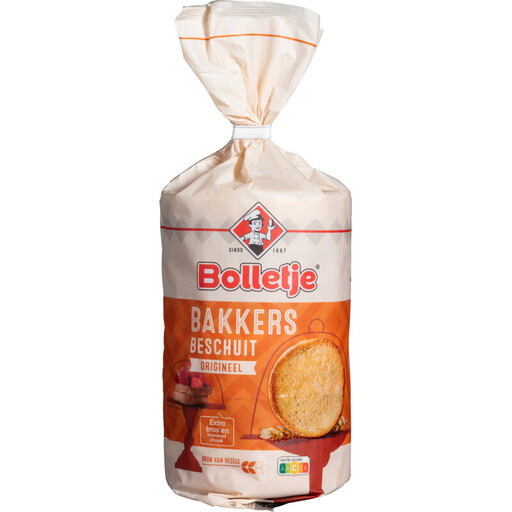 Image unavailable
A neutral base if you want the toppings to provide the flavour. Bolletje describes these original rusks as extra large, but that doesn’t tell you how thick they are or whether they’re suitable for heavy toppings.
No. Those words don’t measure thickness or how much the rusk can hold. If you’re serving generous or wet BBQ toppings, try them on one rusk first.
No, you can’t assume that baker’s salt is used in every rusk. The Netherlands Nutrition Centre explains that baker’s salt contains iodine, but bakers aren’t required to use it. If this matters to your choice, check the packaging or ask the manufacturer.
Read the current ingredients and allergen information for each variety you choose. The Netherlands Food and Consumer Product Safety Authority states that allergens must be listed on the labels of prepacked foods. Don’t rely on names such as ‘spelt’ or ‘multiseed’ alone.
Add the toppings just before serving, especially if they’re moist. Until then, store the rusks in a dry place and seal the pack securely after opening.