
Holiday shopper planning quantities
You’re looking for rusks for breakfast and snack occasions, and want to know how many packs you’ll need. Product ranges from ALDI, Albert Heijn and PLUS show that pack sizes and weights vary between products.


Plain rusks are a sensible choice if your main priority is working out how many you’ll need for your holiday. If wholegrain, seeds or specific ingredients matter to the people sharing them, compare the contents and label of each product; the product name alone doesn’t tell you the whole story.
You’re looking for rusks for breakfast and snack occasions, and want to know how many packs you’ll need. Product ranges from ALDI, Albert Heijn and PLUS show that pack sizes and weights vary between products.
You want to compare wholegrain rusks with plain and seeded varieties. Check the ingredients and fibre per 100 g for each product to make sure you’re comparing like with like.
You’re buying rusks for people with different dietary needs. The varieties reviewed list different grains and allergens, so read the label on the pack you choose.
First, work out how many rusks you’ll need for your snack occasions. Then check the ingredients and nutritional information for the type you want to buy.
| What to consider | What to check | Who is it most relevant to? |
|---|---|---|
| Quantity | Check the number of rusks or the weight per pack, and match it to the occasions you have planned. | When I’m shopping for several holiday occasions, I want to know how many rusks are in a pack. For around 50% of consumers, quantity comes first. |
| Ingredients and allergens | Read the ingredients list and allergen information on the pack you’re going to use. | When we’re sharing a snack, I need to check what everyone can eat. Around 30% of consumers prioritise checking the label. |
| Wholegrain and nutritional information | Compare the ingredients, fibre and salt per 100 g; consider the Nutri-Score alongside the full label. | When I’m specifically looking for wholegrain rusks, I want to compare the ingredients in each variety. These product features matter most to around 20% of consumers. |
Rusks are sold in packs with different quantities and weights. Looking only at the type of product won’t tell you how much you’re taking home.
Compare the pack contents with the number of breakfasts and snack occasions you have planned.
The varieties reviewed differ in their ingredients, nutritional information and allergens. A Nutri-Score doesn’t replace these individual details.
Check the ingredients, allergens and nutritional values per 100 g for each product, rather than relying on ‘wholegrain’ or ‘with seeds’ alone.
According to the Netherlands Nutrition Centre, using baker’s salt when baking is not compulsory. So you can’t tell whether it’s included just from the product category.
Check the ingredients on the pack if baker’s salt is relevant to your choice.
Product information can change. This is particularly important if someone needs to avoid certain ingredients or allergens.
Before eating, read the label on the pack you’ve actually bought.
ALDI lists plain and wholegrain rusks from Goud Gebakken, both in packs of 13.
Albert Heijn lists AH Plain Rusks at 125 g and AH Wholegrain Rusks at 140 g.
PLUS lists plain rusks at 125 g and wholegrain rusks with seeds at 230 g.
The Bolletje products reviewed include classic and wholegrain rusks.
Lidl lists a 140 g wholegrain rusk product, which is marked as in-store only on its product page.
These products include two Bolletje varieties for anyone looking for wholegrain rusks, plus a plain variety to compare. Check the pack contents and label when choosing.
 No image available
For anyone looking for a wholegrain option for breakfast or a snack. The pack contains 10 pieces.
Check the current pack for ingredients and allergens before sharing these with others.
 No image available
For anyone looking for wholegrain rusks in a pack of 13 for breakfast or a snack.
Read the allergen information on the current label, especially if you’re sharing them with others.
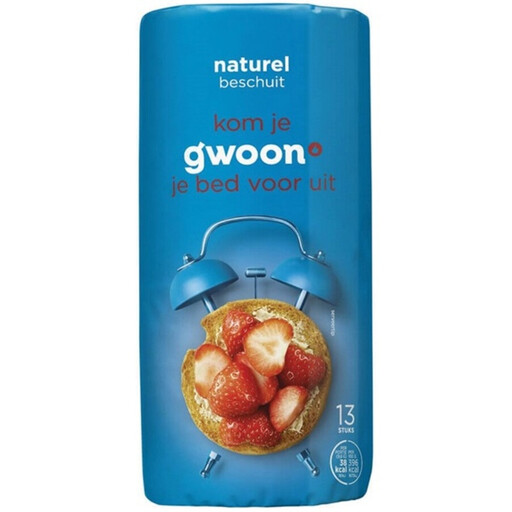 No image available
A plain 125 g option to compare with the wholegrain varieties.
If anyone has a milk allergy, check the current pack carefully before they eat these.
No, you shouldn’t assume so. According to the Netherlands Nutrition Centre, using baker’s salt when baking isn’t compulsory. Check the ingredients of the rusks you choose.
Check both the weight and the number of pieces, then think about how many snack and breakfast occasions you’re planning for. A 125 g pack and a 230 g pack don’t contain the same amount of rusks.
It depends on the variety. The plain, wholegrain and seeded rusks reviewed list different grains and sometimes egg or sesame. Check the allergen information on the current pack for everyone who’ll be eating them.
Follow the storage advice on the pack and seal an opened pack as directed on the label. That way, you can continue following the instructions for your chosen product throughout several snack occasions.