
Hosts serving generously topped appetisers
You want a roomier base for your toppings, without assuming that a larger rusk is also sturdier.


If you need plenty of room for generous toppings, rusks described as ‘extra large’ are a useful starting point. Choose dark wholemeal or multiseed if the grains or seeds complement your toppings, but don’t assume that ‘extra large’ means the rusk is thicker or can support more weight. Try your planned topping in advance, and check the current label if you’re catering for guests with food allergies.
You want a roomier base for your toppings, without assuming that a larger rusk is also sturdier.
You want to consider the flavour and ingredients of the rusk when choosing your appetisers.
You check the ingredients and allergens for each variety before serving rusks to your guests.
First, decide how much room you need for the toppings and which ingredients are suitable for your guests. Then choose a flavour profile. If you’re using rich or moist toppings, try them in advance to see whether the appetisers will be practical to serve.
| What to consider | What to check | Who should consider this? |
|---|---|---|
| Room for toppings | Check whether the variety is described as ‘extra large’. Try your planned topping in advance; size doesn’t indicate how much weight it can support. | If I want to add several ingredients to one rusk, I’m mainly looking for a roomier base. Around 42% of consumers prioritise this. |
| Grains, seeds and flavour | Compare the ingredients and nutritional information per 100 g for your chosen wholemeal or multiseed variety. | If I want the rusk itself to add flavour to an appetiser, I prefer wholemeal grains or seeds. This is the first consideration for around 25% of consumers. |
| A neutral base | See whether a plain variety will work with your toppings, and check how many rusks are in the pack. | When I want the toppings to provide the flavour, I prefer a simple rusk. Around 17% of consumers prioritise this neutral base. |
| Ingredients and allergens | Check the current label for allergens. If you want to know whether baker’s salt has been used, check the ingredients list or ask the manufacturer. | If guests with food allergies are coming, I want to know which ingredients are in the variety I’ve chosen before serving it. This check is the top priority for around 16% of consumers. |
The description refers to the size and doesn’t guarantee that the rusk can hold rich or moist toppings without breaking.
Try one rusk with the topping you plan to serve, and only top the appetisers shortly before serving.
Ingredients and allergens vary by variety. The Bolletje varieties mentioned contain ingredients such as wheat, egg and sesame, or list sesame as a possible allergen.
Check the label on the pack you’re using and, if necessary, provide a suitable alternative.
According to the Netherlands Nutrition Centre, bakers aren’t required to use baker’s salt. So the product category alone won’t tell you whether a particular rusk contains it.
Check the ingredients list or ask the manufacturer if you want to find out.
These brands and supermarket ranges offer different types of rusk. Compare the features of the specific variety you plan to serve.
Offers classic, dark wholemeal and multiseed rusks, among other varieties.
Offers its own rusks in plain, wholemeal and multiseed varieties.
Offers several Bolletje varieties, including Echte Beschuit, Bakkers Beschuit, dark wholemeal and multiseed.
Offers plain rusks as a simple option.
Offers plain rusks from Goud Gebakken.
Offers Bolletje Echte, Bakkers, dark wholemeal and multiseed rusks, among other varieties.
These Bolletje varieties are described as ‘extra large’. Choose between multiseed, dark wholemeal and a classic variety based on flavour and ingredients, and try rich toppings in advance.
 Image unavailable
For appetisers where you’d like to use a rusk with seeds and kernels. The product information describes this variety as ‘extra large’ and lists ingredients including sunflower seeds, linseed, sesame and pumpkin seeds.
The size doesn’t guarantee that the rusk will hold your toppings securely. Check the current label for allergens, including wheat and sesame.
 Image unavailable
For anyone who wants the flavour of wholemeal grains to complement their toppings. The product information describes the rusks as ‘extra large’ and lists wheat bran, oat flakes and seeds.
Try your topping in advance; the size description doesn’t indicate how much weight the rusk can support. Check the current label for ingredients including wheat, oats, barley and sesame.
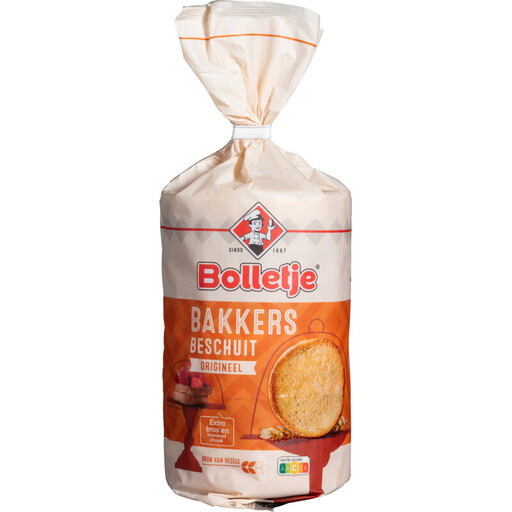 Image unavailable
A classic rusk variety if you want the toppings to provide the flavour. The product information describes the rusks as ‘extra large’.
Try generous toppings in advance: ‘extra large’ isn’t a measure of sturdiness. The product information lists wheat and egg, and warns that the rusks may contain sesame; check the current label.
No. The description ‘extra large’ doesn’t tell you anything about thickness or how much weight a rusk can support. Use it to find a roomier base, and try your chosen toppings on the rusk before your dinner party to see if they stay in place.
Check the current label for each variety separately. The Bolletje varieties mentioned list ingredients including wheat, egg or sesame; oats and barley are also listed for the dark wholemeal variety. The product name alone isn’t enough to tell you what a guest can eat.
No. You can’t assume this based on the type of product: according to the Netherlands Nutrition Centre, bakers aren’t required to use baker’s salt. Check the ingredients list or ask the manufacturer if you want to know which salt was used in a particular rusk.
Store the opened pack in a dark, dry place and keep it sealed, as PLUS advises for Bolletje Echte Beschuit. If you want to limit how long the rusks are in contact with moist toppings, add them shortly before serving.