
If you serve rusks occasionally
If rusks are only being served at a small family dinner, the number in each pack matters. For example, Jumbo lists a Bolletje variety containing 10 rusks, while Albert Heijn lists a wholegrain rusk with 13 portions.


For a small family dinner, start by deciding how many rusks you want to serve. A pack of 10 may be a better fit for one meal, while 13 may be more practical if you’ll be eating rusks later too; choosing the larger pack doesn’t guarantee you’ll have fewer leftovers. Then compare the wholegrain option, size and ingredients of the pack you’re considering.
If rusks are only being served at a small family dinner, the number in each pack matters. For example, Jumbo lists a Bolletje variety containing 10 rusks, while Albert Heijn lists a wholegrain rusk with 13 portions.
If you prefer wholegrain rusks, compare the ingredients and nutritional information for the exact variety. Check the allergen information too: products with similar names may not have the same ingredients.
Size may be worth considering for a family dinner with generous toppings. Jumbo describes Bolletje Vezelrijk Donker Volkoren as extra large; also check whether the ingredients are suitable for everyone at the table.
First decide how many rusks you need and whether you’ll use any leftovers after dinner. Then compare the ingredients and size of each variety.
| What to consider | What to check | Who should consider this? |
|---|---|---|
| Pack size to suit your needs | Count how many you want to serve and compare packs of 10 and 13. Think about whether you’ll use any opened rusks later. | I’m only serving rusks once and don’t want many left over; around 25% of consumers prioritise a pack size that suits their needs. |
| Wholegrain and fibre | Read the ingredients and compare the fibre content on the same basis, for example per 100 g. | If I’m specifically looking for wholegrain rusks, I want to know what’s in the variety I choose; around 25% of consumers prioritise this nutritional information. |
| Size for toppings | Check the size and product description if you want to add generous toppings to your rusks. | For a table with generous toppings, I’m looking for rusks of a suitable size; this is the first thing around 25% of consumers consider when choosing. |
| Ingredients for guests | Check the allergen and ingredient information on the exact pack, even if you’ve bought the product before. | If someone at the table needs to avoid an ingredient, I want to know what’s in these rusks; around 25% of consumers make this check a priority. |
‘Half loaf’ isn’t a standard way to describe packs of rusks in the Dutch ranges mentioned here. For a small dinner, the number of rusks in a pack gives you a better idea of how many you’ll have left over.
Count the portions you need, then compare the pack size and the size of each rusk.
‘Wholegrain’ and ‘high-fibre’ don’t tell you which allergens a product is free from. The wholegrain rusks listed by Albert Heijn contain wheat and egg; the Bolletje Vezelrijk Donker Volkoren listed by Jumbo contains sesame, among other ingredients.
Check the latest ingredient and allergen information on the pack for every variety you choose.
The Dutch agreement on baker’s salt, published in the Government Gazette in 2008, encourages the use of iodised salt. This doesn’t mean that every variety of rusk contains it.
If iodine is important to your choice, check the information for the exact product or ask the manufacturer.
Bolletje makes rusks in a range of varieties, including standard, wholegrain and high-fibre options.
Albert Heijn lists AH Beschuit volkoren under its own brand.
Jumbo’s online rusk range includes plain, wholegrain and varieties with grains or seeds.
PLUS lists wholegrain rusks under its own brand.
ALDI lists plain and wholegrain rusks from Goud Gebakken.
Lidl lists Beschuit volkoren in its Dutch range.
These Bolletje varieties at Joybuy are available in packs of 10 and 13. Choose according to how many rusks you want to serve and which type is right for your table.
 Image unavailable
An option if you’re looking for a pack of 10 for one dinner and want to serve dark wholegrain rusks.
Check the latest ingredient and allergen information, especially if a guest needs to avoid cereals or sesame.
 Image unavailable
A pack of 10 for anyone who wants to serve seeded rusks at a smaller meal.
If you have allergies, check the latest packaging carefully; don’t rely on the product name alone.
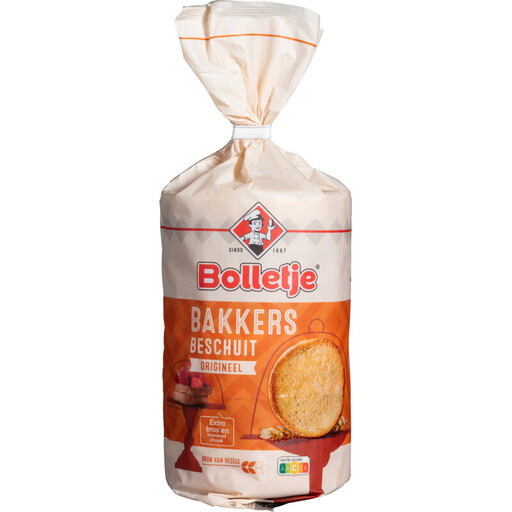 Image unavailable
A pack of 10 if you’re looking for the Original variety for dinner rather than a wholegrain or seeded option.
Read the allergen information on the pack if a guest needs to avoid certain ingredients.
 Image unavailable
A wholegrain option with 13 rusks if you’d like to enjoy some after the family dinner too.
Only compare nutritional values when it’s clear what quantity they refer to, and check the allergens on the latest packaging.
‘Half loaf’ isn’t a common way to describe rusks in the Dutch ranges mentioned here. For a small dinner, it’s better to compare the number of rusks per pack, for example 10 or 13.
No, don’t assume they do without checking the product. The agreement published in the Government Gazette in 2008 encourages the use of iodised baker’s salt; the RIVM explains that Dutch iodine policy focuses on iodised salt in bread. For rusks, check the information for the exact product or ask the manufacturer.
Store opened rusks in a dry place in an airtight container. For its wholegrain rusks, Albert Heijn recommends using a sealed tin after opening; for the high-fibre Bolletje variety reviewed, Jumbo advises storing it in a dark, dry and sealed place.
Read the allergen and ingredient information on the exact pack. The wholegrain products reviewed have different ingredients; those listed include wheat and egg, and the Bolletje Vezelrijk Donker Volkoren reviewed also contains sesame.