
Students on a tight shopping budget
You’re looking for a quick, light base and want to know how many pieces are in each pack. Comparing the number of pieces and the weight can help you weigh up different packs.


Plain rusk is a straightforward option when you’re focused on how much is in the pack and your shopping budget; choose wholegrain if you’re mainly comparing fibre content. Rusk on its own doesn’t make a varied evening meal, so think about what you’ll have with it, too. The Netherlands Nutrition Centre describes an evening meal as including foods from different sections of the Wheel of Five.
You’re looking for a quick, light base and want to know how many pieces are in each pack. Comparing the number of pieces and the weight can help you weigh up different packs.
You want to tell plain and wholegrain rusk apart, so you compare the nutritional information for the options you’re considering, especially fibre per 100 g.
You’re looking for a light meal that takes little preparation. You also want to think in advance about what other foods you’ll have alongside the rusk.
First decide what matters most to you: pack size, wholegrain and fibre, or the make-up of your evening meal. Then compare the information on the specific packs.
| What to consider | What to check | Who it matters to |
|---|---|---|
| Pack contents | Compare the number of pieces and the weight. Jumbo lists 13 pieces and 125 g for its plain rusk; you can’t compare the weight of a pack that only gives the number of pieces. | On a tight shopping budget, I want to know how much I’m getting without treating packs of different sizes as equivalent. For around 42% of consumers, this comparison comes first. |
| Wholegrain and fibre | Check that the product is labelled wholegrain, along with the ingredients and the amount of fibre per 100 g on the pack you’ve chosen. | If fibre matters more to me than choosing standard plain rusk, I want to compare the values for each option. Around 33% of consumers give this the highest priority. |
| Evening meal | Think about what other foods you’ll have with the rusk. The Netherlands Nutrition Centre describes an evening meal as including foods from several sections of the Wheel of Five. | For a quick evening meal, I want rusk to be part of the meal, not the only thing on my plate. This is the main consideration for around 25% of consumers. |
The number of pieces doesn’t tell you how much the pack weighs. This makes it difficult to compare the contents of two options.
When the information is available, check both the number of pieces and the weight on the packaging.
Rusk is a grain product, but on its own it doesn’t include the different food groups that the Netherlands Nutrition Centre recommends for an evening meal.
Think about which vegetables and other foods you’d like to have with it before choosing rusk as part of your meal.
The stated amount of fibre varies by product. Albert Heijn lists 9 g per 100 g for AH Wholegrain Rusk; Joybuy’s product information lists 11 g and 10 g per 100 g for two different Bolletje options, respectively.
Compare the nutritional information per 100 g for the exact option, and check the ingredients and allergens on the pack, too.
AH Wholegrain Rusk is a 140 g own-label option.
According to Jumbo, Jumbo Plain Rusk contains 13 pieces and weighs 125 g.
Goud Gebakken offers plain and wholegrain rusk; ALDI lists 13 pieces for both options.
PLUS Plain Rusk is a 125 g own-label option.
Bolletje offers plain and wholegrain rusk. Compare the specific option rather than relying on the brand name alone.
Lidl lists a 140 g wholegrain rusk option that, according to the product page, is only available in store.
These products give you two Bolletje wholegrain options and one g'woon plain option to consider as a base for your meal. Also decide what you’d like to have with the rusk for your evening meal.
 Image unavailable
An option to compare if wholegrain and fibre are your priorities.
Joybuy’s product information lists 11 g of fibre per 100 g and 13 pieces. Check the ingredients and allergens on the packaging.
 Image unavailable
A dark wholegrain option for anyone who wants to compare the fibre content of the pack they’re considering.
Joybuy’s product information lists 10 g of fibre per 100 g and 10 pieces. Check the ingredients and allergens on the packaging.
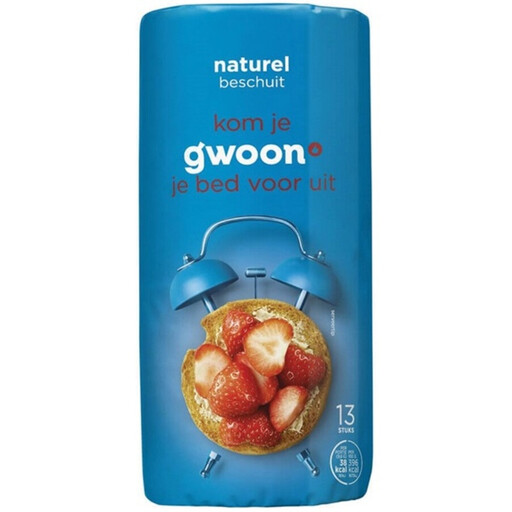 Image unavailable
A plain option if you’re looking for a simple rusk base.
The product name states that the pack contains 125 g. Check the nutritional information and allergens on the pack if you’re comparing this option with wholegrain rusk.
No. Rusk on its own doesn’t provide the variety the Netherlands Nutrition Centre recommends for an evening meal. You could use it as a base, but think about which vegetables and other foods you’ll have with it.
Choose wholegrain if you specifically want a wholegrain product and would like to compare the fibre content of different options. Check the ingredients and fibre per 100 g on the exact pack; the composition varies by product.
Seal the pack securely or use an airtight tin, and store the rusk somewhere dry. The Jumbo and Joybuy product information reviewed recommends resealing the pack after opening to keep the rusk crisp.
That doesn’t follow from the rules for bakery products. The Netherlands Food and Consumer Product Safety Authority explains that iodine compounds may only be present in bread, bread substitutes and other bakery products through baker’s salt. This doesn’t mean that every pack of rusk contains baker’s salt with iodine. Check the ingredients for the product you’ve chosen.
Always check the label on the exact option. The Albert Heijn, Jumbo and PLUS own-label products reviewed list wheat and egg; don’t assume the same applies to other rusk products.