When choosing rusk, don’t look for a literal half loaf. Instead, choose a pack whose total weight suits how often you eat it. The Netherlands Nutrition Centre advises that opened rusk can be kept in a kitchen cupboard for one month. So compare the weight per piece too, and make sure you reseal the pack properly. Then choose between regular and wholemeal rusk based on your preferences, the nutritional information and the ingredients list.
Who is this choice for?
Small households that don’t eat much rusk
If you don’t eat rusk every day, the main thing is whether you’ll use up an opened pack before its quality deteriorates. So compare the total contents with how much you eat, and reseal the pack properly once opened.
Breakfast lovers looking for wholemeal rusk
If you want a wholemeal option, check the nutritional information per 100 g and the size of each piece, as well as the product name. Ten larger pieces don’t automatically mean a smaller pack than thirteen smaller ones.
Shoppers who check ingredients carefully
If particular grains, egg, sesame or the type of salt used matter to your choice, check the current ingredients and allergen information for the specific product.
What should you look for when choosing?
Start with how much you usually eat. Then compare the type and nutritional information: the number of rusks doesn’t tell you how much the pack weighs in total.
| What to consider |
What to check |
Who is it important for? |
| Quantity and storage |
Compare the total weight and weight per piece; check whether you can store the opened pack properly sealed. |
If I only eat rusk occasionally, I want to finish a pack without having much left over. This quantity is the top priority for around 40% of consumers. |
| Wholemeal and fibre |
Read the product description and compare the stated fibre per 100 g; also check the size of each piece. |
I specifically want to choose wholemeal rusk, even if the pieces are larger than regular rusk. This is the top priority for around 30% of consumers. |
| Ingredients and nutritional information |
Check the current allergen list, the type of salt used and the nutritional information on the same basis. |
If an ingredient or a particular composition is the deciding factor for me, I want to be able to assess each product individually. This is the main concern for around 30% of consumers. |
Common mistakes
-
Comparing only the number of pieces
A pack with fewer rusks may still weigh more if each piece is larger. Albert Heijn lists Bolletje Echte Beschuit as 13 pieces at around 9.6 g each; one listed wholemeal version has pieces weighing around 16 g each.
Compare the total weight and weight per piece with how often you eat rusk.
-
Assuming the allergens are the same across different varieties
Ingredients vary between types of rusk. Albert Heijn’s product information lists wheat, rye and egg among the ingredients in the regular Bolletje rusk reviewed; other grains and sesame are also listed for the wholemeal version reviewed.
Check the current ingredients and allergen list on the packaging for each variety.
-
Not sealing an opened pack properly
Rusk can lose its crispness once opened. The Netherlands Nutrition Centre advises that opened rusk can be kept in a kitchen cupboard for one month.
Store the pack in a cool, dry, dark place, sealed tightly, and choose an amount that suits how much you eat.
Brands to consider
Bolletje
Bolletje makes regular and wholemeal rusk, which you can compare by quantity and ingredients.
- Albert Heijn lists Bolletje Echte Beschuit as 13 pieces at around 9.6 g each.
- Pieces in a wholemeal variety may be larger. So compare the total weight and ingredients, not just the number of pieces.
Albert Heijn
The own-brand range includes regular and wholemeal rusk.
- Albert Heijn’s category information lists plain rusk at 125 g and wholemeal rusk at 140 g.
- For a specific variety, check the current packaging for ingredients, allergens and storage advice.
TastyBasics
An option for anyone looking for a different nutritional profile.
- The sunflower seed rusk described comes in eight larger pieces weighing 23 g each.
- So eight pieces don’t automatically mean a small total quantity. Check the ingredients and allergens for this variety too.
Rusk on Joybuy
These two Bolletje packs let you compare regular and dark wholemeal rusk. Use the number of pieces as a starting point, and check the pack weight if the quantity is a deciding factor for your small household.
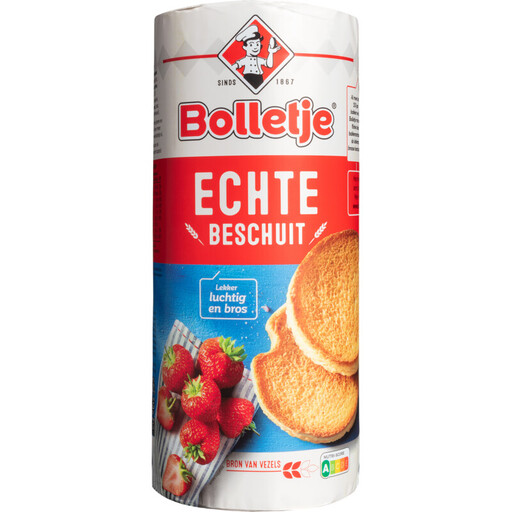 Image unavailable
Bolletje Echte Beschuit, 13 pieces
A regular pack to compare with how much you eat in a small household. Albert Heijn lists Bolletje Echte Beschuit as around 125 g in total, with each piece weighing about 9.6 g. If you have an allergy, check the current packaging; the variety described contains wheat, rye and egg.
View on Joybuy
 Image unavailable
Bolletje dark wholemeal rusk, 10 pieces
A wholemeal option for anyone looking for this type of product. The pack contains 10 pieces; compare the net weight and weight per rusk too before deciding whether the quantity suits how much you eat. Check the current packaging for nutritional values and allergens.
View on Joybuy
Frequently asked questions
Is rusk available as half a loaf?
The rusk products described are sold in packs or as a set number of pieces, not as a literal half loaf. Compare the total weight and weight per rusk to choose an amount that suits how much you eat.
How long can I keep an opened pack of rusk?
The Netherlands Nutrition Centre advises that opened rusk can be kept in a kitchen cupboard for one month. Store the pack in a cool, dry, dark place, sealed tightly, and watch out for changes in smell, taste or crispness.
Should I throw rusk away as soon as it passes its best-before date?
Not necessarily: according to the Netherlands Nutrition Centre, a best-before date relates to quality. After that date, look at it, smell it and taste it, and make sure the packaging is intact and the rusk smells and tastes normal.
How can I tell whether iodised baker’s salt was used in rusk?
Don’t rely on the product category alone. Check the ingredients information for the specific rusk, or ask the manufacturer which salt was used if this matters to your choice.


