
Parents of babies trying their first tastes
They want to know whether sprinkles are needed when offering bread. According to the Voedingscentrum, bread doesn’t need a topping at this stage.


Don’t choose dark or extra-dark chocolate sprinkles as a regular topping for a baby in the early weaning stage: according to the Voedingscentrum, bread doesn’t need a topping at this stage. A higher cocoa percentage doesn’t change that advice. With baby-led weaning, your baby’s eating skills, an appropriate texture and supervision matter more than the choice between different types of sprinkles.
They want to know whether sprinkles are needed when offering bread. According to the Voedingscentrum, bread doesn’t need a topping at this stage.
When offering larger pieces of food, texture and eating skills matter more than variety of flavour. The Voedingscentrum says babies should be able to sit upright, swallow and chew; stay with your baby while they eat.
Allergen information varies between types of chocolate sprinkles. Check the latest label on both the sprinkles and the rusk you’ve chosen, especially if the food is going to nursery.
First, consider whether a topping is appropriate for the stage at which your baby is learning to eat. Then look at the texture of the food. If you’re also choosing sprinkles for older family members, compare the sugar content and allergens on each pack.
| What to consider | What to check when buying | Who it matters to |
|---|---|---|
| Stage of introducing solid food | Check whether your baby is ready for practice foods. According to the Voedingscentrum, a topping isn’t needed at the first-tastes stage. | When my baby is just learning to eat, I don’t want to assume that bread needs a topping just because I’ve chosen dark chocolate sprinkles. For around 44% of consumers, this question about the stage of weaning comes first. |
| Texture and eating skills | Choose a size and texture your baby can manage; only offer larger pieces if they can sit upright, swallow and chew. | When my baby is holding food themselves, I mainly want to know whether the texture is right for what they can already eat. Around 33% of consumers give these eating skills the highest priority. |
| Labels and allergens | Compare sugars per 100 g and check the allergen information on the sprinkles and rusk separately. | If my baby has an allergy or the food is going to nursery, I need to know what’s in both products; a claim on one pack doesn’t apply to the combination. Checking the labels comes first for around 23% of consumers. |
A higher cocoa percentage doesn’t make dark chocolate sprinkles a suitable first topping. Albert Heijn’s product information states that De Ruijter Intens Puur contains at least 52% cocoa solids and 43 g of sugars per 100 g; Jumbo Chocolade Hagelslag Puur contains at least 50% cocoa solids and 43.1 g of sugars per 100 g.
Use the cocoa percentage to compare flavours for older family members, at most. First decide whether a topping is appropriate for your baby at all.
Albert Heijn labels AH Hagelslag Puur as gluten-free, while Jumbo says its dark chocolate sprinkles may contain gluten and wheat. Neither statement automatically applies to the rusk you choose.
Check the latest allergen information on both packs every time you buy them. If your child has a diagnosed allergy or coeliac disease, follow the individual advice that applies to them.
Choosing a different type of chocolate sprinkles doesn’t change the skills needed to eat larger pieces independently. The Voedingscentrum says babies should be able to sit upright, swallow and chew.
Offer food that your baby can manage, and stay with them while they eat.
These products can help you compare labels when choosing for older family members. Their product information doesn’t change the advice for a baby trying their first tastes.
Albert Heijn states that De Ruijter Intens Puur contains at least 52% cocoa solids.
Venz offers a dark chocolate sprinkles product in a 400 g pack.
AH Hagelslag Puur is Albert Heijn’s own-brand 400 g product, which it labels as gluten-free.
Jumbo states that its 200 g dark chocolate sprinkles contain at least 50% cocoa solids.
Lidl lists Mister CHOC Hagelslag Puur as a 600 g own-brand product.
ALDI lists Kiekeboe Hagelslag Puur in a 600 g pack made with Rainforest Alliance cocoa.
This Joybuy selection is for older family members looking for dark chocolate sprinkles. It isn’t a selection of toppings for a baby trying their first tastes, nor is it a complete combination with rusk.
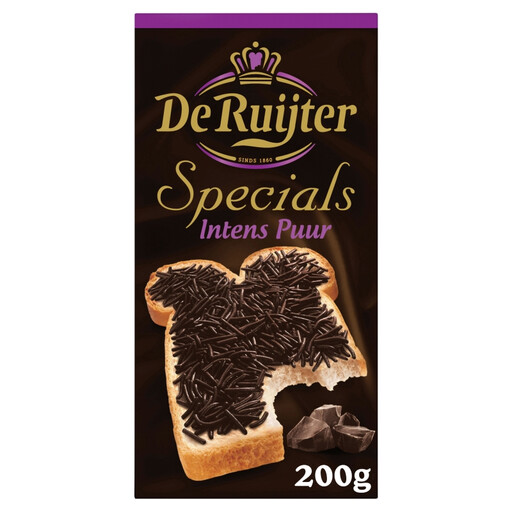 Image unavailable
For those looking for dark chocolate sprinkles for older family members, not as a regular topping for a baby trying their first tastes.
Check the allergens on the pack before use, and assess your chosen rusk separately.
No, not as a regular topping for a baby trying their first tastes. According to the Voedingscentrum, bread doesn’t need a topping at this stage; a higher cocoa percentage doesn’t make sprinkles a necessary first topping.
According to the Voedingscentrum, you can try offering bread without the crust once your baby is used to practice foods and can manage coarser textures. For larger pieces that your baby holds themselves, they need to be able to sit upright, swallow and chew; stay with them while they eat.
No, it varies by product. Albert Heijn labels AH Hagelslag Puur as gluten-free, while Jumbo says its dark chocolate sprinkles may contain gluten and wheat. Check the rusk too: the information about the sprinkles doesn’t apply to the whole snack.
Yes, check the latest packaging for every product you use. The chocolate sprinkles listings we reviewed include milk and soya, among other allergens, and some carry warnings about the possible presence of other allergens. The Netherlands Food and Consumer Product Safety Authority says that allergen information for prepacked products must appear on the label.
No, don’t assume that’s the case for a particular rusk. The Netherlands Food and Consumer Product Safety Authority explains that iodine compounds may only be added to bread, bread substitutes and other bakery products through baker’s salt. That doesn’t mean every rusk is made with iodised baker’s salt. Check the ingredients of the product you’ve chosen.