
Vandaag of morgen in huis

Kwaliteit gegarandeerd

Welkomstaanbiedingen ontgrendelen: GRATIS bezorging | Tot 80% korting | Gratis 30 dagen JoyPlus-proefperiode
Download de app
Unscrewing a round, smooth object sounds simple enough – until the oil filter is stuck, a trap won't budge, or a jar lid offers no grip. An ordinary pump plier or metal oil filter wrench can slip, leaving scratches, dents or distortion behind. A rubber strap wrench set distributes pressure over a larger surface area, making it ideal for many smooth, round objects.
However, not every adjustable strap wrench is the same. Pay particular attention to the size, tensile strength and quality of the rubber. Below, you'll discover which features make a practical difference and which users might benefit from a 2-piece strap wrench set.
A product might appear suitable for large objects, but in practice may not have enough strap length for your application. Always check the rotation diameter range rather than just the overall handle length.
For an oil filter, pipe or tap, the shape is also important. A strap wrench for smooth surfaces works best when the rubber band makes sufficient contact all the way around the object.
Tensile strength in newtons and torque in newton-metres describe different things. Tensile strength indicates the load the strap can withstand according to the product specification. Torque tells you more about the turning force you can apply with the wrench.
A higher value doesn't mean you should always pull harder. Too much force can damage the filter, fitting or rubber strap. Therefore, follow the manufacturer's limits and only use a larger wrench when the diameter and required torque justify it.
A metal oil filter wrench often provides plenty of grip, but can leave marks on painted, chrome-plated or plastic surfaces. Rubber is softer, but can wear down due to sharp edges, heat, oil or incorrect use.
Before purchasing, check whether the strap is made from wear-resistant rubber and that the warnings are clear. Avoid using it on extremely hot components and inspect the strap before every job.
A set with two sizes is more practical than a single fixed wrench when you want to turn both small and larger objects. According to the product information, the ValueMax set includes two adjustable strap wrenches of 460 mm and 630 mm. The stated range is for a rotation diameter of 100 to 150 mm.
The smaller wrench can be handy for lighter household tasks, such as a wrench for jars and bottles or smaller fittings. The larger version offers more strap length and leverage for bigger pipes and filters.
A rubber pipe wrench isn't a replacement for every type of tool, but it can be a suitable choice when the surface needs to remain undamaged. The strap should sit tightly around the object, without folds or loose sections.
Clean the contact surface beforehand and remove oil, sand or dirt. This reduces the chance of slipping. On a delicate surface, building up tension slowly is safer than a sudden yank on the handle.
According to the product description, the large ValueMax wrench has a stated maximum tensile strength of 2000 N and a torque of 180 Nm. For the small wrench, 1500 N and 90 Nm are listed. These are manufacturer specifications; the actual grip also depends on the diameter, material and condition of the object.
Never use an extension on the handle to create extra force. This can overload the strap or deform the component you're working on.
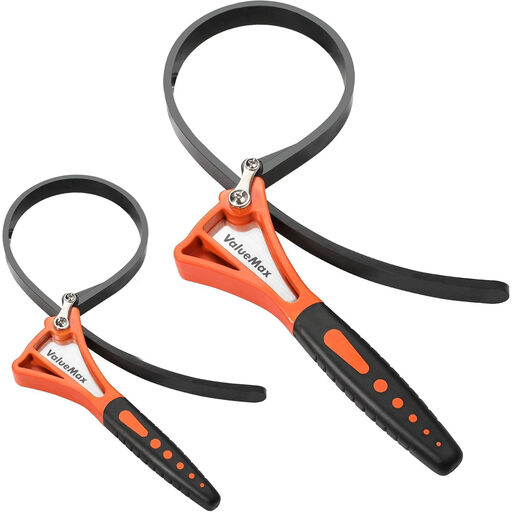
Why this fits the profile: The two sizes offer a practical starting point for DIYers who want one set for oil filters, pipes, jars and bottles.
The set states both the strap lengths and the diameter range, so you can check beforehand whether your application falls within the specifications.
Two sizes, rubber straps for less risk of scratches, and a stated diameter range of 100 to 150 mm.
Why this fits the profile: Those who value control across different jobs will appreciate the two versions offering more choice in size and required turning force.
The stated torque values of 180 Nm and 90 Nm make it clear which wrench is intended for heavier or lighter applications.
The product information states a tensile strength of 2000 N for the large and 1500 N for the small strap, plus composite handles.
Why this fits the profile: For car maintenance, plumbing and connections, the large wrench offers extra reach, while the smaller version remains suitable for less bulky components.
The rubber construction is intended for smooth or finished surfaces. The manufacturer does warn against sharp edges, extreme heat and exceeding the torque limits.
Suitable for applications such as oil filter removal, plumbing fittings, shower heads and glass jars; the total product weight is stated as 500 g.
For an oil filter, it's wise to let the engine cool down sufficiently first. Do not use the wrench on a hot filter or on a surface with sharp burrs. With pipes and taps, you should also avoid twisting a vulnerable connection.
We've put together a full, up-to-date list of products that fully meet these strict selection criteria and comply with current European safety regulations.
No. Check the diameter of the filter and compare it with the wrench's range. A rubber strap wrench works best on round, smooth surfaces where the strap can make contact all the way around. A heavily damaged or seized filter may require a different type of tool.
The lifespan depends on use, storage and load. Oil, heat, sharp edges and prolonged stretching can degrade rubber. Therefore, check the strap regularly and replace the tool as soon as you see cracks, cuts or noticeable hardening.
Yes, when the diameter falls within the stated range and the surface is sufficiently clean and smooth. Use the smaller wrench for light applications and the larger version for objects that need more reach or torque. Never pull harder than the stated limits.
