
Vandaag of morgen in huis

Kwaliteit gegarandeerd

Welkomstaanbiedingen ontgrendelen: GRATIS bezorging | Tot 80% korting | Gratis 30 dagen JoyPlus-proefperiode
Download de app
By Joybuy Product Recommendation OfficerLast Updated: 07/04/2026
The new generation of NVIDIA graphics cards is here. With the introduction of the NVIDIA Blackwell architecture, many PC gamers and creative professionals are facing an important decision. The performance leap is promising, especially for a graphics card for 4K gaming and heavy graphics workloads. But with models like the RTX 5080, 5070 Ti, and 5070, it can be difficult to determine which card is the right investment for your system.
This article is intended as a practical guide. We'll skip the marketing jargon and focus on the specifications that truly matter. This way, we'll help you make an informed decision when you're considering buying a new graphics card.
Before we look at specific models, here are a few key points that apply to the entire RTX 50 series.
One of the most significant innovations in the RTX 50 series is the switch to GDDR7 memory. This type of memory offers significantly higher bandwidth than its predecessor, GDDR6(X).
The RTX 50 series makes full use of the PCI Express 5.0 interface. Although many current systems still run on PCIe 4.0, a PCIe 5.0 graphics card offers double the throughput.
High-end graphics cards are becoming larger and more powerful, and the RTX 50 series is no exception. Therefore, pay close attention to the dimensions (length, width, and number of slots) and the power requirements.
Based on objective specifications, we have highlighted a few popular choices. These are all models from the Gigabyte brand, known for their reliable cooling solutions.
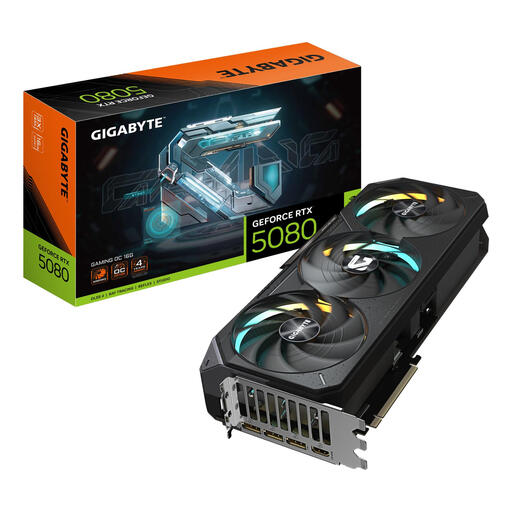
Why It Stands Out: This model is all about pure performance. With 16GB of GDDR7 memory on a 256-bit bus and a high clock speed, this RTX 5080 is designed for uncompromising 4K and even 8K gaming. The WINDFORCE 3X cooling system with a vapor chamber is built to keep performance stable and relatively quiet.
Pros:
Who is this card for? For the serious gamer or creative professional who wants the highest possible framerates and graphics settings, without compromise. Ideal for those building a high-end PC and wanting to be ready for the years to come.
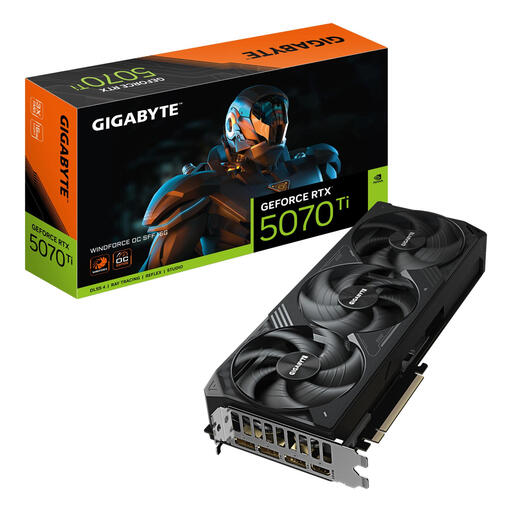
Why It Stands Out: The RTX 5070 Ti offers a strong balance between price and performance. This Gigabyte model surprisingly also features 16GB of GDDR7 memory, making it a very future-proof choice for 1440p and 4K gaming. Its more compact form factor (SFF-ready) makes it an interesting option for builders of smaller systems who still want high-end performance.
Pros:
Who is this card for? For the gamer seeking a significant upgrade for smooth 1440p and capable 4K gaming. It's a smart choice for those who want to experience the power of the Blackwell architecture without the budget of a 5080.
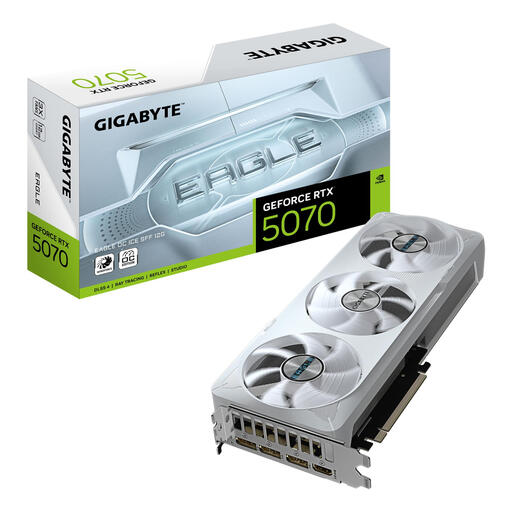
Why It Stands Out: The RTX 5070 is the entry point into the new generation. This EAGLE OC ICE model stands out with its white color scheme and sleek design, perfect for builds with a specific aesthetic. With 12GB of GDDR7 memory and a 192-bit bus, it's a capable card for excellent 1440p performance and a solid introduction to 4K gaming.
Pros:
Who is this card for? For the gamer who wants to modernize their system and take advantage of the latest technologies, primarily focusing on 1080p and 1440p gaming. Also a great choice for builders putting together a white-themed PC.
A powerful Gigabyte graphics card performs best in a balanced system. If your upgrade also includes a new motherboard or faster memory to fully utilize your PCIe 5.0 graphics card, it's worth looking at compatible parts.
? Check out our selection of DDR5 Components here to complete your build.
This depends on your current card and your needs. The jump from an RTX 4060 to an RTX 5070 Ti will make a significant difference. The main advantages of the 50 series are the NVIDIA Blackwell architecture, higher efficiency, support for GDDR7 memory, and the latest generation of AI acceleration (DLSS). For users with an RTX 4080 or 4090, the performance gain might be less decisive, unless you specifically need the latest technologies.
For a graphics card for 4K gaming, 12GB of VRAM is considered a good starting point. However, games with high-resolution textures and ray tracing can quickly demand more memory. A card with 16GB, like the RTX 5080 or the recommended RTX 5070 Ti, offers more headroom and is a safer bet for the future.
The difference lies mainly in the CUDA cores, the amount of VRAM, and the memory bus width.
