
Organisers planning a special lunch
If you’re serving rolls with soup, salads or special fillings, you could consider rustic and sourdough options. Just check that you’ll have the time and equipment to finish baking them shortly before lunch.


Choose a white rustic or sourdough roll if the style of bread is your main priority for an office lunch. If a wholemeal base or fibre matters more, compare the ingredients and fibre per 100 g in multigrain and wholemeal options. For guests who eat gluten-free, choose a separate roll explicitly labelled gluten-free; also make sure the preparation method and pack size suit when you plan to serve it.
If you’re serving rolls with soup, salads or special fillings, you could consider rustic and sourdough options. Just check that you’ll have the time and equipment to finish baking them shortly before lunch.
If a wholemeal base or fibre is important, look beyond the word ‘multigrain’. Compare the proportion of wholemeal flour in the ingredients list and the fibre per 100 g on the label.
If a guest eats gluten-free, labels such as spelt, sourdough or multigrain aren’t enough. Choose an option explicitly labelled gluten-free and check the other allergens listed on the packaging too.
First, decide which need matters most for your lunch. Then check whether the packaging, preparation method and ingredients of each option suit your guests and schedule.
| What to consider | What to check when buying | Who it matters to |
|---|---|---|
| Bread style and presentation | Check the type of bread, the number of rolls and whether the packaging actually specifies sourdough or a rustic style. | For a lunch with special fillings, I want the rolls to suit the presentation; for around 27% of consumers, bread style comes first. |
| Wholemeal base and fibre | Compare the proportion of wholemeal flour in the ingredients list and the fibre per 100 g. | If I’m deliberately looking for an alternative to white rolls, I want to be able to compare the ingredients. Around 27% of consumers give this their highest priority. |
| Preparation and planning | Check the baking time, suitable appliance, pack size and any defrosting instructions. | When lunch needs to be ready at a set time, I want to know how many rolls I can prepare at once; this matters most to around 33% of consumers. |
| Gluten-free and allergens | Read the gluten-free label and the current allergen information for the option you’ve chosen. | If I need to arrange a suitable bread option for a guest, I don’t want to rely on labels such as sourdough or multigrain. For around 13% of consumers, this is their first concern. |
The sourdough and multigrain rolls described by PLUS contain wheat or other cereals containing gluten. So the style of bread doesn’t mean a roll is suitable for a guest who eats gluten-free.
If needed, choose a separate product explicitly labelled gluten-free and check the latest allergen information.
A rustic product name doesn’t tell you how much fibre it contains, which allergens are present or how long it needs to be baked.
Compare the ingredients, fibre per 100 g and preparation instructions for the options you’re considering.
According to Jumbo, the frozen rolls described should be prepared and eaten within 24 hours of defrosting; these products are not intended to be refrozen.
Only defrost as many rolls as you can use for lunch, following the instructions on the packaging.
Ingredients and allergens can vary between product options. That makes the packaging of the rolls you’re actually serving important when you’re hosting several guests for lunch.
Check the label when you buy the rolls, and again before serving them.
Albert Heijn describes both white part-baked rolls and a separate gluten-free white option.
The range described includes several bread styles, including sourdough and frozen rolls.
The PLUS rolls described include white, multigrain, sourdough and gluten-free options.
Lidl describes white and brown rolls that you can finish baking at home.
Dirk lists both loose rolls and packaged part-baked options.
This pack of four white rustic rolls is a good fit for a lunch where you’re looking for that style of bread. Check the preparation instructions and label before matching your order to the number of guests and when you plan to serve them.
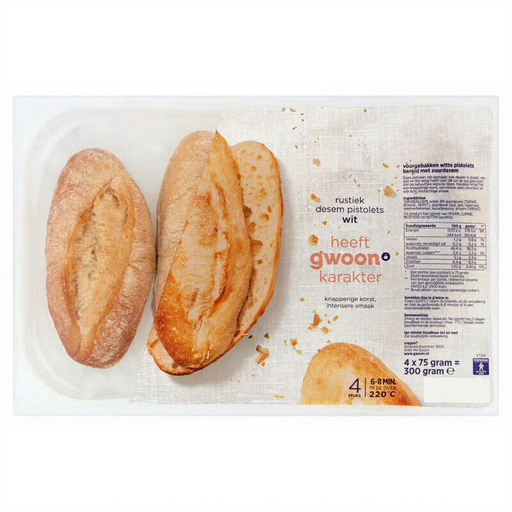 Image unavailable
A white rustic roll for a lunch where this style of bread is just what you’re looking for.
Pack: 4 pieces. Check the preparation instructions and allergen information on the packaging before serving to several guests.
No. Compare the nutritional information for each product instead. For its multigrain roll described here, PLUS lists 7 g of fibre per 100 g; for the white Korenlanders sourdough option described, it lists 2.29 g per 100 g. If a wholemeal base is important, check the ingredients too.
Not based on those descriptions alone: the options described by PLUS contain wheat or other cereals with gluten. If a guest eats gluten-free, choose a product explicitly labelled gluten-free and check the other allergens on the label.
It depends on the product and appliance. Albert Heijn says the white rolls described need 8–10 minutes in the oven; for the Korenlanders options described, PLUS gives a baking time of 6–8 minutes in the oven or 4 minutes in an air fryer. Follow the instructions on the pack you choose and consider how many rolls will fit in the appliance at once.
You can’t tell from the product name. Check the ingredients list for terms such as baker’s salt or iodised salt, and don’t assume all rolls have the same ingredients.
Match the number of packs to the expected number of diners and follow the storage instructions for the product you choose. Pay particular attention to the instructions for frozen rolls after defrosting: for the option described, Jumbo says they should be prepared and eaten within 24 hours and not refrozen.