
Fans of white bread
If you prefer a light, familiar type of bread, a white roll is an obvious choice. If fibre also matters to you, compare the nutritional information separately.


Choose a white roll if a familiar taste and texture matter most; choose a roll labelled wholemeal if you’re mainly looking for wholemeal flour and fibre. A multigrain roll may suit you if you’re somewhere in between, but the name doesn’t tell you how much wholemeal flour it contains. Also check whether storage and preparation suit your late-night snack plans.
If you prefer a light, familiar type of bread, a white roll is an obvious choice. If fibre also matters to you, compare the nutritional information separately.
If wholemeal flour or the fibre content of the roll is your priority, the product description, ingredients list and nutritional information per 100 g are more useful than the colour of the crust.
If you keep rolls at home, it’s worth checking whether they need to be baked and how they should be stored. Check the instructions for the variety you’re buying.
Before choosing a late-night snack, decide whether taste, ingredients or preparation matters most to you. Then compare only rolls that match your preference on that point.
| What to consider | What to check when buying | Who is it important to? |
|---|---|---|
| Wholemeal flour and fibre | Read the product description and ingredients list; compare fibre per 100 g on the same basis. | If I want the roll itself to meet my preference for wholemeal, I need to know more than whether it looks brown. For around 44% of consumers, the ingredients come first. |
| Preparation and storage | Check whether the roll is ready to eat, part-baked or frozen, and follow the relevant instructions. | For a late-night snack, I want to know whether I’ll need an appliance and how I can store the rolls. This practical consideration matters most to around 33% of consumers. |
| Familiar taste | Choose deliberately between white, explicitly labelled wholemeal and multigrain; don’t assume the name multigrain tells you how much wholemeal flour the roll contains. | If a hearty type of bread is likely to be left uneaten, I’d rather choose a white roll that suits my taste. Around 23% of consumers put familiarity first. |
According to the Netherlands Nutrition Centre, multigrain refers to bread made with at least three types of grain. It doesn’t tell you how much wholemeal flour the roll contains.
If you’re choosing a roll other than white because you want wholemeal flour or more fibre, check the ingredients list and fibre per 100 g.
White, brown and multigrain don’t tell you which allergens a particular roll contains. Products with similar names can also have different ingredients.
If you have a relevant allergy, check the current ingredients and allergen information on the packaging, not just the product title.
A part-baked or frozen roll needs to be prepared differently from one that’s already baked. That difference is especially noticeable late in the evening.
Check the preparation and storage instructions for the variety you’ve chosen in advance.
A part-baked product needs time to prepare at home; a frozen product also requires suitable freezer space.
The mention of iodised salt on one roll that has been checked doesn’t tell you anything definite about another variety.
If the type of salt used matters to your choice, check the ingredients list for the specific product.
Albert Heijn lists both a white roll and one explicitly labelled wholemeal, so you can compare their product descriptions side by side.
Jumbo sells rolls in different varieties and storage formats, including a brown frozen variety that has been checked.
At PLUS, you can compare the ingredients and preparation instructions for white and multigrain part-baked rolls, among other options.
Dirk lists both an individual white roll and a pack of four multigrain part-baked rolls.
ALDI lists a white roll and also mentions white and wholemeal rolls in its bakery range.
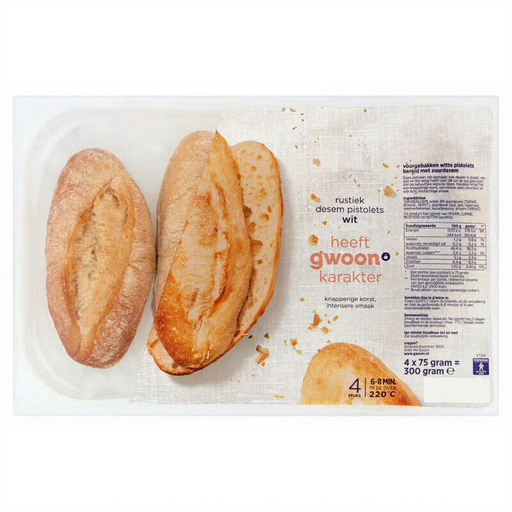
These white rolls suit anyone looking for a familiar type of bread for a late-night snack. If wholemeal flour or fibre is your priority, compare the ingredients and nutritional information for the roll you’re considering.
 No image available
A white roll for anyone who starts by choosing the type of bread for a late-night snack.
Check the packaging to see whether the rolls need to be baked. If you’re also considering a wholemeal variety, compare the nutritional information per 100 g.
No. According to the Netherlands Nutrition Centre, multigrain means that bread is made from at least three types of grain; the name doesn’t tell you how much wholemeal flour it contains. Check the ingredients list and, if necessary, compare the fibre per 100 g.
No. The terms white, brown and multigrain don’t provide allergen information. The Netherlands Food and Consumer Product Safety Authority says that types of grain containing gluten must be clearly identifiable in the ingredients list. Always check the current packaging for the specific product.
A roll that’s already baked doesn’t need baking at home; a part-baked or frozen variety is only suitable if you can fit in the preparation and storage it requires. Follow the packaging instructions for every variety, and check what’s available locally when you visit a shop.
You can’t tell from the product category. Albert Heijn lists iodised salt for the white and wholemeal rolls checked, but if the type of salt used matters to your choice, check the ingredients list for the specific roll.