Choose individual rolls if you want to serve just a few with coffee; a half loaf is a better fit if you’ll also want sandwiches later. A pack of bake-at-home rolls gives you rolls to bake yourself, but you’ll need to allow time to prepare them and decide what to do with any leftovers. So first compare the quantity with what you’ll actually use, and freeze any bread you won’t eat soon in portions.
Who is this choice important for?
Small households looking to avoid leftovers
If you’re buying for one or two people, think beyond what you’ll serve with coffee and consider what you’ll eat over the following days too. A half loaf may suit you if you’ll want sandwiches later; for rolls, you can base the quantity on the number of guests. Together Against Food Waste recommends freezing any bread you won’t use straight away in portions as soon as you’ve bought it.
Hosts who want to serve individual rolls
If you want to give each guest their own roll, individual rolls are a more obvious choice than slices from half a loaf. ALDI and Dirk sell rolls individually; if you’re buying bake-at-home rolls, you’ll also need to allow time to prepare them.
Shoppers who check grain type and labels
If wholemeal or nutritional value matters to you, don’t let the shape of the bread be the only deciding factor. Check the product description and compare the fibre per 100 g, ingredients and allergen information for the varieties you’re considering.
What should you consider?
First decide whether you want individual rolls for coffee or bread to eat later as well. Then compare the pack size and preparation requirements with your plans, and read the label if the grain type or ingredients will influence your choice.
Individual rolls
When to choose them: you want to buy one roll per guest and don’t need a larger pack.
Things to consider: you’ll need to choose from whatever fresh rolls the shop has available; Lidl says its fresh range may vary by store.
Bake-at-home rolls
When to choose them: you want to bake the rolls yourself just before coffee.
Things to consider: prepare them according to the pack instructions, and decide in advance what you’ll do with any leftovers.
Half a loaf
When to choose it: you expect to want sandwiches later as well as something with your coffee and cake.
Things to consider: you’ll be serving slices rather than individual rolls; freeze any portions you won’t eat soon.
| What to consider |
What to check when buying |
Who is this most important for? |
| Quantity and leftovers |
Compare the number of rolls or the weight of the half loaf with the portions you’ve planned. Decide what you’ll freeze straight away. |
If I only eat a little bread, I don’t want to be left with a pack I can’t finish after one coffee occasion. The right quantity is the top priority for an estimated 42% of consumers. |
| Serving and preparation |
Check whether rolls are available individually or come in a pack; if you’re buying bake-at-home rolls, read the preparation instructions. |
If I want to give each guest a roll, it needs to fit the time I plan to serve it. Around 33% of consumers prioritise this way of serving bread. |
| Grain type and ingredients |
Check whether it’s labelled wholemeal and compare the fibre per 100 g, ingredients and allergens for the exact products. |
The shape of the bread isn’t the deciding factor for me if I mainly want to check the grain type or ingredients. This is the main consideration for around 25% of consumers. |
Common mistakes
-
Assuming half a loaf will automatically mean less waste
You can still have bread left over from half a loaf if you hardly ever eat sandwiches. According to the Netherlands Nutrition Centre, bread is among the product groups that Dutch households throw away a lot; what matters for your choice is how much you’ll actually use.
Count the portions you’ll need with coffee and over the following days. Buy individual rolls if you only need bread for guests, or freeze unused portions of a half loaf or multipack as soon as you’ve bought it.
-
Treating multigrain and wholemeal as the same thing
The word ‘multigrain’ doesn’t tell you by itself whether a roll is labelled wholemeal. You could end up with a different type of bread from the one you were looking for.
Read the product description and ingredients list, and compare the fibre per 100 g shown for the products you’re considering.
-
Assuming all bread contains iodised baker’s salt
Baker’s salt is iodised salt, but according to the Netherlands Nutrition Centre, bakers aren’t required to use it. So the name of a roll or half loaf won’t tell you which salt a specific product contains.
Check the ingredients list on packaged bread, or ask which salt has been used for individual rolls.
-
Relying on an old product description instead of the label
Albert Heijn points out that ingredient, nutritional and allergen information can change. If you’re choosing based on this information, the exact variety available at the time of purchase is what matters.
Read the current packaging, especially if you want to avoid an ingredient or compare products by nutritional value.
Brands and shops worth comparing
Albert Heijn
Albert Heijn lists white and wholemeal rolls in its range.
- You can compare the descriptions of these roll varieties side by side.
- Albert Heijn recommends checking the packaging, as product information can change.
Jumbo
Jumbo lists white and mixed-seed rolls in packs of four, as well as half loaves in its wholemeal range.
- This lets you compare a pack of rolls with a half loaf as different types of product.
- A nutritional claim for one specific mixed-seed roll doesn’t automatically apply to other rolls or loaves.
PLUS
PLUS lists bake-at-home rolls and a half wholemeal loaf.
- These products let you consider preparation and bread format separately.
- Check the current packaging and preparation instructions for the variety you choose.
Dirk
Dirk lists, among other products, a brown roll sold individually.
- An individual roll can match the number of guests without you having to buy a whole pack.
- Information about this brown roll doesn’t tell you what other varieties are available in every shop.
ALDI
ALDI lists a white roll sold individually.
- This gives you a way to match the number of rolls to a small coffee gathering.
- Check in store that the roll is available when you need it.
Lidl
Lidl lists a white roll as part of its freshly baked in-store range.
- You can look for a freshly baked individual roll.
- Lidl says its fresh range may vary by store.
Rolls on Joybuy
If you’re serving four rolls with coffee, you can compare this pack with the number of people eating. If you also want bread for sandwiches later, consider how much you’ll use after coffee when choosing between rolls and half a loaf.
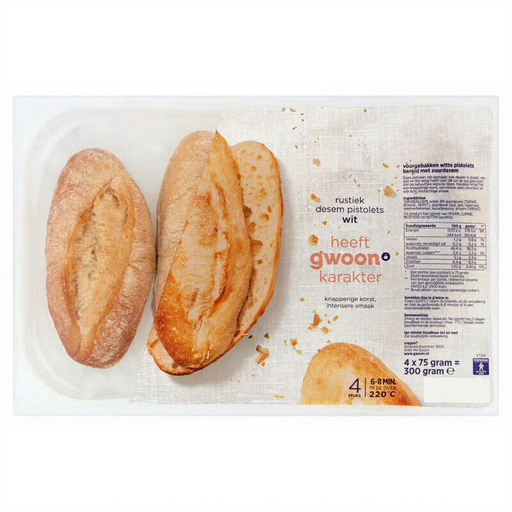 Image unavailable
g'woon White Rustic Pistolet, 4 pieces
A pack for a coffee occasion when you want to buy four rolls. Before buying, check the preparation method and the latest ingredient and allergen information.
View on Joybuy
Frequently asked questions
Is a roll the same as half a loaf?
No. A roll is an individual bread roll, while you can slice half a loaf to make sandwiches. Individual rolls may suit coffee and cake if you want to give each guest their own; if you expect to eat sandwiches later too, compare how much of a half loaf you’ll use.
What should I do with leftover rolls or bread?
Freeze any bread you won’t eat soon in portions as soon as you’ve bought it. Together Against Food Waste recommends freezing bread straight after purchase; before you buy, also check whether the number of rolls or the amount of bread in a half loaf suits your plans.
Does all bread in the Netherlands contain iodised baker’s salt?
No, you can’t tell from the type of bread. According to the Netherlands Nutrition Centre, bakers don’t have to use baker’s salt; check the ingredients list on packaged bread, and ask which salt has been used for bread sold individually.
What should I check if I need to avoid an ingredient?
Read the latest ingredient and allergen information for the exact variety you’re buying. Details for a different roll or half loaf are no substitute for the label on your product.


