
Hosts serving generously filled rolls
You want to choose how far to slice the roll open, leaving room for sauce and fillings. If you choose bake-at-home rolls, you can prepare them just before serving.


Choose a white roll if you want a neutral base for generous fillings. If wholegrains or fibre are more important to you, look for wholemeal or multigrain options. If you need a gluten-free roll, choose one that is explicitly labelled as such. Don’t assume it will come pre-sliced: check the packaging or cut it open to suit your filling.
You want to choose how far to slice the roll open, leaving room for sauce and fillings. If you choose bake-at-home rolls, you can prepare them just before serving.
You want to consider a wholemeal or multigrain roll for the same meal, and compare the ingredients and nutritional information per 100 g.
You’re looking for a product explicitly labelled gluten-free, and check the current allergen information rather than assuming that a regular white or multigrain roll is suitable.
First, decide whether you need a gluten-free roll. Then compare the grains, how you want to prepare it and how you’ll slice it to suit your filling.
| What to consider | What to check before buying | Who it matters to |
|---|---|---|
| Crust, filling and cut | Check whether the rolls are bake-at-home or fresh, and follow the cooking instructions for bake-at-home products. Look for details of how they’re sliced. | If you want to fill a roll generously, you’ll want to decide how deeply to cut it yourself. Around 36% of consumers prioritise room for fillings and control over the opening. |
| Fibre and grains | Read the ingredients and check the fibre content per 100 g. The term ‘multigrain’ alone doesn’t tell you how much wholegrain a roll contains. | When choosing a roll for a fakeaway, you mainly want to know which grains it contains and what its nutritional value is. Around 21% of consumers prioritise their choice of grains and fibre. |
| Preparation and quantity | Compare the number of rolls in the pack with how many you need, and check whether you’ll need to bake them at home. | You want to have enough rolls ready without more preparation than planned at serving time. The quantity and convenience matter most to around 29% of consumers. |
| Gluten and allergens | If needed, choose a variety explicitly labelled gluten-free and read the current allergen information on the packaging. | If gluten is a concern for you, you need to be able to rely on the product description and label, not its colour or type of grain. This check is the top priority for around 14% of consumers. |
The word ‘roll’ doesn’t tell you how far it has been sliced open. If the opening isn’t right for your filling, it can be awkward to fill.
Check the packaging if you want a pre-sliced roll. If it doesn’t specify how it’s cut, slice it open yourself to the depth you want.
The multigrain rolls described by PLUS contain wheat, rye, barley and oats, among other ingredients. Multigrain is not a substitute for a product explicitly labelled gluten-free.
If you need to avoid gluten, choose a roll labelled gluten-free and check the current allergen information.
One roll’s ingredients listing for iodised baker’s salt doesn’t tell you what’s in another variety.
If the type of salt matters to you, read the ingredients list for the rolls you’re actually buying.
These retailers and own-label brands offer different types of rolls to compare by bread type, packaging and preparation method.
Albert Heijn lists white rolls alongside fresh, wholemeal and sourdough varieties.
Jumbo lists white, mixed-seed, frozen, sourdough and spelt rolls, among other varieties.
PLUS describes white, multigrain and gluten-free rolls, with product information covering preparation and ingredients, among other details.
The 1 de Beste own-label range includes white and rustic multigrain bake-at-home rolls.
ALDI lists a single white roll as an alternative to a multi-roll pack.
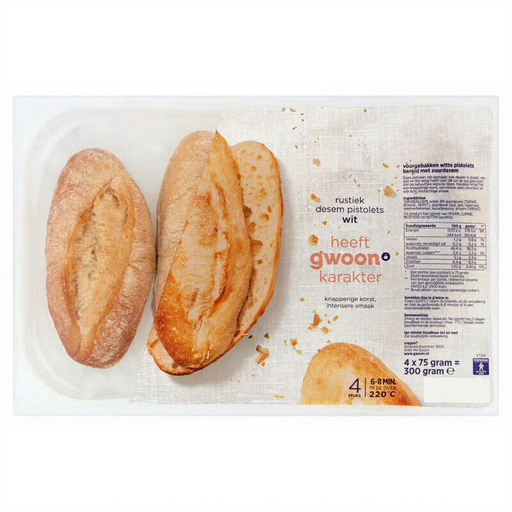
If you’re looking for white rolls as a base for a filled fakeaway meal, you can take a look at the pack of four below. Before use, check the slicing and preparation instructions on the packaging.
 No image available
An option if you want to fill white rolls and need four at once.
Check the packaging for preparation instructions and to see whether they’re already cut. If not, slice them open to suit your filling.
Yes, if the packaging gives air fryer instructions. For its white and multigrain bake-at-home rolls, PLUS recommends four minutes in a preheated air fryer at 200°C. For other products, follow their own preparation instructions.
You can’t tell from the name alone. The multigrain roll described by PLUS contains 7 g of fibre per 100 g, while the white variety described contains 2,7 g per 100 g. For other rolls, compare the nutritional information per 100 g.
Choose a product explicitly labelled gluten-free and check the current label. The regular white and multigrain rolls described by PLUS contain gluten-containing grains; calling a roll multigrain doesn’t make it gluten-free.