Choose rolls for a coffee morning based on the filling, the type of bread you want and how much time you have to prepare, rather than relying on a ‘thick cut’ label. For generous or moist fillings, try the roll with the filling you plan to use. Look specifically for wholemeal if that’s your nutritional preference, and check that the preparation time for bake-at-home rolls fits your plans. If any guests have allergies, always check the latest packaging.
Who are these rolls for?
Hosts serving generous fillings
You want to serve rolls filled with things such as egg mayonnaise, cream cheese, fish or vegetables, with enough structure to hold together when picked up. A rustic roll can be a good starting point, but check how well it holds up with the filling you’ll actually use.
Coffee morning planners who care about the type of bread
You want to offer an alternative to white rolls. If fibre matters to you, compare the ingredients and nutritional information, and check whether a product is specifically labelled wholemeal.
Organisers short on preparation time
You want to know whether you can bake the rolls just before serving, or whether you’d rather choose fresh rolls that don’t need an oven.
What should you look for?
Before your coffee morning, decide what filling you’ll serve, what type of bread you’re looking for and how much time you have. A label such as ‘rustic’ doesn’t, by itself, tell you how well a roll will hold up with your filling.
| What to consider | What to check | Who is this important to? |
|---|
| Holding the filling |
Check the size and texture of the roll. If possible, try generous or moist fillings on one first. |
When I serve a generously filled roll, I want the filling to stay in place when it’s picked up. This is the top priority for around 43% of consumers. |
| Type of bread and fibre |
Look for the ‘wholemeal’ label if you want wholemeal bread; compare the ingredients and fibre information per 100 g. |
I want to be able to choose between white bread and a roll that focuses on wholemeal or fibre. This is the main concern for around 29% of consumers. |
| Preparation and storage |
Check the cooking instructions and whether you can use an oven or air fryer. For leftovers, check the storage instructions on the packaging. |
When guests are nearly here, I want to know how much preparation the rolls need and what I can do with any leftovers. This is the top priority for around 28% of consumers. |
Common mistakes when choosing rolls
-
Assuming multigrain means wholemeal
‘Multigrain’ doesn’t automatically mean that the whole grain has been used. The name alone won’t tell you how much fibre the roll contains.
If wholemeal is what you’re looking for, check for the ‘wholemeal’ label, then compare the ingredients and nutritional information.
-
Treating ‘thick cut’ or ‘sturdy’ as measurable qualities
These labels don’t necessarily tell you how a roll will hold up with your filling. Dirk describes its rustic multigrain roll as sturdy, but that description isn’t a comparable measure of how much filling it can hold.
Assess the roll for yourself and, if needed, try it first with the heaviest or moistest filling you plan to serve.
-
Relying on out-of-date ingredient information
Recipes and product information can change. So a product page you viewed earlier is no substitute for checking the packaging you’ll be serving.
Check the latest ingredients and allergen information on the packaging, even if you’re choosing a roll specifically for a guest with a food allergy.
-
Opening more bake-at-home rolls than you need
Storage advice for opened bake-at-home rolls is different from that for an unopened pack. If you’re hosting a small group, bear in mind that you may have leftovers.
Open packs as you need them and follow the storage instructions on the packaging for any leftover rolls.
Brands and retailers to compare
Albert Heijn
Albert Heijn offers a range that includes white, multigrain, wholemeal and gluten-free rolls.
- The product pages offer different types of bread to compare.
- Albert Heijn notes that ingredients, nutritional values and allergen information may change; check the latest packaging.
Jumbo
Jumbo offers several types of rolls, including white and multiseed varieties.
- There are different product types and pack sizes to factor into your plans.
- Don’t assume a particular slice thickness or firmness based on the type of bread or packaging.
Lidl
Lidl describes its white roll as an individual white wheat roll.
- Individual rolls can be a good option if you want to tailor the quantity to your group.
- Check the roll itself for size and how well it holds generous fillings.
ALDI
ALDI offers individual white rolls.
- Buying rolls individually makes it easy to adjust the quantity to suit your guests.
- Describing a roll as crusty doesn’t tell you how much filling it can hold.
PLUS
PLUS offers a range that includes white, multigrain and gluten-free rolls.
- Preparation methods, ingredients and allergens are listed for specific products.
- An ingredient or preparation instruction for one PLUS roll won’t necessarily apply to another variety.
Dirk
Dirk offers white and rustic multigrain rolls.
- Dirk describes one rustic multigrain roll as sturdy. That could be a reason to try it with the filling you have planned.
- The description doesn’t provide a measurement you can use to compare its firmness with other rolls.
Rolls on Joybuy
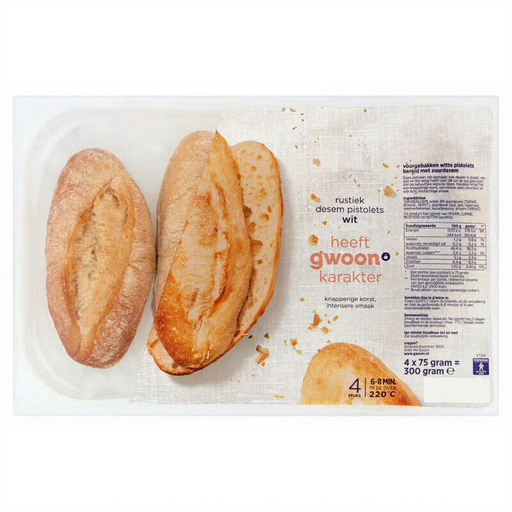
This white, rustic roll is one option to consider if you’re looking for rolls to serve with fillings at a coffee morning. Check how well it holds up with the filling you plan to serve.
 No image available
g'woon White Rustic Pistolet, 4 pieces
This white, rustic roll is an option for a coffee morning with fillings. Check how well it holds up with the filling you have planned.
The pack contains 4 pieces. Check the latest packaging for ingredients, allergens and any preparation instructions.
View on Joybuy
Frequently asked questions
What does ‘thick cut’ mean on a roll?
Don’t treat ‘thick cut’ as a standard measure of a roll’s firmness. Check its size and texture, and if you’re unsure, try it with the filling you have planned.
When should I bake rolls for a coffee morning?
Where possible, bake them shortly before serving and follow the instructions for the product you’ve chosen. PLUS recommends baking one white roll for 6–8 minutes in an oven at 220 °C or for 4 minutes in a preheated air fryer at 200 °C; don’t use those timings for another type of roll. Add moist fillings shortly before serving.
Do I need to check allergens in white rolls too?
Yes. Check the latest allergen information for every roll before serving it to a guest with a food allergy. Even if a product is labelled ‘gluten-free’, check the packaging and avoid cross-contamination with other products during preparation or filling.
Does every roll contain iodised salt?
Don’t assume it does: check the ingredients list for the roll you’ve chosen, or ask the retailer. The Voedingscentrum (Netherlands Nutrition Centre) notes that bread made with iodised baker’s salt is an important source of iodine in the Netherlands, but that doesn’t tell you which salt is used in any particular roll.
How should I store an opened pack of bake-at-home rolls?
Follow the storage instructions on the packaging. For opened bake-at-home rolls, the Voedingscentrum recommends 2–4 days in the fridge or 1–3 months in the freezer; check which instructions apply to your product.


