
For homes with narrow passageways
You want the robot to fit along your everyday route, and you also need a suitable place to charge it. Measure both before comparing features.


First, measure the narrowest passage, the clearance beneath furniture and the space for the charging dock. Only then decide between a compact robot and extra automation. A robot can help keep crumbs under control on an open-plan floor, but it won’t replace cleaning stairs, gaps and awkward corners. A mop or self-emptying dock takes care of some tasks, but needs space and still requires maintenance.
You want the robot to fit along your everyday route, and you also need a suitable place to charge it. Measure both before comparing features.
You want to keep crumbs and dirt brought in from outside under control on an open-plan floor, and decide whether mopping is worth the extra work for your flooring.
You want to empty the dust bin less often, but you also need to consider the space required for the dock, the noise when it empties and the replacement parts.
Measure the robot’s route and the space for its charging dock first; then compare its cleaning features and the maintenance tasks a dock can take care of.
| What to consider | What should you check? | Who is this most important for? |
|---|---|---|
| Passageway and charging space | Measure the narrowest passage and the available clearance; check the dock’s dimensions and placement instructions separately. | If I have a narrow route, I want to know whether the robot can get through and where it can charge. Around 33% of consumers put fit and storage first. |
| Everyday floor cleaning | Compare how well it picks up dust on your type of flooring, then decide whether you need a mopping function and are happy to maintain the pads. | If you mainly want to keep crumbs under control on an open-plan floor, your flooring and the extra work involved in mopping both matter. Around 27% of consumers put everyday floor cleaning at the top of their list. |
| Navigation and obstacles | Check tests of obstacle avoidance and stair-edge detection; also see whether you can set no-go zones. | If there are cables, chair legs or loose rugs along my route, I want to know how the robot will handle them. Around 20% of consumers give navigating around obstacles top priority. |
| Maintenance and dock | Compare which tasks the dock takes care of, which consumables are needed and how much space it requires. | If I want to empty the bin manually less often, I weigh that up against the extra space and ongoing maintenance. Around 20% of consumers choose mainly to reduce maintenance. |
A charging or self-emptying dock needs space too. Consumentenbond points out that an automatic emptying dock can take up more room than a standard charging dock. The dock’s height alone doesn’t tell you how much floor and manoeuvring space you’ll need.
Measure the robot’s route and the space for its dock, and follow the placement instructions for the exact model.
A dock can take up useful floor or storage space.
The stated suction power alone doesn’t tell you how well a robot will pick up dirt from your floors or out of gaps. Consumentenbond describes tests using different types of dirt and floor surfaces.
Compare test results for your type of flooring, and also consider navigation and reach.
A self-emptying dock can reduce the need to empty the bin by hand, but it needs maintenance itself. Depending on the model, you may also need dust bags, mop pads or other replacement parts.
Check which tasks the dock you’re considering takes care of and whether the relevant parts are available.
Dust bags and other replacement parts mean ongoing maintenance.
The Roomba Mini is available with different charging setups. That choice matters if storage or emptying the bin less often is a priority.
According to ECOVACS, the DEEBOT mini combines a 28,6 cm-wide robot with a multifunctional OMNI dock.
According to Roborock, the Q7 M5 and Q7 L5 ranges include models with and without a self-emptying dock.
The HomeRun 2000 Series, including the XU2000/25, is a range worth comparing for support and spare parts.
This selection includes robots for vacuuming and mopping living areas, with models both with and without an automatic emptying dock.
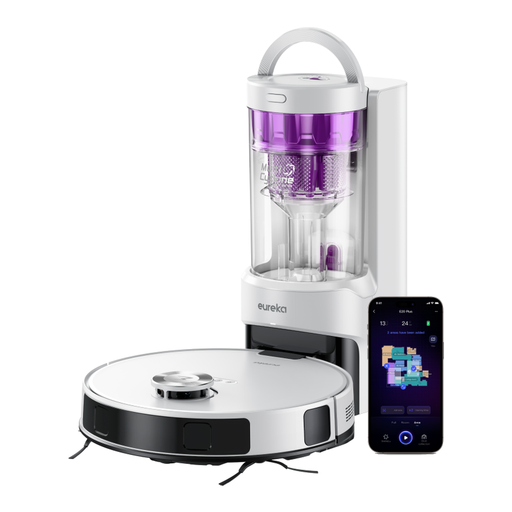 No image available
An option to compare if you want to vacuum and mop an open-plan living area and empty the bin by hand less often; check that you have enough space for the dock.
The product name lists 8000 Pa, DuoDetect AI 3D obstacle avoidance, app control and a 45-day dust container.
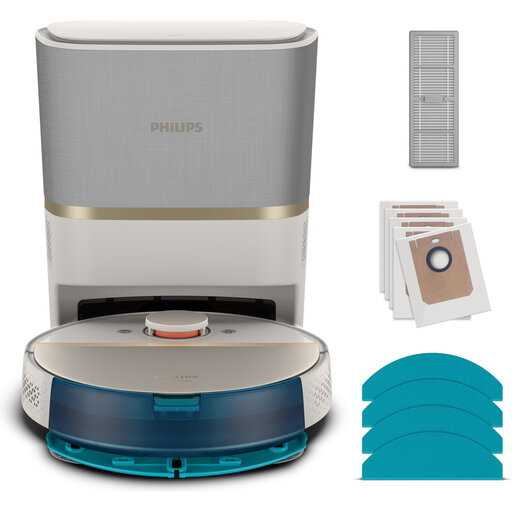 No image available
An option to compare if you want to vacuum and mop and empty the bin by hand less often; measure the space for the automatic emptying dock beforehand.
The product name lists 5000 Pa, a runtime of 180 min and LiDAR navigation.
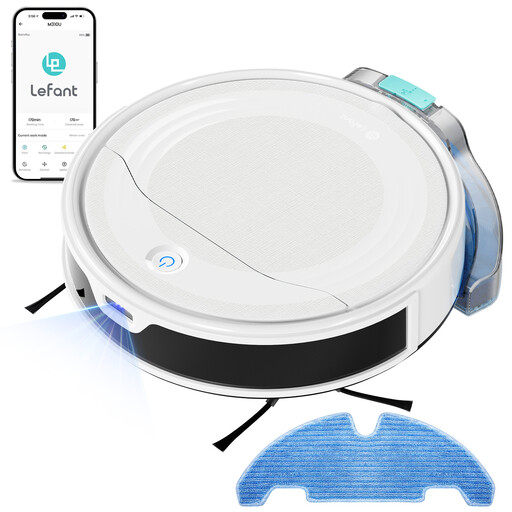 No image available
An option to compare if you’d prefer a model without a large automatic dock. Measure the passageway and available clearance at home; the product name alone doesn’t confirm that the robot will fit.
The product name lists 6000 Pa, ToF laser navigation and control via app or Alexa.
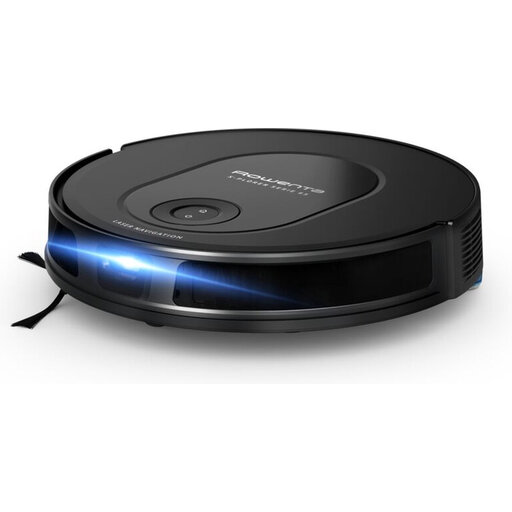 No image available
A model to compare if you also want to clean beneath furniture; measure the available clearance and compare it with the exact robot model.
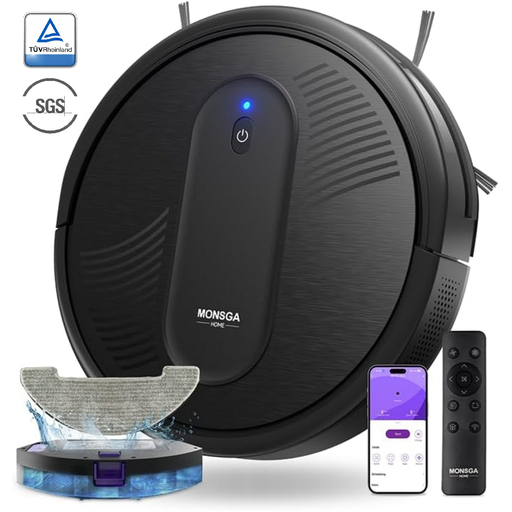 No image available
An option to compare if you want to vacuum hard floors or low-pile carpets; check that the stated controls suit your preferences.
The product name lists a 3,2-inch profile, 4000 Pa, a runtime of 140 min and control via remote, app or voice.
Measure the narrowest usable passage and compare it with the width of the exact robot model. Also measure the clearance beneath furniture and check how much space the charging setup needs; the stated robot width alone doesn’t guarantee it will fit through.
Don’t count on it to clean stairs: Consumentenbond points out that a robot won’t vacuum stairs and may not reach edges and corners properly. Have another cleaning method ready for these areas, and check test information on stair-edge detection.
Check the map and any no-go zones, and maintain the dust bin, brushes and filters according to the instructions. A mop or self-emptying dock also means looking after the relevant pads, water components or dust bags; check which parts are needed for your exact model.
No. According to the Dutch government, there is no fixed statutory guarantee period in the Netherlands. You’re entitled to a product that lasts as long as you can reasonably expect; if a product is faulty, contact the seller. Any manufacturer’s guarantee is in addition to this.
Electrical appliances sold in the Netherlands must meet the applicable European safety requirements, including CE marking and an EU Declaration of Conformity. Appliances with Wi-Fi or other radio connections are also subject to radio equipment regulations. The stricter digital security requirements apply to wireless devices placed on the European market from 1 August 2025. A statement alone doesn’t confirm that a specific product meets all applicable requirements.