
Vandaag of morgen in huis

Kwaliteit gegarandeerd

Welkomstaanbiedingen ontgrendelen: GRATIS bezorging | Tot 80% korting | Gratis 30 dagen JoyPlus-proefperiode
Download de app
A robot vacuum cleaner with a mop and auto-empty station can take a lot of the housework off your hands. However, not every model is equally well suited to a Dutch home with carpets, hard floors, pets or high thresholds. A high suction power figure on the packaging, for example, doesn’t tell you everything about everyday performance.
As Joybuy’s Product Recommendation Officer, I focus on the practical details in the product information. This helps you see which features matter and which marketing claims are worth checking before you order.
A robot vacuum cleaner rated at 10,000 Pa sounds powerful, but Pa isn’t a complete measure of performance. The brush design, airflow, filter and automatic suction settings all play a part too. If you have pets, it’s also worth checking whether hair gets tangled around the main brush.
So don’t compare just 4,000, 7,000 or 20,000 Pa. Check these details as well:
A robot vacuum cleaner with a mop usually uses a damp pad, rotating mop or mop roller. That’s not the same as scrubbing by hand. Check how the appliance handles carpets. An automatic mop lift stops a damp mop from travelling over carpet, but make sure the stated lift height is suitable for your rugs.
Also check whether the station only empties the dust container or washes and dries the mop too. A robot vacuum cleaner with automatic mop cleaning usually means less hands-on work, but you’ll still need to check the dirty-water tank, mop tray and filters.
A robot vacuum cleaner with a self-cleaning station needs space. Various models recommend leaving around 50 centimetres of clearance on both sides and 1.5 metres in front. Measure the space beforehand, especially if you plan to put it in a hallway or under a cupboard.
Check the Wi-Fi requirements too. Some models support 2.4GHz Wi-Fi only. According to the product information, this includes the eufy Omni C20 and various other models. So a robot vacuum cleaner with app control won’t necessarily be compatible with every home network setup.
A robot vacuum cleaner with LiDAR navigation uses lasers to map your home and usually follows a more systematic route than a model that moves in random patterns. In a home with several rooms, furniture and pets, features such as these are more practical than high suction power alone:
LiDAR won’t solve every problem. Loose cables, toys, clothes and low mirrors can still cause blockages. Before creating the first map, clear as much as possible from the floor.
For a robot vacuum cleaner for pet owners, a rotating main brush, side brush and anti-tangle feature are important. Models such as the eufy Omni C20 list a Pro-Detangle Comb, while other products use an anti-wrap or anti-tangle system. According to the brands’ own information, these features are designed to limit hair build-up. The actual results depend on the type and amount of hair and the floor surface.
For a robot vacuum cleaner for carpets and hard floors, an automatic carpet mode is useful. Check the maximum threshold height too. If the robot can’t get over your door bars, it may miss rooms, whatever its navigation system.
There are big differences between a robot vacuum cleaner with a charging station and one with an all-in-one station:
A station reduces the amount of maintenance, but it doesn’t make the appliance maintenance-free. You’ll still need to keep an eye on dust bags or the dust container, clean water, dirty water, mop pads and filters.
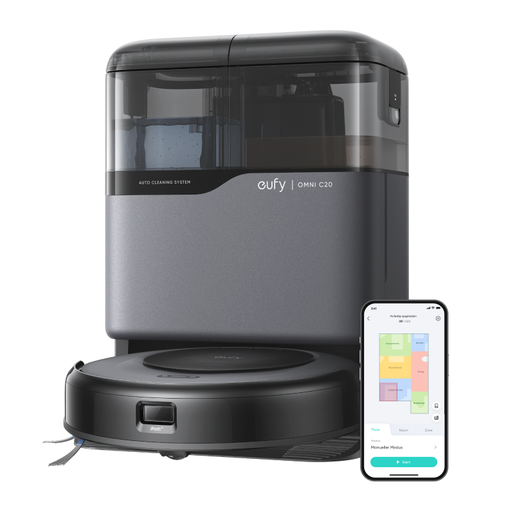
Why it suits this profile: This model combines vacuuming, mopping, emptying, washing and drying in one station. At 8,5 cm tall, it could be useful under low furniture.
As well as 7,000 Pa, the product description mentions a Pro-Detangle Comb and automatic mop care. Do check that your Wi-Fi supports 2.4GHz.
Rated suction power of 7,000 Pa, an 8,5 cm-high robot, mop cleaning and a drying function, according to the product information.

Why it suits this profile: Suitable for larger homes with different floor types and a need for extensive station functions.
The product information specifies TrueMapping 2.0, carpet detection and mop washing with 75°C water. Check the station’s dimensions before you buy.
Rated suction power of 20,000 Pa, mop washing at 75°C, drying at 45°C and multi-floor management, according to the product description.
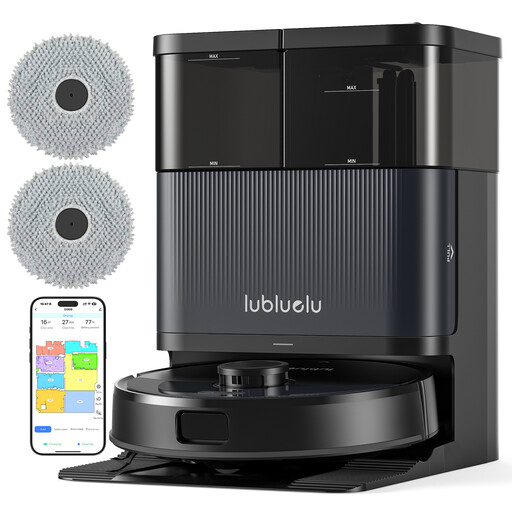
Why it suits this profile: A practical choice for homes with pets, carpets and hard floors, looking for 10,000 Pa and LiDAR navigation.
The product information lists automatic carpet detection, a mop lift and LiDAR mapping. The mop pad, sensors and dust bag will still need regular maintenance.
Rated suction power of 10,000 Pa, LiDAR navigation, automatic emptying and app control, according to the product specifications.
We’ve put together a complete, up-to-date list of products that meet these strict selection criteria and the applicable European safety regulations.
It depends on the features. If you have carpets, look for a model with carpet detection and an automatic mop lift. Check the stated lift height and, if necessary, set no-go zones in the app for delicate rugs. A damp mop isn’t suitable for deep water or a wet floor.
This varies by station and how often you use it. Empty or replace the dust bag or dust container when the app tells you to. Also check the dirty-water tank, mop pads, filters, brushes and sensors regularly. In a home with pets, hair may mean you need to carry out maintenance more often.
As well as the purchase price, you may need to budget for electricity, filters, mop pads, brushes, cleaning products and dust bags. A bagless station doesn’t use disposable dust bags, while a station with a dust bag may mean less direct contact with dust. So compare not just the price of the robot, but also the cost and availability of consumables.
