
Vandaag of morgen in huis

Kwaliteit gegarandeerd

Welkomstaanbiedingen ontgrendelen: GRATIS bezorging | Tot 80% korting | Gratis 30 dagen JoyPlus-proefperiode
Download de app
A robot vacuum cleaner can take care of much of your daily cleaning, but not every model is suitable for every home. A flat with hard floors has different needs from a house with carpets, pets and multiple floors. Features such as mopping, automatic emptying and app control may sound convenient, but they can also involve extra maintenance or limitations.
So don’t focus solely on a high number on the packaging. Above all, check how the robot navigates, which floors it can handle and how much manual maintenance is still required.
A figure such as 8,000 or 20,000 Pa does not tell you everything about everyday performance. Results also depend on the brush, airflow, floor covering and amount of dirt. According to manufacturers’ product information, performance can vary depending on the type and amount of dust.
A robot vacuum cleaner with strong suction is particularly useful for crumbs, sand and pet hair. Also check whether the main brush helps to loosen hair and whether the robot is suitable for both hard floors and carpets.
A basic mop module with a water tank dampens the floor, but it generally does not wash the mop automatically. After use, you will need to remove, clean and dry the cloth yourself. A robot vacuum cleaner with automatic mop washing and drying has a more comprehensive base station and often requires more space.
Pay attention to carpets, too. A mop lift can prevent a damp cloth from travelling over the carpet, but always check the stated lifting height and maximum threshold height.
A robot vacuum cleaner with a self-emptying station needs more space than a standard charging base. For proper operation, the station usually needs to stand flat against a wall, with enough clearance at the sides and front. For example, the JONR T5 Pro specifies at least 0.5 metres on both sides and 1.5 metres in front.
Also check the robot’s height. A low-profile model may fit under a bed or cupboard, while a robot with LiDAR navigation often has a raised sensor on top.
Pa is a technical indication of maximum suction pressure, not a universal measure of quality. So compare several features:
For households with pets, models with an anti-tangle brush or hair-detangling function are practical. For example, the eufy Omni C20 lists a Pro-Detangle Comb which, according to the product description, helps remove hair from the roller brush. According to its product specifications, the Lefant M310 Ultra has maximum suction power of 6,000 Pa, a HEPA filter and a runtime of up to 170 minutes.
A robot vacuum cleaner with LiDAR navigation uses laser information to create a map of the room. This can help with systematic cleaning, multiple rooms and configurable no-go zones. However, check that the app is compatible with your Wi-Fi network. Some models support 2.4 GHz only, such as the eufy Omni C20 and the Eureka E20 Plus.
Obstacle recognition is useful for cables, shoes and toys, but it does not automatically clear the floor. Remove loose cables, small objects and fragile items before starting a cleaning cycle. This is also important for the safety of children, pets and the appliance.
A self-cleaning station can combine several tasks:
More automation does not mean that maintenance disappears. Water tanks still need to be emptied and cleaned, filters must be put back once dry, and brushes can still collect hair. If the station has drainage and a water supply, you should also check whether it can be installed in your home.
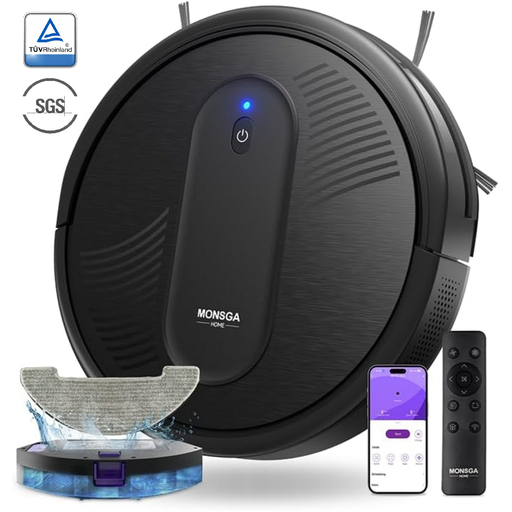
Why it suits this profile: This model is designed for basic cleaning on hard floors, low-pile carpets and in homes with pet hair. According to the product information, it can be controlled via remote control, app or voice assistant.
The stated height of 3.2 inches and the specified suitability for hard floors and low-pile carpets make its intended use clearer than a general claim that it works on all floors.
4,000 Pa according to the product name, up to 140 minutes of runtime, and control via app, remote control and voice assistant.
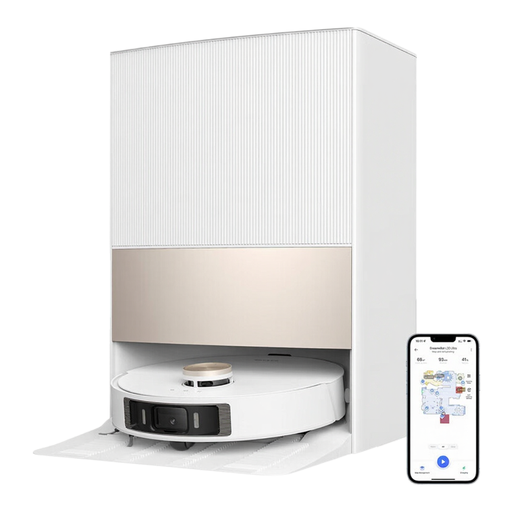
Why it suits this profile: If your priority is reducing manual work, the product description says that the station can empty the dust container, wash the mops, dry them with warm air, refill the water and add detergent.
The product information clearly describes which station functions are included. However, check the space required and the maintenance of the water and dust containers beforehand.
7,000 Pa according to the product description, a 6,400 mAh battery, and a station with a 3.2-litre dust bag and 4.5-litre clean-water tank.
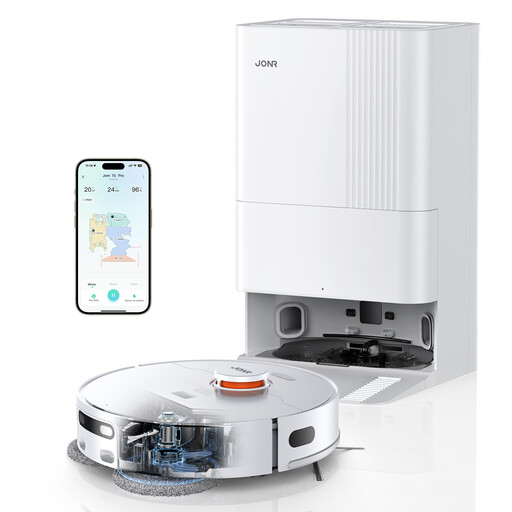
Why it suits this profile: This model is worth considering for larger households that want to combine LiDAR navigation, obstacle avoidance, mopping and an all-in-one dock.
The installation instructions specify the clearance required around the station and remind you that the dirty-water tank and dust bag still require maintenance.
8,150 Pa according to the product name, LiDAR navigation, an anti-tangle side brush, app control and warm-air drying.
We have put together a complete, up-to-date list of products that fully meet these strict selection criteria and the applicable European safety regulations.
Use this quick checklist before ordering a robot vacuum cleaner:
Fully charge the robot, remove loose cables and small objects, and leave internal doors open while it maps your home. Also check stairs, edges and places where the robot could become stuck. Then use the app to set cleaning times, no-go zones and suction levels.
Service life depends on usage, maintenance and the availability of spare parts. Clean the brushes and sensors according to the manual, keep the filters free from dust, and do not leave wet mop cloths in the appliance for extended periods. A model with extensive automation also has more components that require periodic attention.
In addition to the purchase price, you may need to pay for dust bags, filters, mop cloths, cleaning solution and electricity. A station without a dust bag can save on recurring bag costs, while a system with hot water, drying or automatic water supply may have different consumable and maintenance costs. So don’t compare only the price of the appliance; consider its maintenance requirements, too.
