
Walker with a light bag
You want to take a quick riverside panorama while out and about, without carrying extra lenses. The Dutch Consumers’ Association highlights size and zoom range as factors to consider when choosing a camera.


First, choose the field of view you need from the riverbank, then decide how much weight and how many separate items you want to carry. A compact camera with a fixed wide-angle lens keeps your kit simple, a travel zoom lets you frame distant buildings too, and a small mirrorless camera gives you the option to use a different lens. For twilight photos, stabilisation and finding a stable place to set up are separate considerations; a wide zoom range alone says nothing about low-light performance.
You want to take a quick riverside panorama while out and about, without carrying extra lenses. The Dutch Consumers’ Association highlights size and zoom range as factors to consider when choosing a camera.
You stay on one riverbank and want to frame individual buildings as well as the wider view. Compare the optical zoom range: Panasonic lists a 24–720 mm full-frame equivalent for the LUMIX TZ99.
You want to capture illuminated buildings and reflections around sunset, and are wondering whether you can set the camera up securely. Canon recommends the blue hour for cityscapes and describes shooting from a low viewpoint by the water as a compositional choice.
Start with the widest field of view you need from the riverbank. Then compare portability, twilight use and the flexibility to frame distant details.
| What to consider | What should you look for? | Who is this important for? |
|---|---|---|
| Fitting the whole skyline in the frame | Compare focal lengths using their full-frame equivalents and check whether the widest setting is enough from your chosen spot. Ricoh lists approximately 28 mm for the GR IV; Panasonic gives 24 mm as the widest setting on the TZ99. | If I want to capture the whole river view from where I’m standing, I look at the widest field of view first. Around 31% of consumers say panoramas are their main concern when buying. |
| Carrying the complete kit | Compare the camera’s weight and dimensions with the lens attached and any other items included. Canon lists the EOS R50 body at approximately 375 g including a card and battery; this is not the weight of a complete kit. | If I want to carry as little as possible on a walk, I consider the weight of the complete setup, not just the camera body. Around 25% of consumers give portability top priority. |
| Taking photos at twilight | Check what stabilisation the exact camera-and-lens combination offers and whether you can set the camera down securely where you’ll be taking photos. Stabilisation won’t prevent moving water or people from appearing blurred. | If I want to photograph buildings and reflections after sunset, I consider stabilisation and a stable setup separately. Around 25% of consumers say twilight photography is their main concern when buying. |
| Buildings on the opposite bank | Check whether the camera has optical zoom or whether you can choose a suitable additional lens. Remember to factor in the extra bulk of an interchangeable-lens kit. | If I want to make a building on the opposite bank look larger in the frame, a narrower optical field of view is more useful than a wide panorama alone. Around 19% of consumers give distant architectural details top priority. |
The stated weight of the Canon EOS R50 body is not the same as the weight of the camera with a lens and other items. The complete setup determines what you’ll be carrying.
Compare the full contents and weight of the exact kit with those of a camera with a fixed lens.
An extra lens or separate accessories also take up space on a walk.
The range listed by Panasonic for the TZ99 describes framing, not how the camera performs in low light.
Choose a zoom based on the framing you want, and assess evening use and the option of setting the camera up securely separately.
A specific Canon bundle is listed as including items such as a lens, card, bag and spare battery; another kit may have different contents.
Check the contents of the specific product listing and compare the complete kit before choosing.
If you need a different lens or a missing item, you may have to buy it separately.
The GR IV is a compact fixed wide-angle option for anyone who mainly wants to capture a sweeping view from the riverbank.
The LUMIX TZ99 is a travel zoom option for anyone who wants to frame both a wide view and distant details from one spot.
The EOS R50 with RF-S 18-45mm is a small mirrorless kit for anyone who may want to choose another compatible lens later.
Sony E-mount APS-C is worth considering if you’re looking at an interchangeable-lens kit with a retractable standard zoom.
This selection includes pocket and compact cameras, as well as a Sony ZV-E10 kit with a 16–50mm zoom lens. Compare the camera type, zoom and included items with what you want to photograph from the riverbank.
 No image available
A pocket gimbal camera for anyone looking for a compact camera for photos and video.
Listed features include a 1″ CMOS sensor, 2× lossless zoom, 3-axis stabilisation and 107 GB of built-in storage. The product name mentions 4K/240fps video and a rotating 2″ screen.
 No image available
A pocket camera for anyone considering a compact camera for photography and video.
Listed features include a 1″ CMOS sensor, 3-axis stabilisation and a rotating 2″ touchscreen. The product name mentions 4K/120fps video; the description gives a weight of 179 g.
 No image available
An interchangeable-lens kit for anyone who wants to start with a standard zoom and have the option of choosing another compatible lens later.
The kit includes a 16–50mm lens, and the description lists a 24.2 MP APS-C sensor. Digital stabilisation in Active Mode is mentioned for video. According to the description, an SD card and adapter/charger are not included.
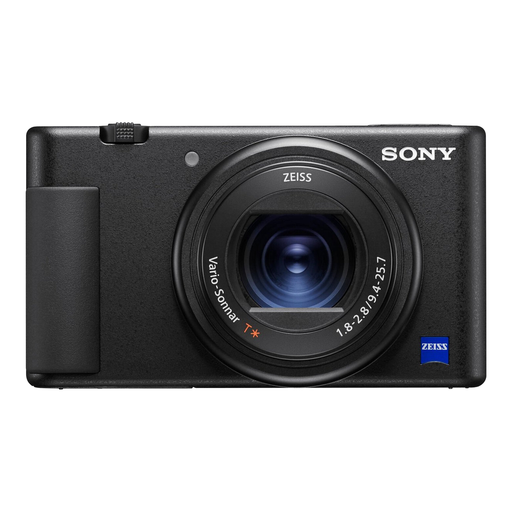 No image available
A compact camera for anyone looking for a fixed lens that offers both wide and tighter framing.
The listed specifications include a 1-inch sensor, 24–70 mm, 2.7× optical zoom and image stabilisation.
 No image available
The product name describes this as a pocket camera for photography.
The description lists autofocus and Full HD video. The stated 16× zoom is digital, which is not the same as optical zoom for distant architectural details.
From the spot you plan to use, decide whether the whole river view will be your main subject or whether you also want to make one building on the opposite bank look larger. Ricoh lists a fixed field of view of approximately 28 mm full-frame equivalent for the GR IV; Panasonic lists 24–720 mm full-frame equivalent optical zoom for the TZ99.
Canon recommends the blue hour for cityscapes and describes using a low viewpoint by the water, possibly with a tripod, as a compositional choice. Check that you can place the camera somewhere safe and stable; moving water can look different with a longer exposure than it does in a handheld shot.
According to the Dutch government, if there’s a problem with a product, the retailer—not the manufacturer—must provide a solution. Check separately what any extra warranty on offer covers.
This depends partly on how you use the photo. The Dutch Data Protection Authority explains that recognisable people in photos count as personal data, so privacy rules are relevant when taking and publishing images.