
Filming shiny stamps
You shoot close-ups where reflections on the paper or a protective sleeve can obscure details, and want to adjust the direction of the light. ULANZI recommends checking for reflections in your footage.


A dimmable ring light with a suitable camera mount can work well for stamp close-ups, provided a test recording shows even lighting without distracting reflections. If glare on the paper or protective sleeve obscures details, change the angle of the light or try adjustable, diffused lighting. Set the white balance too, and check a short video for flicker.
You shoot close-ups where reflections on the paper or a protective sleeve can obscure details, and want to adjust the direction of the light. ULANZI recommends checking for reflections in your footage.
You want to capture stamp colours and the white background consistently. Canon Europe explains that white can take on a colour cast if the white balance is not set appropriately.
You film from above or at an angle over a table and want to check that the tripod, camera mount and power supply will fit in the space available. Canon Europe highlights a tripod as a useful way to keep framing consistent.
Start by filming your own stamps. This will show you whether the light brings out the details and whether glare or flicker affects the picture.
| What to consider | What to look for | Who is this important for? |
|---|---|---|
| Reflections and details | Check whether you can dim the light and change its angle. Make test recordings with a loose stamp and, if applicable, a protective sleeve. | If glare obscures details on my stamp or sleeve, I want to be able to adjust the angle of the light; around 33% of consumers say controlling reflections is their top priority. |
| Stamp colours and white background | Compare the stated colour temperature of the exact model, and test the light with a fixed white balance on your own camera. An adjustable light does not replace setting the white balance. | If I want to capture colours and a white background consistently, I need to consider both the light and the camera settings; around 27% of consumers say colour and white are their first considerations. |
| Camera position and workspace | Measure the available table space and filming height. Check that the holder fits your phone or camera and that you can position the light at the angle you want. | If my camera needs to be positioned above or at an angle over the table, I want to know whether the tripod and mount will fit; around 20% of consumers say mounting and workspace are their top priorities. |
| Flicker during video recording | Record a short video using the brightness and camera settings you intend to use. If you notice flicker, check which flicker-reduction settings your camera offers. | If I want to record longer videos without distracting flicker, I test the light with my camera; around 20% of consumers prioritise a stable video image. |
Canon Europe highlights the importance of white balance for how whites and colours appear. Nikon explains that flicker is influenced in part by camera settings and the lighting used. The results of a test recording therefore depend on the combination of light, camera and setup.
Reflections on a stamp or protective sleeve depend on the filming angle. An example setup won’t show how your own stamps will look.
Make a test recording of the stamps you plan to film. Change the angle of the light if glare obscures details.
The camera’s white balance and ambient light also affect how colours and the white background appear on screen. A stated CRI value alone does not guarantee that colours will look right in your footage.
Compare the specifications for the exact version, then test the light with the background, stamps and camera settings you plan to use.
A tripod or phone holder won’t automatically suit every table, camera or desired filming angle. The power supply you need is also worth checking.
Before buying, compare the exact contents of the set, connection and dimensions with your camera and workspace.
The SRP18-2.4G is designed for a larger, fixed ring light setup with a phone or camera mount.
The LUMIS Comfort Bi-Color is designed for a compact smartphone setup with a tripod and a tilting ring.
The SpotLight FoldUp 102 II is a folding ring light set for smartphone recording, with storage space in mind.
The Ring Light is an example of a desk-mounted light with a camera mount and adjustable colour temperature.
These product picks are ring lights for smartphone videos, selected with adjustable lighting and a practical setup in mind. Check the version on offer, including its power supply, and make a test recording before starting a longer shoot.
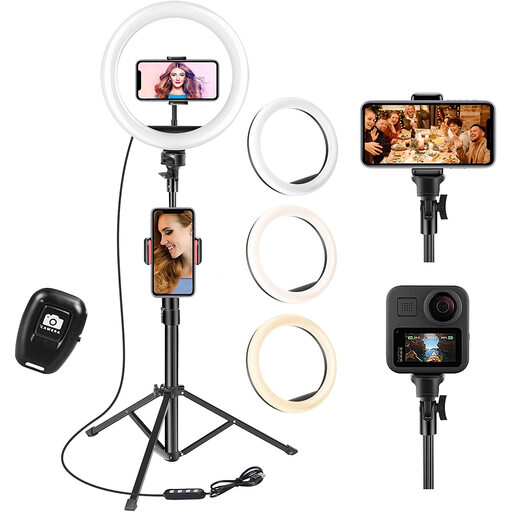 No image available
An option for smartphone videos if you want to adjust the light’s brightness and colour.
10 inch; remote control; 3 colour modes; 10 brightness levels. Check that the included holder and power supply suit your setup.
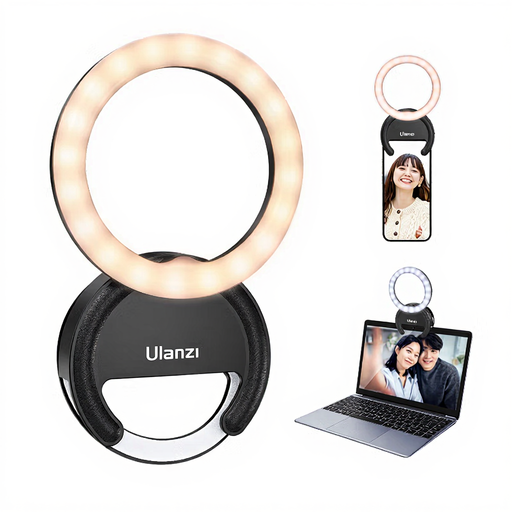 No image available
Worth considering if you’re looking for a compact light that attaches directly to a smartphone.
4 inch; 3 colour temperatures from 3000 K–7000 K; 5 brightness levels. The light attaches directly to a smartphone.
No, it depends on the reflections in your footage. Check whether glare obscures the printed design or details. If it does, change the angle of the light or try adjustable lighting with a diffuser.
Where possible, use a fixed lighting setup and adjust your camera’s white balance to suit it. Canon Europe explains that white can take on a colour cast without correction; a light with an adjustable colour temperature won’t automatically solve this.
Check the camera mount and the direction of the light, then review a short video for reflections and flicker at your preferred brightness. Nikon explains that flicker is influenced in part by camera settings and the lighting.
According to the Dutch government’s Rijksoverheid, you generally have a 14-day cooling-off period when buying at a distance. If there’s a fault, you can claim under the seller’s statutory guarantee; in the Netherlands, there is no fixed statutory time limit for this.
No. According to Business.gov.nl, CE is not an independent quality mark. It is a marking by which the manufacturer declares that the applicable EU rules have been met. The rules that apply depend in part on the version, so check the power supply too.