A ring light is a good fit if its mount can achieve the camera angle you need and the setup does not get in the way in your shared workspace. First, work out how to show both your hands and your weaving at the same time, then check that the tripod, mount and power supply are suitable. Front lighting can reduce shadows, while angled light can bring out texture; Nikon USA explains how shadows can reveal depth and texture.
Who is this for?
Weaver filming their work from above
You want to show your hands, tools and the relevant part of your weaving all at once. So consider the camera angle, mount and light position together. Product information from NEEWER and Godox describes their accessories, but it cannot confirm whether your specific filming angle is achievable.
Teacher explaining yarns and weave structure
You want colour differences and the way the threads run to be clear on camera. Compare front and angled lighting, and set the white balance to suit the existing light. Canon Europe and the U.S. Department of Energy explain aspects of white balance and colour rendering.
Maker working in a space that changes
You want to set up your lighting and recording equipment without occupying the shared space for too long. Consider the support, power supply and cable route; the Godox manual and Ulanzi product information describe different power and accessory options.
What should you look for?
Start with the camera angle you need and check that the setup will physically accommodate it. Then record a test clip to see how the lighting, yarn colours and available space work in your workshop.
| What to consider |
What should you check? |
Who should prioritise this? |
| Camera angle and clear workspace |
Try out the camera angle you want and check that you can see your hands, the mount has enough range of movement, and there is room around the support. |
If I want to film my hands and weaving at the same time, the mount needs to achieve the right angle without blocking my workspace. Around 33% of consumers put a clear filming angle first. |
| Yarn colour and thread texture |
Compare test clips using your actual yarns, under your workshop lighting and with both front and angled light. Manufacturer specifications, such as the NEEWER RL-18’s CRI of 95 or the Godox LR150’s 3000–6000 K range, do not replace this check. |
I want to be able to judge both the yarn colour and its texture in the footage. Around 27% of consumers put colour and texture first. |
| Setup, power and sharing the space |
Check the support, what is included in the kit, the power supply and the cable route. The Godox LR150 manual lists an adapter and phone holder; no tripod is included in the listed components. |
In a workspace that changes, I want a setup that does not obstruct a walkway or someone else’s work area. Around 20% of consumers prioritise setup, power and sharing the space. |
| Light control and video banding |
Film at your preferred brightness with the other workshop lights on, then review the clip. Nikon explains that LED lighting can cause banding in video in certain circumstances. |
If I’m filming under LED lighting, I want to know whether my camera settings and the existing workshop lights will cause distracting bands. Adjustable, stable video lighting is the top priority for around 20% of consumers. |
Common pitfalls
-
Assuming a phone holder automatically gives you an overhead view
A holder included in the box does not guarantee that you can position the camera above your weaving or achieve the angle you want.
First decide on the camera angle you need, then check the movement range and fittings on the exact kit.
Some setups may need a separate, suitable arm or support.
-
Assuming a high colour-rendering score guarantees accurate yarn colours
Ambient lighting and your camera’s white balance also affect how colours appear in your footage.
Record a test clip with your actual yarns under the lighting you’ll be using for the demonstration.
-
Treating every version of a portable ring light as a complete kit
Ulanzi describes the U200 as available both as a light-only version and in more extensive kits; the accessories vary by version.
Check what comes with the specific bundle before you order.
A light-only version may need a separate holder or support.
-
Using only even front lighting to show thread texture
Front lighting can reduce shadows, but shadows can help to reveal texture.
Compare front and angled lighting while carrying out the same weaving action, and look out for shadows cast by your hands too.
Angled lighting may require a different position or an additional mount.
Brands to consider
NEEWER
The RL-18 is an example of a larger ring light kit for a permanent filming setup.
- NEEWER says the RL-18 has a 45 cm ring, a tripod and a stated CRI of 95.
- The stated light colours are achieved using white and orange filters. Check that the tripod and mount allow for your camera angle.
Godox
The LR150 is worth considering if you want to control brightness and colour temperature separately.
- The Godox manual says the colour temperature can be adjusted from 3000–6000 K; the adapter and phone holder are listed as included components.
- No tripod is listed among the components. The manual also advises against using the light in damp conditions.
Ulanzi
The U200 is an example of a portable ring light setup with a battery.
- Ulanzi lists a built-in battery and a 1/4-inch mount.
- Several versions are available. Check which accessories come with your chosen bundle and whether the battery life is sufficient for the brightness you need.
Elgato
The Ring Light is an example of a ring light with a desk clamp and device controls.
- Elgato lists an adjustable colour temperature and a clamp for this model.
- Elgato classifies the Ring Light as legacy/EOL and warns that the technical information may not match current hardware and software.
Ring lights at Joybuy
These product options are aimed at ring light setups for filming a weaving demonstration, with either a tripod or a compact phone setup.
 No image available
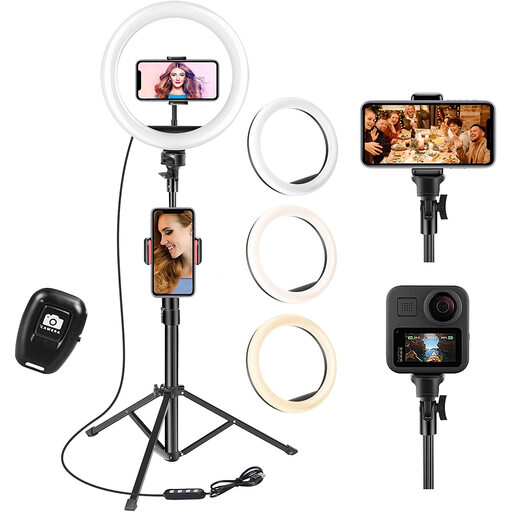
10-inch ring light with 63-inch tripod, remote control, 3 colours and 10 brightness levels
An option if you’re looking for a ring light with a tripod for a fixed video setup; check that you can position it to achieve the camera angle you need.
The product title lists a 10-inch ring, a 63-inch tripod, 3 colours and 10 brightness levels.
View at Joybuy
 No image available
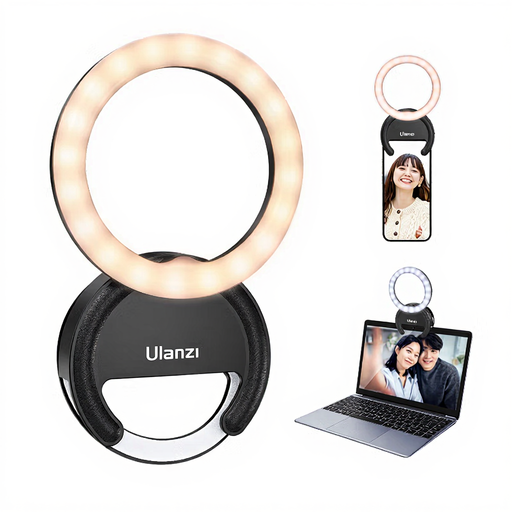
ULANZI 4-inch phone ring light, 3 colour temperatures (3000 K–7000 K), 5 brightness levels
A compact option if you’re looking for a ring light for phone videos; check that the mount fits your phone and works with your preferred camera angle.
The product title lists 3 colour temperatures from 3000 K–7000 K and 5 brightness levels.
View at Joybuy
Frequently asked questions
Is a ring light enough to show the texture of the weaving?
Not always. Front lighting can reduce shadows, while shadows can help to reveal depth and texture. Compare a test clip with the ring light in front of your work and then with the light angled from the side.
How can I stop yarns looking like a different colour in my video?
Compare your footage with the actual yarns under the lighting you’ll be using for the demonstration, and adjust the camera’s white balance accordingly. A CRI rating or adjustable colour temperature alone cannot guarantee accurate colour under mixed lighting.
What should I check when setting up in a shared workshop?
Check that the mount can achieve the camera angle you need, tripod legs are kept clear of walkways, and any power cable can be routed safely. Also check what comes with the exact kit: the Godox LR150 manual lists an adapter and phone holder, but no tripod among the listed components.
What can I do if horizontal bands appear in my test video?
Test with the other workshop lights on and compare the available camera settings and lighting modes. Nikon explains that LED lighting can cause banding in certain circumstances; this does not tell you which light is causing it in your setup.


