
Weaver filming close-up details
You want to show stitches and hand movements up close without the camera or light getting in the way. This is in line with Ulanzi’s set-up advice.


For a close-up weaving demonstration, a dimmable ring light beside the camera can be a simple starting point. First, check that the light, camera and mount can all be positioned without getting in the way of your hands. For a wide loom or clearly visible weave texture, additional light placed at an angle may work better than ring light alone from the front. Test your yarn colours and check for possible light banding in a test recording: manufacturer specifications won’t automatically predict the results in your set-up.
You want to show stitches and hand movements up close without the camera or light getting in the way. This is in line with Ulanzi’s set-up advice.
You want to show more of the loom in a single shot, so you need to consider both the lighting and the space needed for the tripod and your hands. Ulanzi’s set-up advice and NEEWER’s model specifications are relevant to this decision.
You want to be able to repeat your lighting settings between recordings and avoid ambient light or coloured effects affecting the comparison. NEEWER describes models with adjustable white light and RGB controls, among other features.
First decide which part of the loom you want in shot and how much space you have. Then choose the lighting settings and mounting option to suit your camera and recording space.
| What to consider | What should you check? | Who should give this more weight? |
|---|---|---|
| Visibility of the weave texture | Compare front lighting with angled lighting in a test recording; look at the texture and your moving hands. | If I film stitches close up, I want the texture and my hands to be clearly visible without the light getting in the way of my work. Around 28% of consumers prioritise seeing the weave texture and hands clearly. |
| True-to-life yarn colours | Test the yarns you actually use and repeatable white-light settings in your studio’s ambient light. | When I compare yarn colours, I want to avoid changing the image with a different lighting setting. Around 22% of consumers prioritise true-to-life yarn colours. |
| Clear workspace and mounting | Check there’s room for tripod legs, your hands and cables, and test that your phone or camera fits. | If I film more of the loom, I want to be able to move my hands freely and position the camera securely. Around 22% of consumers prioritise a clear workspace and a suitable camera mount. |
| Consistent light in video | Record a short clip at the dimming levels you use and check for visible light banding. | When filming movement, I don’t want distracting bands to appear in the recording. Around 17% of consumers prioritise consistent lighting in video. |
| Power and session length | Compare the power supply with your planned recording time, and keep cables and the adapter out of your workspace. | If I film for a long time or can’t work near a socket, I want to know whether the power supply will suit my session. Around 11% of consumers pay most attention to power and session length. |
Front lighting can reduce shadows, but it won’t automatically make the texture of the yarn clearer. Your hands, the light and the camera may also get in each other’s way.
Film the widest work area and your full range of hand movements first. If needed, compare a recording with angled light against one with only the ring light on.
The bundle may vary by version. For example, Ulanzi describes the U200 as being available in several bundle options, while the NEEWER RL-18 is described as a set with a tripod and phone holder.
Check the exact version and what’s in the box against the camera and mount you want to use.
If the version you choose doesn’t include a suitable holder or tripod, you may need to buy a mount separately.
Elgato has marked its Ring Light as discontinued and its technical support as legacy. BRESSER also lists the MM-26AB as no longer available.
Check the current status of the exact model and don’t base your choice on an older list alone.
The RL-18 and SRP18C are examples of sets with different control options. When choosing, consider how much space you have around your weaving.
The LR150 is worth considering if you want to adjust the colour temperature and brightness directly.
According to Ulanzi, the U200 combines a portable ring light with a camera ring set-up. It may be worth considering if you want to move your camera set-up around.
The Ring Light is a reference point for a light with a clamp and adjustable output, but the manufacturer has marked this model as discontinued.
This selection includes ring lights for filming on a phone, from a compact light that clips onto your phone to a tripod set-up. Check that the mount and positioning work with your camera, hand movements and loom.
 No image available
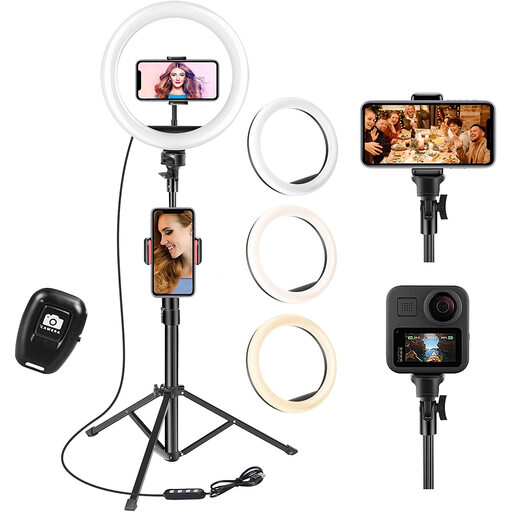
An option for a phone set-up, with the light positioned beside the loom.
The product description lists three adjustable colour temperatures, ten brightness levels, a remote control and a phone holder. It says the tripod adjusts from 44 to 156 cm.
 No image available
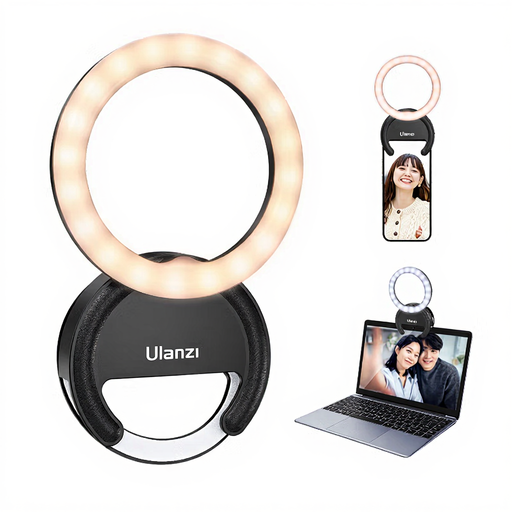
This compact version is designed for close-up phone recordings; the description says the light clips onto a smartphone.
The product title lists three colour temperatures, from 3000 K to 7000 K, and five brightness levels.
First decide which part of the loom you want in shot and how you move your hands. Then position the camera, light and cables, and check that you can work freely. Also make sure the mount is suitable for your camera’s size and weight.
Record a short video using the yarns, ambient light and dimming setting you’ll actually use. Compare the colours with the yarn and check for visible bands while there’s movement. The stated CRI or a claim about flicker doesn’t replace a test recording.
Yes. The Netherlands Food and Consumer Product Safety Authority states that CE marking is mandatory for electrical products. The technical requirements that apply depend in part on the light’s and power supply’s electrical design and voltage. A declaration for a different model doesn’t prove anything about the ring light you’re buying.
For online consumer purchases, you generally have a 14-day cooling-off period, according to the Government of the Netherlands. You’re also covered by the statutory guarantee; in the Netherlands, there is no fixed statutory time limit. If a product is faulty, contact the seller. Before buying, check who the seller is and which version will be supplied.
Milieu Centraal says you can hand in a broken electrical appliance free of charge when you buy a new, similar appliance. There are also collection points for small appliances. Where possible, remove any detachable battery from the appliance separately.