An adjustable ring light on a stand is a good choice if you want to illuminate your hands and a defined area of the weaving evenly; check that the mounting and power supply suit your setup. To bring out the yarn’s texture, angled fill light may work better than front lighting alone: Nikon explains how shadows can reveal depth and texture. Compare your yarns and existing artificial lights in a test clip, checking for colour differences and flicker. The U.S. Department of Energy notes that lights which appear to have the same shade of white do not necessarily render colours in the same way.
Who is this choice relevant to?
Weavers showcasing yarn colours
If you demonstrate colour combinations, you’ll want to see how the yarn looks under your filming lights. Look for adjustable colour temperature, information about colour rendering and how the light performs alongside your existing lamps. The U.S. Department of Energy explains that lights which appear to be the same shade of white do not necessarily render colours in the same way.
Weavers explaining techniques and texture
If viewers need to follow the yarn’s path and your hand movements, compare even front lighting with a test shot using angled light. Nikon explains how shadows can bring out texture and depth.
Solo weavers filming at the loom
If you’re operating the loom and camera at the same time, look for a stable mount and settings you can adjust without moving your filming position. Check that the light and holder suit your setup.
What should you look for when choosing?
First, decide how you want to light your hands and work area. Then compare colour rendering, shadows and how all your lights work together in a test recording.
| What to consider |
What to look for when buying |
Who should pay particular attention? |
| Yarn colours under artificial light |
Look for information about colour rendering and adjustable colour temperature. Compare the same yarns in a test recording alongside your existing lights. |
If I’m demonstrating yarn colours, I want to see how they look on camera alongside my other lights. Around 31% of consumers considering a ring light for this type of weaving demonstration prioritise yarn colours that look true to life. |
| Yarn movement and woven texture |
Film the same action with front-facing ring light and with angled light; compare which details remain visible for your explanation. |
If the yarn’s path and the fabric’s texture are important to my explanation, I want to see what the shadows add to the footage. Around 25% of consumers make visible texture their top priority. |
| Flicker in video |
Record a test clip at the brightness setting you plan to use. With a mains frequency of 50 Hz, Sony lists shutter speeds of 1/50 or 1/100 second as possible settings for reducing flicker; check what your camera offers. |
If I’m filming under artificial light, I want to avoid bands or changes in brightness interrupting my explanation. Around 25% of consumers prioritise footage with no visible flicker. |
| Positioning and power supply |
Check the working height, stand or clamp, holder, supplied power source and cable routing for the exact version. |
If I’m filming alone, the light needs to be stable without blocking the space I need to move around the loom. Around 19% of consumers prioritise a practical, stable setup. |
Common pitfalls
-
Judging by colour temperature alone
Two light sources that appear to have a similar colour do not necessarily render yarn in the same way. The U.S. Department of Energy explains that white light which appears to be the same colour can come from different light spectra.
Check the colour-rendering information and make a test recording with your own yarns alongside your existing artificial lights.
-
Assuming shadow-free light is always better
Fewer shadows can give you a clear overview, but shadows can also help reveal the yarn’s texture and depth. Nikon explains how light and shadow can be used to bring out texture.
Compare front-facing ring light with angled light before settling on your final setup.
-
Assuming accessories are always included
The stand, holder and power supply vary between versions. A light that can’t be positioned where you want it may restrict your movement.
Check the contents list and mounting points for the exact model, not just the product photo or model range.
You may need to buy a stand, holder or power supply separately if it isn’t included with the version you choose.
-
Treating a CE mark as an independent product test
Business.gov.nl explains that CE is not a quality mark. Where the light and supplied power source fall under applicable EU rules, the manufacturer must assess whether they meet the relevant requirements.
Check the product documentation for the exact light and power supply, and assess the lighting in a test recording too.
Brands to consider
NEEWER
NEEWER offers the SRP18-2.4G, among other products: a ring light with a stand and phone holder for a fixed setup.
- According to NEEWER’s product specifications, the SRP18-2.4G has adjustable colour temperature, CRI 95 and a stand that extends from 78 to 190 cm.
- These figures don’t measure how the light will perform at your loom. Check the exact version and power supply before buying.
Godox
The Godox LR150 is a ring light with adjustable colour and brightness for a fixed filming position.
- The LR150 manual lists an adapter and phone holder, a colour temperature of 3000–6000 K and CRI 90.
- The manual says to keep the light dry. Don’t assume other Godox models have the same specifications.
R2B
R2B offers the Groningen model as a ring light with a stand and smartphone holder.
- R2B’s product information lists the included setup options.
- Don’t make assumptions about colour rendering or performance at your workstation; assess the exact version in a test recording.
Ulanzi
The Ulanzi U200 is a compact, rechargeable ring-shaped video light for use with a camera or phone.
- Ulanzi lists a built-in battery, adjustable colour, CRI 96+ and 500 lux at 0.5 m for the U200.
- The stated illuminance at that distance doesn’t prove that a wide loom will be lit evenly. The contents vary between kits.
Falcon Eyes
Falcon Eyes lists the DVR-384DVC in its range of ring lights.
- The model name DVR-384DVC appears in Falcon Eyes’ product overview.
- Features of other models don’t necessarily apply to the DVR-384DVC; only assess information about the exact version.
Ring lights at Joybuy
These products are suited to a fixed ring light setup or a compact light attached to a smartphone for filming your weaving.
 No image available
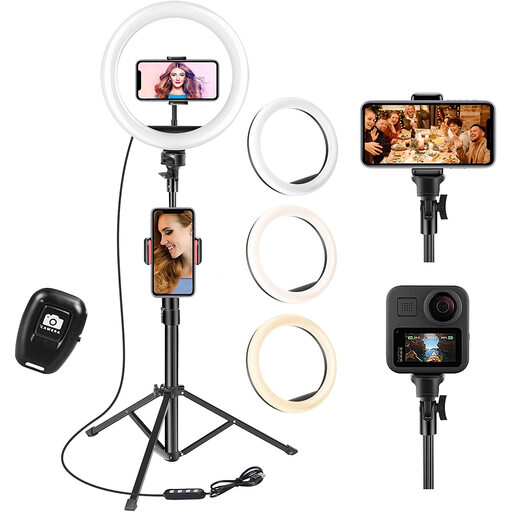
Ring Light with Tripod, 10 inch, 3 Colors, 10 Brightness Levels
A ring light with a stand and phone holder could suit a fixed phone setup beside the loom.
The product description lists 120 LEDs and a phone holder; the product name specifies 10 inch, three colour temperatures and ten brightness settings. Check which accessories are included with the exact version.
View at Joybuy
 No image available
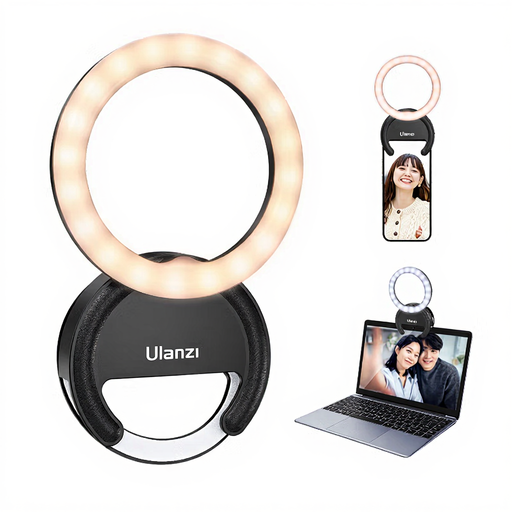
ULANZI 4 inch Phone Ring Light, 3 Color Temperatures, 5 Brightness Levels
A compact light that clips onto a smartphone could suit you if you mainly shoot close-ups and have little space beside the loom.
The product name lists three colour temperatures, from 3000K–7000K, and five brightness settings. Check that the clamp fits your phone and that the light covers the area of the work you want to show.
View at Joybuy
Frequently asked questions
How can I check whether artificial light flickers in my video?
Record a short clip with all your lights on and set to the brightness levels you want to use. If you see bands or changes in brightness, check your camera’s shutter speed. For a mains frequency of 50 Hz, Sony lists 1/50 or 1/100 second as possible settings; this doesn’t guarantee the same result with every camera and light combination.
Can I use a ring light right next to the loom?
Yes, as long as the stand, cable and camera support don’t encroach on the space you need to move around. Keep the light dry and follow the instructions for the exact version; for example, the Godox LR150 manual warns against use in damp conditions.
What costs and rights should I consider when buying online?
Check whether the set includes a suitable stand, holder and power supply so you know which parts you may need to buy separately. According to the Dutch government, consumers buying online generally have a 14-day cooling-off period. In the Netherlands, you’re also entitled to a product that works as it should; there is no single statutory guarantee period for all products.
Does a CE logo prove that a ring light is safe?
No. CE is not a quality mark or an independent test. For electrical equipment covered by applicable EU rules, the manufacturer uses the CE mark to declare that the relevant requirements have been met. Business.gov.nl stresses that you need to establish which rules apply to each product.
What should I do with a discarded electric ring light?
Dispose of the light separately as electrical and electronic equipment; don’t put it in general waste. The European Union specifies the crossed-out wheeled bin symbol for this type of equipment, among other requirements.


