First, choose a setup that lets the camera and light reach your work surface without getting in the way of your hands. Then compare how adjustable the light is and take test shots of the fabric and stitches. A ring light can reduce shadows around the camera, but light from the side can make texture more visible. Also check that the camera mount, power supply and included accessories suit your filming space.
Which setup is right for you?
Repair detail filmmaker
You film needles, thread and stitches close up, and want to check whether front lighting shows enough texture. Nikon explains how light and shadow affect the visibility of details; NEEWER describes the differences between light sources and lighting positions.
Online shop owner focused on colour accuracy
You show fabric and repair materials alongside your tutorial video and want to keep the lighting and white balance as consistent as possible between shots. Canon Europe explains how to set the white balance, while NEEWER provides model specifications for its lighting settings.
Maker with a small worktable
You film with a phone and need a light you can position without taking away the space your hands need to move. R2B’s product information and Ulanzi’s setup tips offer useful pointers for assessing the space around your camera, light and workpiece.
What should you look for when choosing?
First work out where your camera, light and hands can go. Then assess the detail and colour in a test shot before choosing a ring light or additional side lighting.
Compact ring light with phone holder
A good fit if: you film with a phone at a small worktable and can position the light close to a small repair.
Trade-off: a compact ring takes up less space, but its diameter doesn’t tell you how much of your work surface will be evenly lit.
Larger ring light on a tripod
A good fit if: you switch between wider shots and close-ups, and have room to position the tripod away from your hands.
Trade-off: a larger ring light may give you more positioning options, but it also needs more space. Check that the holder fits your camera and that the tripod is stable.
Ring light with side lighting
A good fit if: a test shot with front lighting makes the stitches or edge of a repair look too flat.
Trade-off: directional light can use shadows to show texture, but adding another light source or changing its position makes the setup more complicated.
| What to consider |
What to look for when buying |
Who is this important for? |
| Visible stitches and texture |
Compare dimmable light and a possible side-lighting position in a close-up. |
If I film stitches and fabric edges close up, I want to keep seeing texture rather than a flat, evenly lit image. Around 36% of consumers prioritise visible stitches and texture. |
| Recognisable fabric colours |
Check whether you can repeat your lighting settings, and keep the camera’s white balance consistent. |
When I want fabric and thread colours to stay recognisable between tutorial clips, I look for fixed lighting settings and white balance. Around 29% of consumers give colour consistency top priority. |
| Workspace and mounting |
Check the tripod height, included holder and space for both hands. |
If you film above a worktable, you’ll want to point the camera at the repair without blocking your hand movements. Around 21% of consumers prioritise workspace and mounting. |
| Power and video recording |
Check the power requirements and test the light with your own camera settings. |
If I record for longer periods, I want a suitable power connection and usable footage without visible bands. Around 14% of consumers give power and video recording top priority. |
Common pitfalls
-
Assuming a high CRI rating guarantees accurate fabric colours
A CRI rating is a model specification, but on its own it doesn’t show how fabric will look in your camera footage. White balance also plays a part, as Canon Europe explains.
Compare a test image of fabric and thread under the light you plan to use with the actual materials. Keep your lighting setup and white balance as consistent as possible between shots.
Changing settings can mean extra test shots or colour correction afterwards.
-
Assuming shadow-free front lighting will make every repair step clearer
Front lighting can reduce shadows, but shadows can help show the height and texture of a seam.
Film the same stitch from the front and with a little more light from the side before deciding whether a ring light alone is enough.
-
Comparing ring diameter alone
A ring light is only practical if the camera can see the work surface and your hands can move freely. The mount, power supply and included accessories can also make a difference.
Map out where the camera, light and your hands will go, then compare this with the parts list for the exact version.
Relevant brands to consider
NEEWER
Its range includes the SRP18-2.4G and RL-18, offering different ways to choose your lighting and mounting setup.
- NEEWER specifies a CRI of 95 and a tripod height of 78–190 cm for the SRP18-2.4G. For the RL-18, the manufacturer describes white and orange filters for the listed light colours.
- A stated CRI doesn’t prove that textile colours will look exactly the same in your footage. Also check which accessories are included with each version.
R2B
The Groningen model is a phone kit for anyone looking to use a ring light in a limited filming space.
- R2B lists a 26 cm ring, 30 lighting modes, a phone holder, a tripod extending to 186 cm and USB power for the Groningen.
- The ring diameter and maximum tripod height don’t tell you on their own whether your entire work surface will be in frame. Check the camera angle in your own setup.
Godox
The LR150 is a larger, adjustable ring light sold as a standalone light with a phone holder.
- The Godox manual lists a colour temperature of 3000–6000 K, a stated CRI and TLCI of 90, and a supplied adapter and phone holder for the LR150.
- Check whether a lighting stand is included with the version you’ve chosen; the product listing describes it as an optional mount.
Joybuy products for filming with a phone
These Joybuy products are designed for filming crafts with a phone, from a ring light on a tripod to a compact light that clips onto a smartphone.
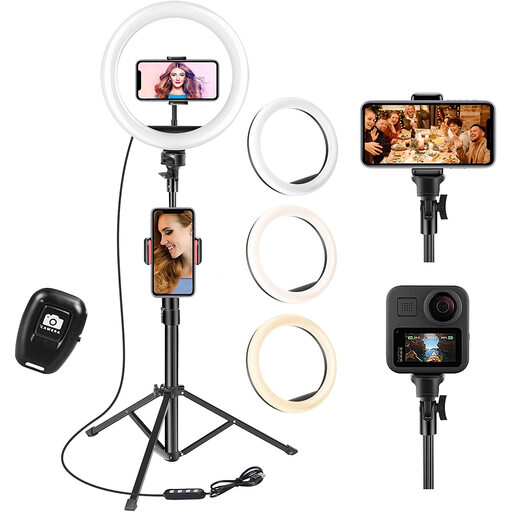 Image unavailable
Ring light with tripod, 10 inch
Suitable for filming with a phone when you want to position a ring light on an adjustable tripod.
The title lists a 63-inch tripod and a remote control. The product description mentions 120 LEDs, three adjustable colour temperatures and ten brightness levels.
View at Joybuy
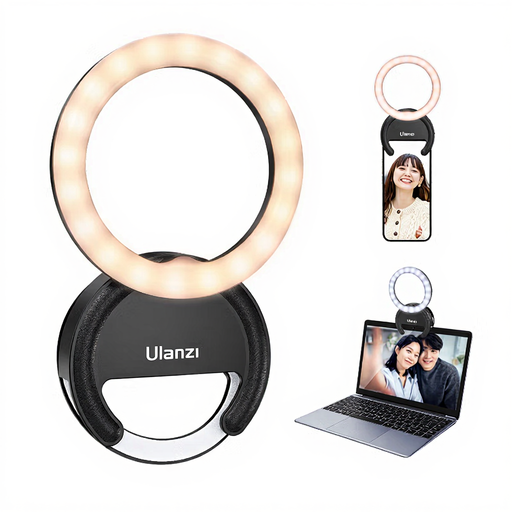 Image unavailable
ULANZI 4-inch ring light for smartphone
Suitable for a compact phone setup, with the light clipping directly onto your smartphone.
The title lists three colour temperatures from 3000 K–7000 K and five brightness levels.
View at Joybuy
Frequently asked questions
Why does the same fabric look a different colour in two shots?
Changes in ambient light and the camera’s white balance can affect the colour shown. Keep your lighting setup as consistent as possible, and take a test shot with the white balance controlled whenever conditions change.
What can you do if horizontal bands appear in your video under LED lighting?
Test the light with your own camera and recording settings. Sony says that adjusting the shutter speed can reduce flicker effects; the available settings and results vary by camera and filming conditions.
Are a tripod, adapter and phone holder always included?
No, what’s included varies by model and version. Check the parts list against your phone or camera, the power connection at your filming location and the camera position you need.
What should you check for the electrical safety of a ring light in the Netherlands?
Electrical appliances placed on the market in the Netherlands must meet the applicable European safety requirements. The Dutch government describes CE marking and an EU declaration of conformity as the manufacturer’s responsibilities; it also says that the CE mark is not a quality mark.
As an online shop owner, are you automatically entitled to a 14-day statutory return period for a ring light?
No, the statutory cooling-off period for online purchases is generally a consumer right. Business.gov.nl says that consumer law does not usually apply to purchases made by a business, so check the seller’s terms for business orders.


