
Filming with window light as a starting point
You film close to a window but want to bring out dark areas of the page without replacing the daylight altogether. Canon Europe explains how fill light can reduce shadows.


A dimmable ring light can supplement window light when the side of the page facing the camera is too dark. Movable side lighting gives you more scope to avoid reflections on smooth paper. Start by positioning the camera and reviewing a test shot of your own work. Also check what’s included in the mounting kit and whether the relevant CE marking is present.
You film close to a window but want to bring out dark areas of the page without replacing the daylight altogether. Canon Europe explains how fill light can reduce shadows.
You want to keep both hands free and need a stable position for your phone or camera above the open book. Product information from NEEWER, Godox and Ulanzi shows that mounts and kit contents vary by model.
You’re showing drawings, colour swatches or the finish of the paper, and want to assess colour casts and visible reflections in your footage. Canon Europe points out that the appearance of natural light changes with the conditions.
Start by positioning the camera and checking for reflections. Then decide how much fill light you need and assess the colours in a test shot.
| What to consider | What should you check? | Who should pay particular attention? |
|---|---|---|
| Filling in shadows | Check whether the light is dimmable and review a test shot with the window light and ring light used together. | If I can see dark areas on my page, I want to bring out the details without replacing the window light; around 31% of consumers in this situation prioritise filling in shadows. |
| A stable overhead view | Check the camera mount, the reach of the support and what’s included in the kit you’ve chosen. | If I want to keep both hands free, my camera needs to be positioned directly above the book; around 31% of consumers in this situation prioritise a stable overhead view. |
| Assessing colours | Take a test shot of your actual work and check the adjustable colour temperature; don’t treat a stated CRI as a guarantee of the final image. | If I want the paper and drawing colours to look true to life, I need to assess the footage using my own work; around 23% of consumers in this situation prioritise colour rendering. |
| Avoiding reflections | Film a smooth or glossy page and check whether you can adjust the angle of the light, camera or book. | If I’m filming glossy areas, I want to stop reflections from obscuring details; around 15% of consumers in this situation prioritise avoiding reflections. |
The working height and a phone holder don’t tell you whether the camera can be positioned horizontally above your sketchbook.
Work out the camera position you need, then check the mount, reach and kit contents before choosing a setup.
You may also need a suitable camera support.
Window light changes with the conditions, and the camera’s white balance affects how paper and colours are captured.
Review a short recording of your own work using the intended combination of window light and ring light.
A reflection can obscure details, even when the rest of the image looks bright enough.
Test the most reflective page and choose a setup that lets you move the light out of the reflection’s path.
The SRP18-2.4G is a large ring light kit with a phone holder and adjustable stand. It’s designed for a floor-standing setup with enough room.
The LR150 is a dimmable ring light supplied with a smartphone holder. It could suit you if you already have a suitable support or plan to choose one separately.
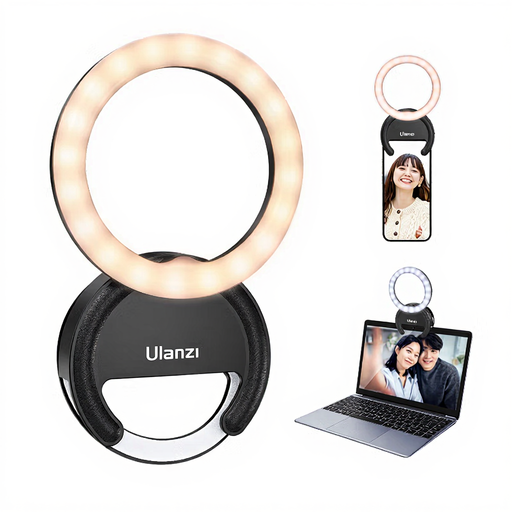
The U200 is a portable ring-shaped video frame for anyone who regularly moves their light or uses their own mounting support.
This product selection is aimed at smartphone videos where you want to be able to adjust the colour temperature and brightness of the fill light.
 No image available
For smartphone videos where you want to adjust the colour temperature and brightness.
The product title lists three colour temperatures from 3000K to 7000K and five brightness levels.
Before buying, check that the relevant CE marking is present on the specific light.
Use the window as your main light first, then add only as much light from the ring as you need. Review a test shot of white paper and your drawing colours. Adjust the white balance again if the light changes; colour temperature and white balance aren’t the same thing.
No. A phone holder included with the light doesn’t prove that the support can reach far enough over your desk. Check the kit you’ve chosen, the mount and the space available. For example, the Ulanzi U200 is also available as a light-only version.
Check the reflection in the camera image and change the angle or position of the light, camera or book. If the ring is still visible, try a movable light source beside the camera instead of simply increasing the brightness.
For eligible online consumer purchases in the Netherlands, you generally have a 14-day cooling-off period, according to the Government of the Netherlands. If a product is faulty, the seller is your point of contact under the statutory guarantee. Check the terms of the specific sale, and don’t confuse an offered manufacturer’s warranty with this legal right.
The Netherlands Food and Consumer Product Safety Authority states that CE marking is required for electrical products. The exact requirements also depend on the product and its supply voltage, so check that the relevant marking is present on the specific light.