
Top-down video creator
You demonstrate small products with your hands over a desk. You’ll need clear workspace and a stable phone position; Ulanzi’s set-up tips for product demos stress that your hands and the product should fit within the frame.


If you film small products from above, choose a ring light set-up with an arm and phone holder that leave your hands and work surface clear. For front-facing shots, adjustable brightness and colour temperature are useful; for shiny products, movable, diffused light may be a better fit if the ring is reflected on the surface. Manufacturer specifications describe what a product can do, but don’t guarantee the results you’ll get in your room.
You demonstrate small products with your hands over a desk. You’ll need clear workspace and a stable phone position; Ulanzi’s set-up tips for product demos stress that your hands and the product should fit within the frame.
You hold a product close to yourself or the camera and want to adjust the front light. NEEWER describes adjustable lighting modes for the BASICS R10; features like these vary by model.
You film glass, screens or other reflective surfaces and want to control distracting reflections. Ulanzi discusses ring-light reflections on glossy surfaces, while Adobe highlights the importance of a controlled product set-up.
A good fit if: you film small products from above on a desk and need your hands free to move during the demonstration.
Bear in mind: the base takes up workspace, so check the phone width, arm position and stability. The Ulanzi Ring-10 is listed with a phone holder for phones up to 9.4 cm wide.
A good fit if: the product and any presenter stay close to the camera and you can direct the light at the demonstration.
Bear in mind: a tabletop set-up may not be suitable for top-down shots. NEEWER lists five colour temperature settings and 1–100% dimming for the BASICS R10; these specifications apply to that model.
A good fit if: a glossy surface reflects the ring or you want to show the product with light coming from a different direction.
Bear in mind: a softbox usually needs more room to set up. Record a test shot to assess reflections and the available desk or floor space.
| What to consider | What should you check? | Who should prioritise this? |
|---|---|---|
| Workspace and mounting | Check the phone width including its case, the mount, arm reach, base footprint and stability while carrying out the full demonstration movement. | When I film from above, I want to secure my phone without the base getting in the way of my hands; around 33% of consumers put mounting and clear workspace first. |
| Light control | Check whether the version you’ve chosen lets you adjust brightness and colour temperature, and try the settings with the product in shot. | When I record different shots, I want to adjust brightness and colour temperature; around 27% of consumers prioritise adjustability. |
| Reflections and detail | Record a test shot of the actual surface and, if needed, compare a different lighting angle or a diffused light source. | When filming glass or glossy packaging, I want to keep distracting reflections out of shot; around 20% of consumers prioritise reflection control. |
| Space and power | Measure the set-up area and check the supplied power source, connection and any stated battery life for the exact version. | In a small room, I want to know where the light will fit and how it’s powered; around 20% of consumers prioritise space and power. |
The light may offer enough space while the phone holder is too narrow or the arm gets in the way of what you’re doing. Compare your phone, including its case, with the stated holder size, and test the full demonstration movement.
If the supplied mount doesn’t fit, you may need a separate phone holder or stand.
A ring light may show up as a reflection on a glossy surface. Record a test shot of the product and, if needed, change the light’s position or compare it with a movable, diffused light source.
A phone adapter or projector stand isn’t a complete ring light on its own. Check the exact model name and what’s in the box on the product detail page.
The Ring-10 is designed for top-down tabletop shots, with an adjustable arm and phone holder.
The BASICS R10 is a ring light with a tabletop base for desk-based shots.
According to Godox, the Litemons LR15Bi/LR30Bi range is designed as compact, rechargeable smartphone lighting.
These Joybuy products are designed for smartphone video: two ring lights and a magnetic selfie fill light. Check which mount and direction of light will work best for your product demo.
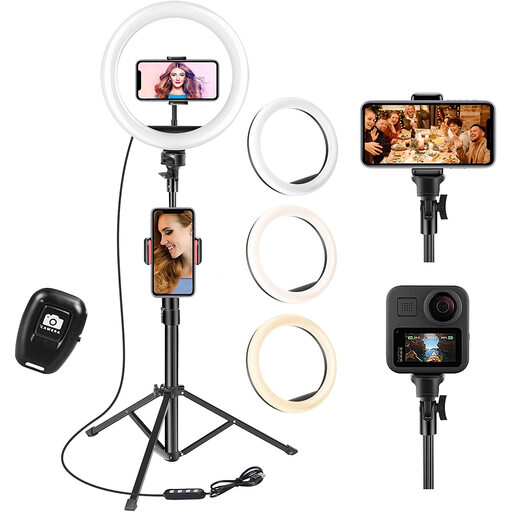 No image available
A ring light with a phone holder and tripod to consider for smartphone video; check that the base and height suit your desk and camera angle.
The product name lists a 10-inch ring light, a 63-inch tripod, a remote control, three colours and ten brightness levels.
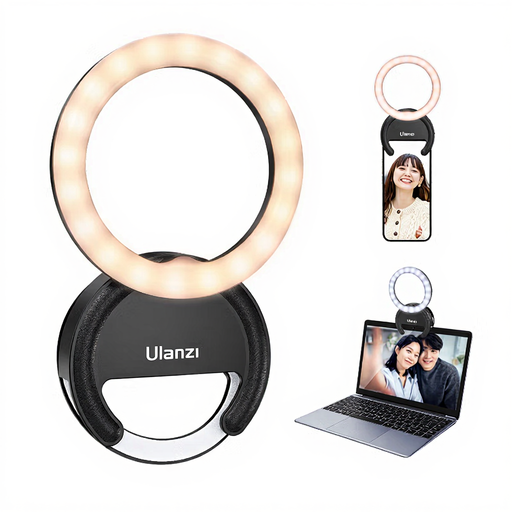 No image available
This clip-on phone ring light is an option if you want to attach the light to your smartphone; check that the clip fits your phone.
The product name lists three colour temperatures from 3000K–7000K and five brightness levels.
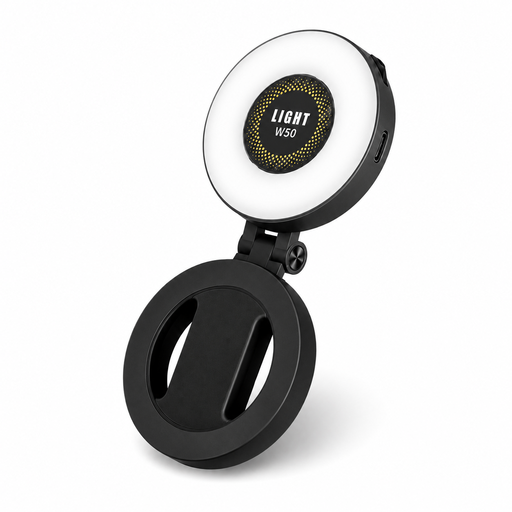 No image available
This is a phone fill light, not a ring light; consider it only if the magnetic mount and direction of light suit your smartphone set-up.
The product name lists a mirror, a 360° rotatable LED light strip and compatibility with iPhone and Android.
First, decide which movements need to be fully in shot as you handle the product. Position your phone and stand so your hands, the product and the controls stay visible, then record a full test shot before adding any accessories.
No, not if the ring creates a distracting reflection. Check with a test shot and, if needed, change the angle of the product or light, or try a diffused light source that you can position outside the reflection.
Check the connection and what’s included with that exact version. For a rechargeable light, compare the stated battery life at the brightness setting you’ll use with the length of your recording session; Godox lists around 1 hour and 15 minutes at 100% brightness for the LR15Bi/LR30Bi.
For many eligible distance purchases from a business, you have a 14-day cooling-off period, according to the Dutch government; exceptions apply. This is a statutory consumer right, not a specific promise from a retailer.
That depends on the product rules that apply to the exact version. For the Low Voltage Directive, the NVWA refers to electrical equipment with a rated voltage of 50 to 1,000 V AC or 75 to 1,500 V DC; check the product information for the light and any supplied adapter.