Who is this setup for?

Makers who want to show the texture of clay

You film your work and want viewers to follow how the clay’s shape changes against a dark background. Lighting position and shadows deserve careful consideration: Adobe and Benel Europe explain how shadows can add dimension and emphasis.

Makers who want to show clay colours

You use clay in different colours and want to compare footage filmed under similar lighting. As well as the lamp, consider colour rendering and keep your camera’s white balance consistent; Elgato explains what the colour rendering index (CRI) tells you about a light source.

Makers with a small work table

You have limited space around your hands and camera, and need a mount that suits your table and camera angle. Check the dimensions and what’s included with the lamp you choose; Godox and Dörr list different mounting and power features for their models.

What should you look for?

What to consider What should you check? Who is this important for?
Shape and texture Compare a shot with front lighting to one with the lamp angled beside the work surface. Also check how much light falls on the dark background. When I film my hands and the clay, I want the texture to remain visible rather than disappear in flat front lighting. Around 36% of consumers focus mainly on shape and texture.
Clay colour Check the stated colour rendering for the exact model and take a test shot with a fixed white balance. When I show different clay colours, I want to compare shots taken under similar lighting conditions. Around 29% of consumers prioritise colour consistency.
Mounting and camera angle Measure the edge of the table and check the clamp range, working height and whether the holder fits your device. Make sure it won’t get in the way of your hands. When I have limited space around my work table, I want to position the camera and lamp securely without restricting my hand movements. Around 21% of consumers say mounting is their main consideration.
Setup and power Check the power source, cable routing and what’s included with the exact set. Only compare lux values if they’re measured at the same distance. When I film lessons in a fixed location, I want to know in advance which power supply and holders I’ll need. Around 14% of consumers give setup and power top priority.

Common pitfalls when choosing

  • Assuming shadow-free lighting is always the goal

    Reducing shadows can also make the texture of the clay less visible. Adobe and Benel Europe explain how light and shadow help to show shape.

    Before choosing your setup, take the same shot with the lamp directly in front of you and angled beside the work surface.

  • Comparing lux values without checking the measurement distance

    Godox and NEEWER state lux values measured at 0.5 m, while Dörr gives a value at 1 m. These figures therefore can’t be compared directly to rank the products.

    Check the measurement distance for each stated value and, where possible, assess the lamp at your own working distance.

  • Assuming every ring light set is suitable for an overhead view

    A phone holder, table clamp or tripod doesn’t guarantee that you can point the camera steadily down at the work surface. You may need a different holder if the one supplied isn’t suitable.

    Before ordering, check what’s included in the set, your table dimensions, the holder and your preferred camera angle.

Brands and models to consider

Godox

According to its manual, the LR150 is a ring light for an adjustable video setup.

  • Godox lists adjustable brightness from 1–100%, a colour temperature of 3000–6000 K and CRI 90. The adapter and phone holder are included, according to the manual.
  • Check what’s included in the set before assuming a tripod is supplied. The stated features alone don’t tell you how the lamp will show the texture of the clay in your setup.

NEEWER

The RL-18 is a 45 cm ring light set with a tripod and phone holder, designed for a setup with more space around the work table.

  • NEEWER lists CRI 95 and 5500 lux at 0.5 m for this version.
  • The 3200 K and 5600 K colour settings are achieved using filters; this doesn’t mean the colour temperature is continuously adjustable. These are manufacturer specifications, not independent measurements.

Dörr

The SLR-16 Bi-Color is a compact ring light with a table clamp and phone holder, designed for a smaller work surface.

  • Dörr lists an outer diameter of 16 cm, USB power of 5 V/1 A, ten brightness settings and a clamp range of up to 5 cm.
  • The stated 280 lux at 1 m and CRI >80 Ra aren’t directly comparable with a lux value measured at 0.5 m. Also check that the phone holder fits your device.

Joybuy product

This Joybuy listing may suit you if you’re looking for a ring light with a tripod and phone holder to film a pottery lesson on your phone.
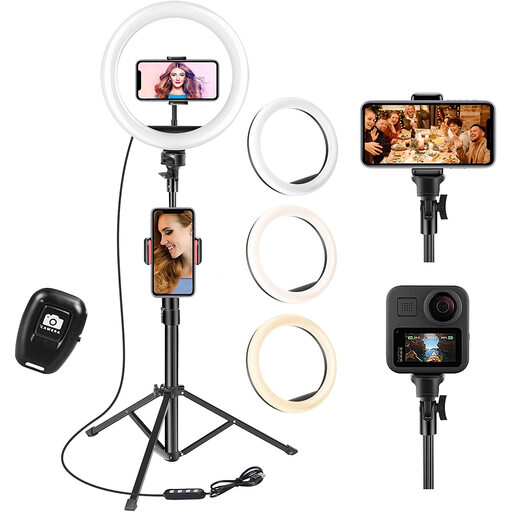
10-inch ring light with tripod, remote control, three colours and ten brightness levels

10-inch ring light with 63-inch tripod, remote control, 3 colours and 10 brightness levels

The listed phone holder and tripod are designed for filming with a phone.

The product information lists three colour temperatures and ten brightness levels. Before buying, check that the mount suits your work table and ask for product-specific safety information.

View at Joybuy

Frequently asked questions

Does the ring light have to sit directly around the camera lens?

No. If even front lighting makes the texture of the clay less visible, try angling the lamp and film the same action again. Adobe explains how light and shadow affect visible dimension; the best angle for your table hasn’t been established for any specific product.

How can you stop the clay colour changing between shots?

Keep the light colour and camera white balance consistent for comparable shots. The colour rendering index (CRI) describes how a light source renders colour, but it doesn’t determine the final colour in the camera on its own; Elgato explains what CRI means.

Can you use any USB ring light with the power connection you have available?

No, check the power specifications for the exact model. For example, Dörr lists USB 5 V/1 A for the SLR-16; according to its manual, the Godox LR150 uses an adapter for DC power. These power specifications aren’t interchangeable.

What are your rights when buying online in the Netherlands?

For an online consumer purchase in the Netherlands, you generally have a 14-day cooling-off period starting the day after delivery; exceptions may apply. Business.gov.nl also describes your right to a product that meets the required standards, for which there is no fixed statutory guarantee period in the Netherlands. Different consumer rules apply to business purchases.

Is a CE logo on its own enough information about a ring light?

No. According to Business.gov.nl, CE isn’t an independent quality mark; it’s the manufacturer’s declaration that the product complies with the applicable EU rules. Check which rules apply to the exact version and what product-specific conformity information is available.
