
Teacher with a permanent worktable
You film your hands and your work from above. Focus on the arm’s position and stability, and make sure there’s enough room to work freely with the clay.


If you mainly film your hands and clay from above, start with a stable setup that captures the whole worktable. Then choose the light settings and power supply to suit your filming location. Test the colour and shape with a short clip, as even, front-facing light can make texture less visible. A tripod or phone holder alone doesn’t guarantee a suitable overhead setup.
You film your hands and your work from above. Focus on the arm’s position and stability, and make sure there’s enough room to work freely with the clay.
You want to capture colour variations clearly in your portfolio. Look for adjustable lighting and check the colour with a test recording and your camera’s white balance.
You set up your filming space from scratch each time. Check which holder, stand and power supply are included with the version you choose.
First, choose a camera angle and mounting setup that show your lesson clearly. Then match the light colour, direction and power supply to your workspace.
| What to consider | What should you check? | Who is this important for? |
|---|---|---|
| Hands and work surface in frame | Check the arm height, phone holder, working space and full frame before choosing your setup. | If I want to film my hands and the piece at the same time, the camera needs to be stable above my work. Around 36% of consumers also prioritise an overhead view. |
| Accurate clay colour | Check the adjustable light colour for the exact model and record a test clip under the lighting you plan to use. | I want the clay colours in my portfolio to look true to life, and I want to be able to check the white balance. Around 29% of consumers prioritise colour rendering and light settings. |
| Shape and shadows | Compare front-facing and angled light on camera, using your own clay, hands and background. | If I need to show texture, I want to assess whether the angle of the light brings out the shape without creating distracting hand shadows. Around 21% of consumers say showing shape is their main consideration. |
| Setup and power | Check what’s included in the bundle you’ve chosen, as well as the mounting, power supply and expected recording time. | When I’m teaching at different locations, I want to set up quickly and avoid relying on a fixed power socket. Around 14% of consumers prioritise portability and power. |
A phone holder doesn’t automatically mean the camera can be positioned securely above the clay. What’s included in a bundle can also vary.
Compare the parts list for the exact version with the camera and lighting positions you need.
Even lighting can reduce shadows, but it can also make texture less distinct. Angled light can bring out the shape more clearly, but may also cast shadows from your hands.
Compare a front-lit test recording with an angled one before choosing additional lighting.
The selected light colour isn’t the same as the final colour in your recording; your camera’s white balance also plays a part.
Use the same light setting when you film and check a test clip with your own clay.
Business.gov.nl explains that CE marking relates to applicable requirements and isn’t a general mark of quality or filming performance.
Check the product information for the exact version, and assess the mounting and lighting separately.
The Ring-10 is worth considering if you’re looking for an arm for overhead filming; the U200 is designed as a portable ring light.
The RH12B set is worth considering if you want to adjust the light colour, brightness and angle.
According to Godox, the LR150 has continuously adjustable colour temperature and brightness for video recording.
Hama describes the SpotLight FoldUp 102 II as a foldable smartphone set for uses including DIY filming.
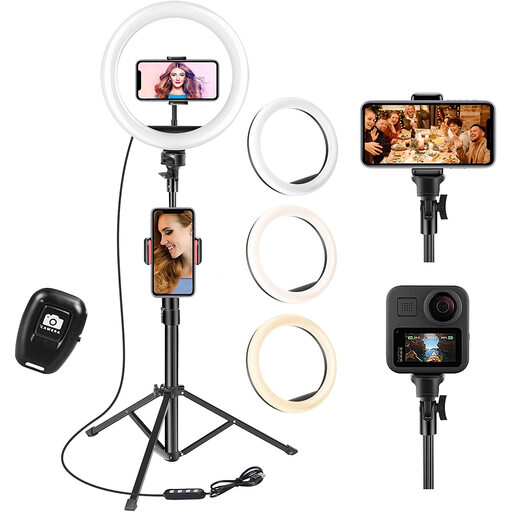
This selection includes a ring light with a freestanding tripod and two compact lights that attach to a smartphone. A tripod or phone clip alone doesn’t guarantee a stable overhead view; check that your chosen setup captures the whole worktable.
 No image available
For smartphone videos with a freestanding setup; check that the light and phone can reach the camera angle you want above the table.
The product information lists three colour modes, ten brightness levels and a remote control.
The tripod is described as adjustable from 44 to 156 cm. Check the exact bundle and product information for the version you choose.
 No image available
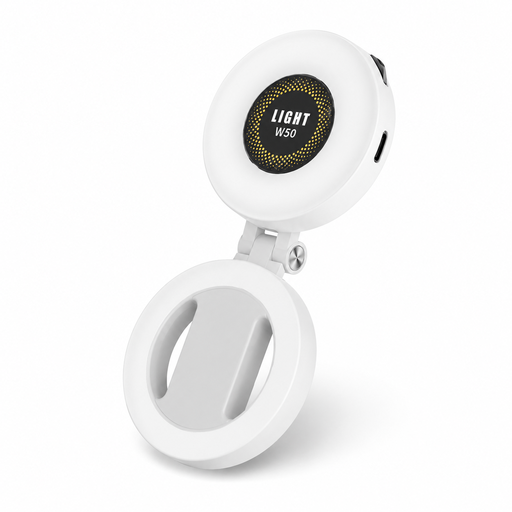
A compact option for smartphone videos if you want to attach a light to your phone; the product name lists iPhone and Android devices.
The product name lists CRI95+ and 360° LED lighting. Record a test clip to see how the clay looks under your filming lights.
The magnetic attachment doesn’t automatically make this suitable for a stable overhead view.
 No image available
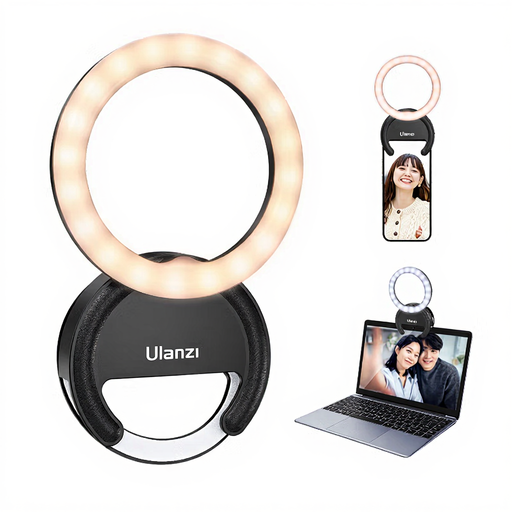
For smartphone videos if you want to attach a compact light to your phone; check that this position works for your camera frame.
The product name lists three colour temperatures from 3000 K to 7000 K and five brightness levels.
A phone clip doesn’t automatically provide the clearance or stability you may need to film directly above your worktable.
No, not for every recording. First choose a camera angle that shows your hands and the whole piece, then check whether the ring gives you a good light from that position. The Ring-10 is described as having an arm for overhead filming, but check that the setup works with your phone and worktable.
Use the same light setting and check your camera’s white balance with a test recording. Nikon explains that automatic white balance and a setting based on a white reference can produce different colour results.
Keep moisture away from electrical connections and follow the manual for the exact model. Godox says to keep the LR150 dry; this instruction doesn’t mean that other lights are waterproof.
For a consumer purchase in the Netherlands, the seller is your point of contact for your statutory guarantee. According to the Dutch Government, there is no fixed statutory guarantee period of two years; what you can expect from a product depends, among other things, on the product and the information provided.
CE marking relates to applicable requirements and isn’t a general quality mark. Business.gov.nl explains that, after the required conformity assessment, the manufacturer draws up an EU declaration of conformity and applies the relevant CE marking; check the information for the exact version.