
Teacher filming from above
Mostly films paper, scissors and hand movements. Clear workspace and a stable camera position matter more than lighting for your face.


For a paper-cutting lesson, a stable camera angle above the paper is essential. Then choose a ring light that illuminates your work surface without getting in the way of your hands. A tilting light with adjustable settings may suit a compact work surface, but test it with a short recording. If shadows from your hands get in the way, a separately positioned LED panel could be an alternative. Also check that the phone holder, tripod, power supply and mounting hardware you need are actually included.
Mostly films paper, scissors and hand movements. Clear workspace and a stable camera position matter more than lighting for your face.
Works with coloured paper or changing daylight and wants to adjust the brightness and colour temperature.
Switches between speaking to the camera and demonstrating at the table, and needs a setup that can work for both.
First decide where the camera and paper will go, then check how the light falls while you work with both hands. Finally, make sure the mount and power supply suit your home setup.
| What to consider | What to check | Who should consider this? |
|---|---|---|
| View of the paper and your hands | Make a test recording using the paper size you plan to work with, with both hands in their usual working position. Check the brightness settings and whether you can position the light so your cutting remains visible. | If I want the cutting line and hand movements to remain clearly visible, I focus on how the light falls while I work. Around 36% of consumers say seeing the cutting clearly is their top priority. |
| Mounting above the table | Check the table clamp, arm reach, load capacity, thread and space for the camera and light. Make sure the whole setup stays stable. | If you want to keep the camera fixed above the paper, you need a suitable mount that won’t get in the way of your hands. Around 29% of consumers prioritise a stable overhead setup. |
| Colour and lighting | Check whether the brightness and colour temperature are adjustable, and whether a CRI value is specified for the exact model. Assess coloured paper in a test recording. | If I want the colours of my paper to look true to life, I want to assess the finished recording for myself. Around 21% of consumers prioritise paper colour accuracy. |
| Parts and power supply | Check whether the adaptor or USB power supply, tripod and phone holder are included. Find out whether you’ll need a separate arm or clamp for an overhead view. | If you want to get started without buying extra parts, you need to know what comes with the light and what power supply it needs. Around 14% of consumers prioritise a ready-to-use kit. |
Your hand can block the light. Lighting that works well for a face may not make the cutting line on paper easy to see.
Make a test recording of the whole work surface while moving both hands. Adjust the angle of the light if the cutting line disappears.
A phone holder and tripod don’t guarantee that the camera can be positioned directly above the paper. A separate arm must also be suitable for your table and the weight of the camera or light.
Check the complete setup, including the table clamp, reach, load capacity and included parts.
You may need a separate table arm or clamp for a suitable overhead setup.
An adjustable colour temperature alone doesn’t tell you how accurately the light will render paper colours.
Check each setting separately and assess coloured paper in a test recording using your own camera settings.
NEEWER offers, among other things, a tilting tabletop ring light and separate mounts for cameras and lights.
The LUMIS Comfort Bi-Color combines a ring light, tripod and smartphone holder for recordings where the teacher also appears on camera.
The LR150 has adjustable colour temperature and brightness; you choose the mounting and light position separately.
The 10-inch R2B ring light is described as a set with an adjustable tripod and phone holder.
These ring lights are intended for phone recordings where you want a separate lighting setup and adjustable light. For each model, check whether the mount is suitable for filming above a paper-cutting work surface.
 No image available
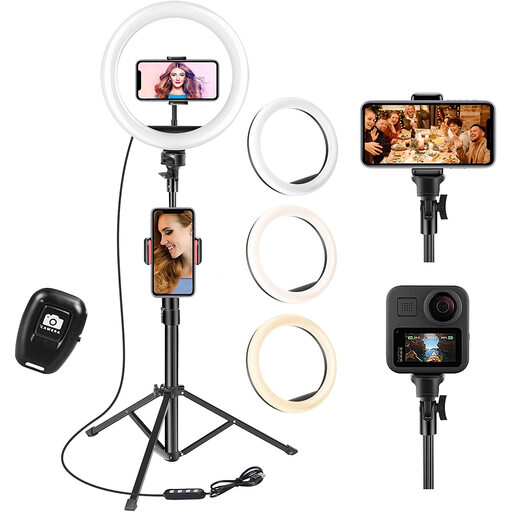
An option for phone recordings if you want to use a ring light with a tripod. Check whether the phone holder you need is included and whether the camera can be positioned above the paper.
The product name lists a 10-inch ring light, a 63-inch tripod, a remote control, three light colours and ten brightness levels.
 No image available
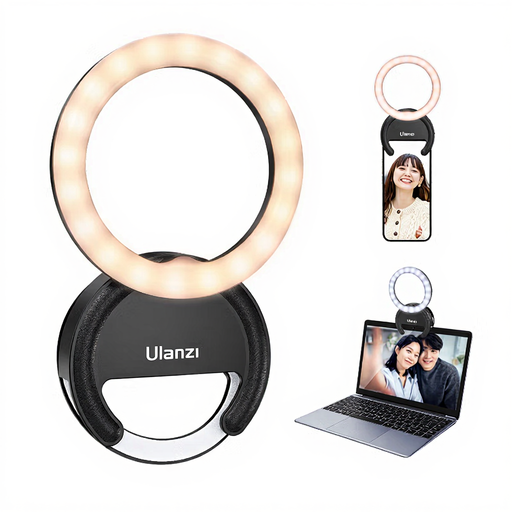
A compact phone ring light for smartphone videos. Check how it attaches to your phone and whether that suits the camera angle you have in mind.
The product name lists three colour temperatures from 3000K–7000K and five brightness levels.
Not necessarily. Check whether the holder can position your phone securely above the paper, without your hands getting in the way of the light or vice versa. If you’re using a separate horizontal arm, make sure the table clamp and load capacity are suitable.
First, position the camera and paper, then make a short recording while moving both hands. Adjust the brightness and angle of the light, and check the colours in the recording if you’re using coloured paper. Colour temperature and CRI describe different properties.
When you buy as a consumer in the Netherlands, you’re entitled to a product that works as it should; a manufacturer’s warranty doesn’t replace your statutory rights. Contact the seller if there’s a fault. For online purchases from a business, you’ll usually also have a 14-day cooling-off period. Check the applicable terms and conditions.
The relevant EU product rules apply to electrically powered ring lights sold in the Netherlands. Which rules apply and whether CE marking is required depends on the design and power supply. Electrical appliances should generally be collected separately. When you buy a new, similar appliance, you can return a broken one free of charge.