
Teacher filming hands from above
You want to position the camera and light so the work surface stays visible, with enough room to demonstrate materials or settings. Ulanzi and NEEWER product information describes setups for overhead filming.


First decide how you want to position the camera above the table and how much workspace you need to keep clear. Then decide whether you want a combined setup or prefer to position the light and camera separately. An integrated kit can make assembly easier, while a separate light with its own arm gives you more freedom to change the direction of the light. Before buying, check that the mounts and clamps will fit, how the light is powered and the product details for the exact model.
You want to position the camera and light so the work surface stays visible, with enough room to demonstrate materials or settings. Ulanzi and NEEWER product information describes setups for overhead filming.
You want to keep space free for your hands and teaching materials. A table clamp could be an alternative to a base on the work surface, provided the edge of your table is compatible with the clamp.
You want to check for reflections on items such as lenses or screens, and redirect the light if needed. Ulanzi advises watching out for unwanted reflections in ring-light footage.
A good fit if: you mainly film on a phone and want to mount the light and holder together.
Trade-off: the base takes up table space, and your phone needs to fit within the holder’s dimensions.
A good fit if: you want to position the camera and light independently, or keep the centre of the table clear.
Trade-off: check the clamp, fittings, load capacity and compatibility of each component separately.
A good fit if: your camera is already mounted and you mainly want to adjust the lighting.
Trade-off: a separate light does not automatically come with a complete overhead support; reflections may mean you need to change the angle of the light.
| What to consider | What should you check? | Which consumers should pay particular attention? |
|---|---|---|
| Workspace and overhead view | Measure the clear table edge and available space; check the clamp range, camera mount and stated load capacity of the arm you choose. | If you want to keep your hands and teaching materials on the table, you’ll need to know whether a clamp will leave your work surface clear. Around 38% of consumers prioritise space and an overhead view. |
| Reflections and light control | Check whether brightness, colour temperature and light angle are adjustable; take a test shot with your teaching materials. | With shiny lenses or screens, you’ll want to check whether the light creates distracting reflections. Around 23% of consumers want to manage reflections as their top priority. |
| Mounting and device fit | Compare the dimensions and mounting options of your phone or camera with the exact holder and kit contents. | If you want to set up quickly, you’ll need to make sure your recording device fits the holder supplied. Around 23% of consumers prioritise ease of mounting and compatibility. |
| Power during the lesson | Check the power specifications, included components and a safe place for the cable away from the work surface. | For a longer lesson, you’ll want to avoid having your recording interrupted by your chosen power solution. Around 16% of consumers prioritise uninterrupted lighting above all else. |
A desk light and an overhead light are not automatically the same thing. For example, NEEWER states that model N16 does not support overhead lighting.
Check that the exact light and support allow the position you want, and find out what load they can take.
If your phone doesn’t fit, you may need a different holder.
The Godox LR120 manual lists USB power and a phone holder, but not a complete overhead table support.
Check what’s included with the version you’ve chosen and whether you already have a suitable support and power source.
You may need a separate support, power source or mounting adapter.
These examples highlight model-specific details for different setups; they are not a general assessment of every product from each brand.
The Ring-10 product information describes an integrated ring light, arm and phone holder for overhead filming.
The brand offers separate table arms, including the DS024, which can hold a camera and a ring light.
According to its manual, the LR120 is a separate ring light with USB power, for anyone choosing their camera support separately.
These products are ring-light options for smartphone video. For overhead filming, check that the holder and support can actually be positioned as you need them.
 No image available
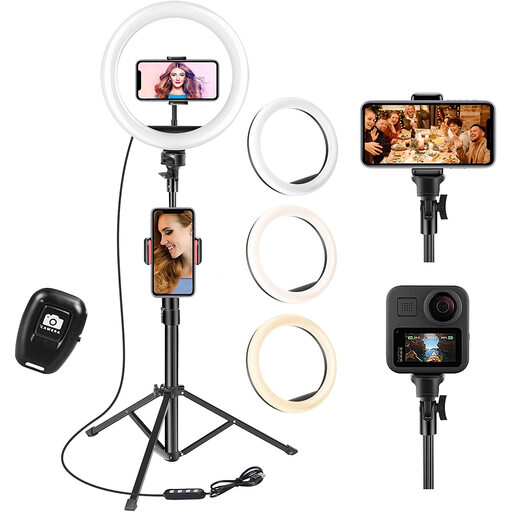
The product description mentions online teaching and a phone holder. Check whether the tripod allows the filming angle you want at your table.
The title lists three colour modes, ten brightness levels and a 63-inch tripod.
 No image available
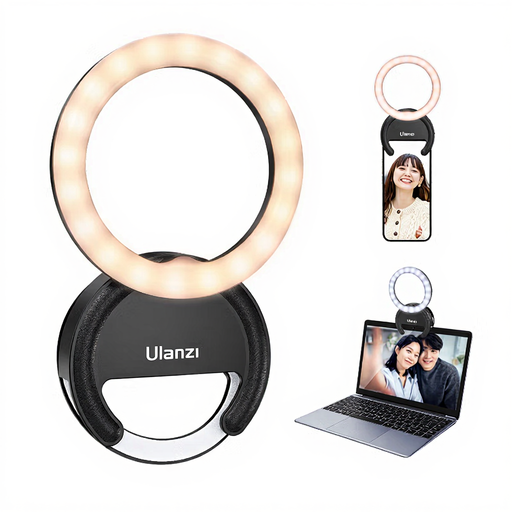
According to the product description, this light clips directly onto a smartphone and is designed for video. Check whether this type of mount suits the way you film your lesson.
The title lists three colour temperatures from 3000 K–7000 K and five brightness levels.
No, not every ring light supports overhead lighting. NEEWER explicitly states this for model N16, for example. Check the mount, tilt direction and permitted load for the exact light and support.
Measure the thickness of the table edge and compare it with the arm’s clamp range. Also check the stated load capacity and keep hands and cables clear of the moving parts. For the NEEWER TL253A+DS001, the manufacturer gives a clamp range of up to 9 cm; this does not automatically apply to other arms.
Take a test shot with the actual teaching materials and adjust the light angle or brightness if needed. Ulanzi advises watching out for unwanted reflections in ring-light footage; this does not guarantee that every reflection will disappear.
No, a logo in an advert does not, by itself, prove that the specific model complies with the applicable rules. According to the Dutch Government, CE marking is compulsory for certain product groups. Check which rules apply to the product and, where relevant, ask for the EU Declaration of Conformity.
According to the Dutch Government, online purchases from a business generally come with a 14-day cooling-off period; exceptions and the type of seller may be relevant. Before buying, also check which components are included in the specific kit.