
Teacher filming from above
You want to keep your hands, paper and each step in shot. That makes the mount and camera angle important. NEEWER describes different tabletop setups, while Canon Europe recommends stable framing.


If you’re filming a collage lesson from above, start by choosing a stable mount that lets the camera capture the whole work surface. Then consider the ring light’s diameter. Adjustable brightness and colour temperature let you tailor the light to white paper and coloured materials, but they won’t automatically prevent shadows or reflections. This advice reflects Canon Europe’s recommendation for consistent framing and Adobe’s explanation of how white balance affects colours.
You want to keep your hands, paper and each step in shot. That makes the mount and camera angle important. NEEWER describes different tabletop setups, while Canon Europe recommends stable framing.
You want colours to stand out and reflections not to hide details. Adobe explains that white balance affects every colour in a shot. A test clip using your own materials will help you assess the settings.
You need to weigh up the space taken by a lamp base or suitable table clamp, and check where your phone and power supply will fit. NEEWER lists different accessories for the R10 and RL7B models.
Start with the camera angle and mounting option: a desk arm, tabletop stand or separate tripod will suit different workspaces. Then consider the lighting settings and make a test recording to see whether you need additional, movable lighting.
| What to consider | What to look for | Who should prioritise this? |
|---|---|---|
| Stable overhead view | Check the width of the work surface, arm reach, clamp opening, camera holder and load capacity separately. | If I’m filming my hands and collage from above, the camera needs to keep the whole work surface in view. Around 36% of consumers put a stable overhead view first. |
| Work details clearly visible | Make a test clip with your hands and glossiest material, then check for shadows and reflections. | If my hands cover small cutting or sticking details, I want to be able to adjust the light’s position. Around 29% of consumers give visibility of work details top priority. |
| Colour and white paper | Check whether the colour temperature is adjustable and review a test clip using the actual paper and collage colours. | If the colours of my materials need to look true to life, I pay attention to the light colour and suitable white balance. Around 21% of consumers prioritise colour reproduction. |
| Space and power | Compare the base or clamp, what’s included, the power source and cable routing with your table setup. | On a small table, I want to leave enough space and connect the light conveniently. Around 14% of consumers make workspace and power their first consideration. |
The listed contents of the NEEWER R10 model include an arm and clamp. The RL7B model does list a phone holder, but accessories can vary between models.
Check the contents of the exact model you’re buying and make sure the holder suits your phone and the camera angle you want.
Your hands can block the light, while glossy materials can reflect it. The angle and distance of the light, your materials and the camera position all affect what appears in shot.
Test white paper and glossy collage pieces from the final camera angle. If needed, adjust the light’s position or angle.
A lux figure applies at the stated measuring distance and, on its own, doesn’t tell you how evenly the whole work surface will be lit. NEEWER states a measuring distance of 0.5 m for the R10.
When comparing figures, check the unit and measuring distance, then use a test clip to assess the lighting across the whole table.
The R10, with its desk arm and clamp, and the more compact RL7B, with its tabletop stand and phone holder, offer different setups.
The LR150 is a ring light worth considering if you already have a suitable tripod setup.
The DVR-160TW is an option if you already have a suitable tripod setup and want adjustable lighting.
The U200 is a portable ring light and camera setup for use away from a fixed workspace.
These Joybuy product picks are aimed at smartphone video with a ring light and adjustable lighting. If you’re filming from above, check whether the included mount lets you position your phone over your work surface.
 No image available
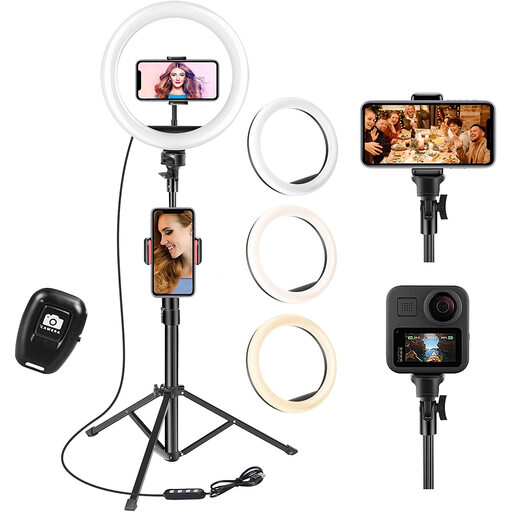
Could suit smartphone video if you’re looking for a ring light with a tripod and holder. Check whether the tripod can position your phone above your work surface.
The product description lists three colour temperatures from 3000–6000 K, ten brightness levels, an adjustable tripod from 44 to 156 cm, a phone holder and a remote control.
 No image available
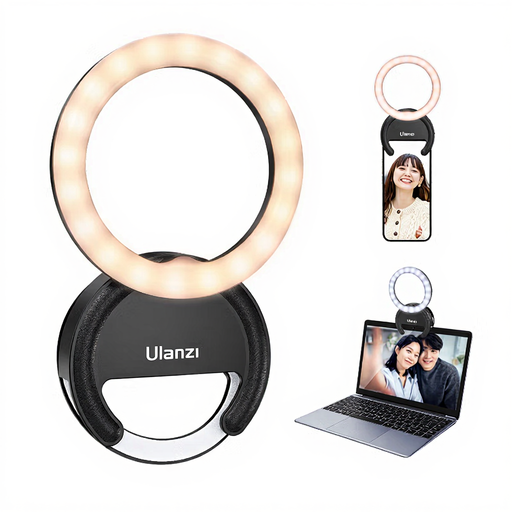
Could suit smartphone video if you’re looking for a compact light that attaches directly to your phone.
The product information lists three colour temperatures: 3000 K, 4500 K and 7000 K, plus five brightness levels.
No, that isn’t a general requirement for a collage lesson. Choose a camera mount that keeps the whole work surface in shot and make a test clip. A ring light can also be used as a movable light source. Check that the set you choose includes the holder you need.
Light colour and white balance affect how white paper and other colours appear on camera. Adobe explains how white balance affects all colours, so assess a test recording using the actual paper and keep the lighting conditions as consistent as possible during each recording.
First, review a test clip from the final camera angle and adjust the position or angle of the light source if needed. If details are still lost, separate fill lighting may be an option for your setup. The effect depends on the situation and isn’t guaranteed by any particular model.
For a consumer purchase in the Netherlands, the seller must offer an appropriate free remedy if a product breaks sooner than you could reasonably expect under normal use. ACM ConsuWijzer also explains that online purchases generally come with a statutory 14-day cooling-off period from receipt, subject to legal exceptions.
Electrical and electronic products covered by the relevant EU rules on CE marking must comply with those rules; check the specific light and power supply. The European Union also explains that the crossed-out wheeled bin symbol means electrical and electronic equipment must be collected separately.