
Teacher on camera
If you mainly appear on screen to explain something, a ring light that’s quick to set up can help provide front lighting. Benel Europe describes this as a good fit for a teacher speaking alone and directly to camera.


If you mainly film yourself speaking to camera, choose a dimmable ring light that lets you position your phone or camera securely. For colour demonstrations and close-ups, colour controls, white balance, potential flicker and mounting options matter too. A large ring light won’t necessarily suit every demonstration.
If you mainly appear on screen to explain something, a ring light that’s quick to set up can help provide front lighting. Benel Europe describes this as a good fit for a teacher speaking alone and directly to camera.
If you show skin tones, prints or colour settings, assess the light setting alongside your camera’s white balance and the artificial light already in the room. Canon Europe explains that white balance may be needed to achieve the colours you want in challenging lighting conditions.
If you regularly film buttons, small accessories or other details, you’ll need a light that’s easy to position at close range. SmallRig describes the Vibe P30 5203 as suitable for tabletop and macro use, with a 67mm mounting solution.
Choose this option if: you usually speak directly to camera and want to set up front lighting quickly.
The trade-off: front lighting can create less depth in the shadows. Check that the mount works with your camera; the colour settings listed for the NEEWER RL-18 kit are achieved using filters.
Choose this option if: you want to match the light to other artificial lighting, for example when demonstrating colours.
The trade-off: choosing the right Kelvin value alone won’t guarantee accurate colours on camera. Set your camera’s white balance too, and check whether the selected kit includes a tripod.
Choose this option if: you mainly film small objects or details at close range, and the mount suits your setup.
The trade-off: a compact light won’t automatically replace a large light used to illuminate a teacher from further away. Check the connection and framing too.
| What to consider | What to check before buying | Who is this important for? |
|---|---|---|
| Lighting the speaker | Check the dimming controls, space for your phone or camera, and which mounts are included. | If I’m mainly on camera, I want to be able to set up quickly and light my face evenly; around 29% of consumers prioritise lighting the speaker. |
| Colour and flicker | Compare the stated colour controls and colour rendering for the exact version, then make a test recording with all the lights on. | If I’m demonstrating colours under existing artificial lighting, I want to check both the light and my camera settings in my own recording; around 29% of consumers prioritise colour and flicker. |
| Lighting for close-ups | Check the working distance, connection and framing; watch out for reflections on shiny objects. | If I’m filming small details, I want to position the light close by without cropping the subject out of the shot; around 24% of consumers prioritise close-ups. |
| Setup and mounting | Check the mounts and support included, the connection and the power supply for the exact version. | If I want to use the light with my existing camera, support and workspace, I want to know in advance how it will fit into my setup; around 18% of consumers prioritise compatibility and mounting. |
According to NEEWER, the colour settings listed for the NEEWER RL-18 kit are achieved using white and orange filters. By contrast, the Godox LR150 manual describes continuous colour temperature adjustment.
If you want to match the light to existing artificial lighting, check how you change the colour setting on the exact model.
Front lighting can work well for a face, while a small tabletop demonstration needs a different position and mounting setup.
Decide whether the teacher or the detail being shown is the main subject, then check your setup for that shot.
A light’s colour setting doesn’t replace white balance. Artificial lights that flicker can also cause visible bands in your footage.
Make a test recording with your own camera and the other lights on, then check the footage for colour differences and bands.
The RL-18 kit is designed for a front-lit teaching setup, with a tripod and a phone or camera mount.
The LR150 is worth comparing if you want to adjust the colour temperature of a larger ring light.
The Halo 18 is a larger ring light worth comparing if adjustable colour and colour rendering matter to you.
The Vibe P30 5203 is designed for tabletop and macro use, with a compatible 67mm setup.
These ring lights are suited to smartphone recordings of lessons and demonstrations. Check that each model’s available settings and mounting options suit your recording setup.
 No image available
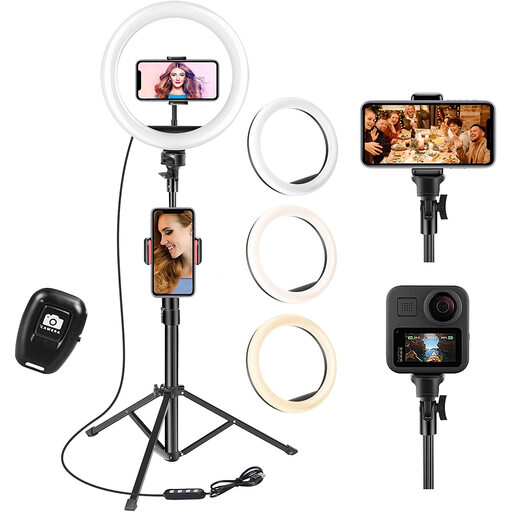
The included phone holder makes this set worth considering for lessons you film on a smartphone.
The set includes a 63-inch tripod and a wireless remote control.
The light has 3 colour settings and 10 brightness levels; its colour temperature isn’t continuously adjustable.
 No image available
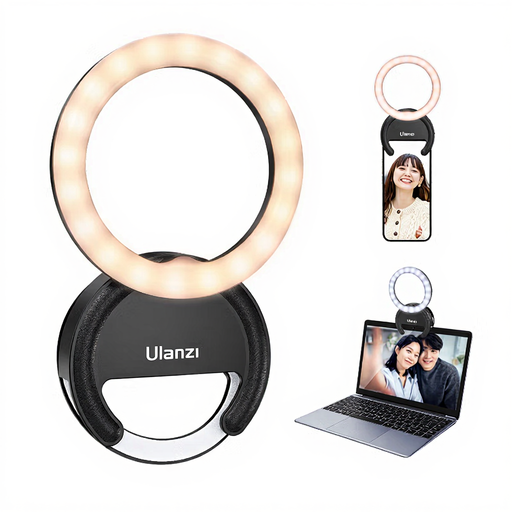
This compact light clips onto a smartphone, making it a good fit for short videos where your phone is the camera.
The product information lists 3 colour temperatures from 3000K–7000K and 5 brightness levels.
Check that the phone mount and distance from the subject suit the framing of your demonstration.
Start with a short recording while your other artificial lights are on, then check the white balance and look for bands or changing colours. For areas with a 50Hz power supply, Sony Support lists shutter speeds of 1/50 or 1/100 second as possible settings for reducing flicker; results depend on the camera and light source.
No, it depends on the version. The NEEWER RL-18 kit lists a tripod, while the component lists provided for the Godox LR150 and Nanlite Halo 18 don’t mention one. So check the packaging for the exact model.
No, you should also adjust your camera’s white balance for the recording. Canon Europe explains that this may be needed to achieve the colour rendering you want in challenging lighting conditions. Check the result with a test recording under the lighting you’ll use for the lesson.
Check that you can position the light close to the subject and that the connection is compatible with your phone or camera. Assess the framing and make a test recording, especially if the object has shiny surfaces.