
Creators filming reflective jewellery
If you film polished metal or gemstones close up, you’ll want to be able to control unwanted glare. Nikon describes reflections as something to consider when photographing jewellery.


An adjustable ring light can be useful if you want to film your hands and the jewellery together, but it can create visible reflections on shiny metal. So prioritise a setup that you can tilt and dim, then compare the colour settings, camera mount and what’s included. To manage reflections, you could also consider diffused light beside the camera or around the jewellery.
If you film polished metal or gemstones close up, you’ll want to be able to control unwanted glare. Nikon describes reflections as something to consider when photographing jewellery.
If you want your videos to show the colours of metal and gemstones, compare the light colour and stated colour rendering, and take your camera settings into account too. Elgato explains that CRI describes colour rendering, not the amount of light.
If you film on your phone and want to keep your hands free, look for a suitable mount, adjustable light and a stable setup. Manufacturers such as NEEWER, Godox and Rollei list different combinations of mounts and tripods.
Best suited to: filming your hands and different pieces of jewellery in one simple demonstration, with the camera and light close together.
Trade-off: the ring may be visible in polished metal or gemstones. Test the angle and dimmer setting with the jewellery you plan to film.
Best suited to: reducing unwanted reflections in close-ups, if you have room for a diffuser, panel or light tent.
Trade-off: this takes extra space and setup. Nikon describes using a light tent for small, shiny pieces of jewellery in photography; that example doesn’t prove the same setup is suitable for continuous video.
| What to consider | What should you look for? | Who is this important for? |
|---|---|---|
| Reflections and visible details | Check whether you can dim, tilt or move the light. With reflective jewellery, try diffused light or positioning the light beside the camera too. | If I film polished metal or gemstones close up, I want to be able to reduce distracting glare. Around 36% of consumers prioritise reflection control. |
| Colour rendering | Compare the stated CRI and adjustable colour temperature for the exact model, then assess a test recording using your own jewellery. | If I want to show the colours of metal and gemstones as accurately as possible, I compare both the light settings and my camera settings. Around 29% of consumers give colour rendering top priority. |
| Camera mounting and workspace | Check the mount or fixing screw, what’s included and whether there’s enough room for your hands above the work surface. | If I’m holding or turning a piece of jewellery while filming, my phone or camera needs to fit securely without blocking my workspace. Around 21% of consumers prioritise a suitable mount and workspace. |
| Ease of use and what’s included | Read the contents list and check the power supply and controls. Don’t assume accessories shown only in a product photo are included. | If I want to get started quickly, I need to know whether the mount, power supply and any stand are included with the version I’ve chosen. Around 14% of consumers give an easy-to-use, complete kit top priority. |
Small, shiny pieces of jewellery can show bright spots even when they’re well lit. The shape and position of the light still affect what you see on camera.
Make a test recording of your most reflective piece of jewellery and, if needed, change the angle or dimmer setting.
Allow time to adjust the light and camera again if a reflection obscures details.
The NEEWER RL-18 uses filters to achieve its stated colour temperatures, while the Godox LR150 is described in its manual as continuously adjustable. Rollei lists three colour modes for the LUMIS Comfort. CRI and colour temperature describe different properties.
Compare the settings on the exact version and review a test recording of the jewellery you want to show.
Different settings may take extra time to balance the exposure and colour.
Kit contents vary. Rollei lists a tripod with the LUMIS Comfort; the Godox LR150 manual mentions an adapter and phone holder. Check which parts are included with each version.
Read the contents list and check that the mount fits your phone or camera before ordering.
Check whether you’ll need a tripod or suitable adapter for your setup.
The RL-18 is a ring light kit to compare if you’re looking for a larger ring with a tripod and phone or camera mount.
The LR150 is worth comparing if continuously adjustable light colour and brightness are important to you.
The LUMIS Comfort Bi-Color is a compact kit to compare if you film on a phone and are looking for a holder and tripod.
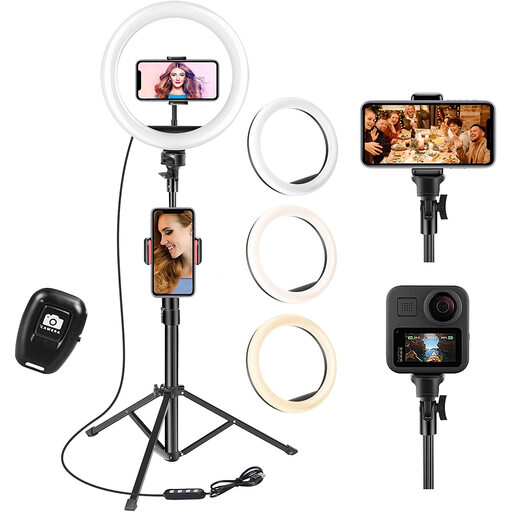
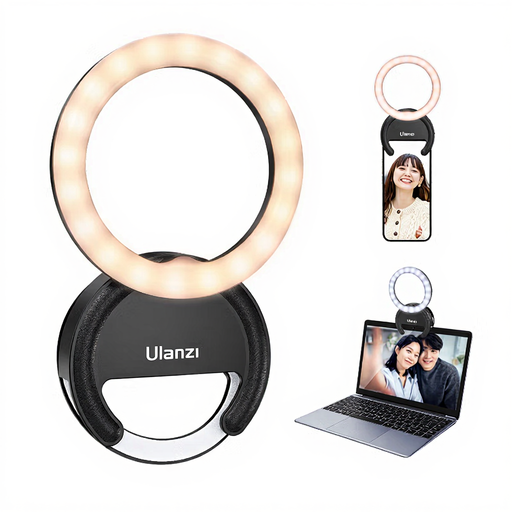
These Joybuy product picks focus on ring lights for phone videos, with adjustable light and a setup that includes a phone holder.
 No image available
An option to consider if you film on a phone and are looking for a tripod setup.
The product name lists a phone holder, three colour modes and ten brightness levels.
 No image available
A compact phone ring light to consider if a small size suits your filming setup.
The product name lists 3000–7000 K, three colour temperatures and five brightness levels.
Yes, as adjustable key lighting for a demonstration, but check the reflections with a test recording. Nikon describes reflections and bright spots as things to consider when photographing jewellery, and mentions diffused light in a light tent as an alternative for photography. That example doesn’t guarantee the same results for every video setup.
First, check that the mount fits your phone or camera and leave enough room to work. If the light is visible in the metal, try a different angle or dimmer setting. Rollei lists a tilting ring for the LUMIS Comfort, while NEEWER lists a phone holder and 1/4-inch mount for the RL-18.
When you buy a product in the Netherlands, you can expect it to meet what’s reasonably expected of that product. The Dutch government advises you to contact the seller if a product is faulty. There’s no single fixed legal guarantee period in the Netherlands that applies to all products.
For a distance purchase from a business, the Dutch government says you generally have a 14-day cooling-off period. Check the terms of the specific purchase; this answer doesn’t assume the same rights apply to an online purchase from a private seller.
No. Business.gov.nl describes the CE marking as the manufacturer’s declaration that the product complies with applicable EU product rules, not as a quality mark. Electrical equipment sold in the Netherlands must comply with the relevant safety and conformity rules; the marking says nothing about how jewellery will look on camera.