
Makers filming shiny jewellery
If you film polished metal or gemstones, you’ll want to capture the details and spot distracting reflections. Nikon highlights reflections and bright spots as things to watch out for when photographing jewellery.


Start with a set-up that captures your camera, hands and jewellery in the frame at the same time. Then choose a ring light based on the space available, how it can be mounted, and how you can adjust the colour temperature and brightness. A ring light can reflect visibly in polished metal. Nikon highlights reflections and bright spots as things to watch out for when photographing jewellery, so try a different light angle or diffusion with your own pieces if needed.
If you film polished metal or gemstones, you’ll want to capture the details and spot distracting reflections. Nikon highlights reflections and bright spots as things to watch out for when photographing jewellery.
If you show different materials and gemstone colours, you’ll need to account for changing workshop lighting and your camera’s white balance. Canon Europe explains that white balance needs attention in challenging lighting conditions.
If you share a table with others, it helps to have a set-up that captures your hands and workpiece, but can be cleared away after filming. Consider in advance whether a desk stand or floor stand is a better fit for the space available.
At a shared workbench, the most important choices depend on your jewellery, the camera angle you want and how much space you can set aside for your equipment.
| What to consider | What to look for | Who is it important for? |
|---|---|---|
| Reflections and details | Check whether the light is dimmable and whether you can adjust its angle; try diffusion too. | If you film polished metal, you’ll want to assess reflections and detail in a test clip. Around 31% of consumers give controlling reflections top priority. |
| Colour of metal and gemstones | Check how the version you choose adjusts the colour temperature, then match it to your camera and the lighting already in place. | If you film different materials, you’ll want to check their colour under your workshop lighting. Around 25% of consumers prioritise colour reproduction. |
| Hands and work surface in shot | Check that the mount allows the camera angle you want and that your hands won’t block the workpiece. | For a demonstration, you’ll want to film both what you’re doing and the jewellery clearly. Around 25% of consumers mainly choose a light based on how well it shows their hands and work surface. |
| Space and storage | Compare the space taken up by a desk base with the floor space needed for a stand, and check the power supply and cable routing. | If you share the workbench, you’ll want to be able to put the light away after use and clear the work area. Around 19% of consumers prioritise footprint and storage. |
Shiny jewellery can reflect the light source, creating bright spots that make details harder to see.
Make a test recording with your own pieces and compare a different light angle or diffusion before treating the light as a complete solution.
Another light or light modifier may take extra time and space to set up.
The included holder, stand and other accessories can vary between versions, and may affect whether the light fits straight into your set-up.
Compare the full model variant with the contents list for the product you’re planning to buy.
If the kit doesn’t include a stand, holder or suitable adapter you need, you may have to buy one separately.
The existing lighting and your camera’s white balance also affect the footage.
Make a test clip with your own materials under the lighting you plan to use for the demonstration.
The RL-18 kit is a larger ring light for a permanent set-up, while the BASICS R10 is designed for desk use.
The LR150 is a ring light for a permanent demonstration space where you want to adjust brightness and colour temperature directly.
The Vibe P30 5203 is a compact 67 mm ring light for close-ups using a phone or lens set-up.
The DVR-160TW is a larger ring light with adjustable colour temperature and mounting options for a more permanent set-up.
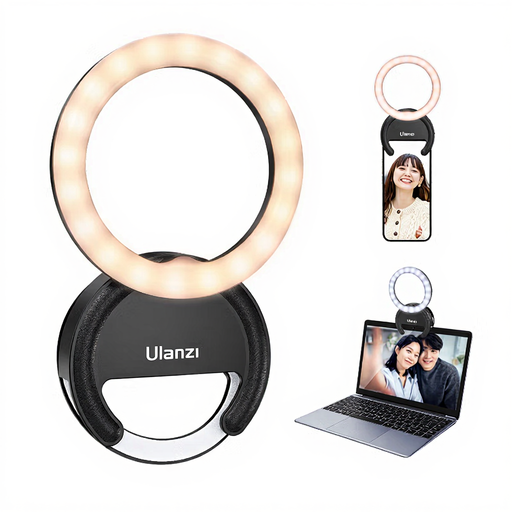
These product picks are aimed at smartphone filming: a compact phone light and a ring light with a stand.
 No image available
The clip-on mount is ideal for a compact smartphone set-up that you can put away after use.
The product name lists three colour temperatures from 3000 K–7000 K and five brightness levels.
A ring-shaped light source can reflect visibly in polished jewellery, so check the result with a test recording.
 No image available
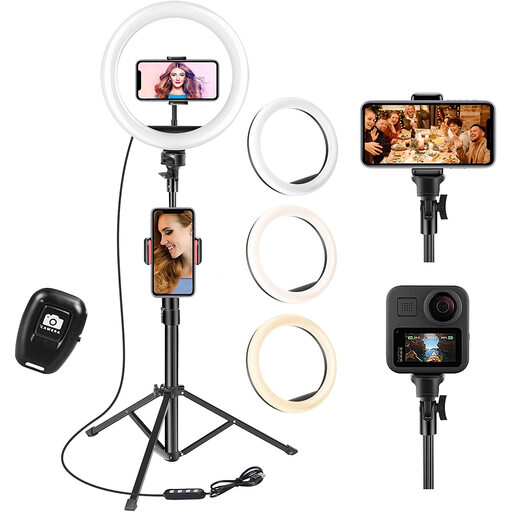
This set gives you a stand-based set-up off the tabletop for smartphone filming; remember to allow for the floor space it needs.
The product description lists a 10-inch ring light, a 63-inch tripod, a remote control, three colour temperatures and ten brightness levels.
Check that the set-up allows the camera angle you want to capture your hands and workpiece.
Make a test clip with the light and camera in the intended position. Check separately whether your hands are visible, whether reflections obscure details and how the metal and gemstones look. A different model or a portrait photo won’t automatically show you how your jewellery will look.
Before setting it up, check the connections, power supply and space for the stand legs or desk base, and follow the instructions for your chosen model. For the Godox LR150, keep the light and power supply dry, and don’t use the light near flammable gases or chemicals.
For an online purchase as a consumer, you generally have a 14-day cooling-off period from delivery, subject to legal exceptions; ACM ConsuWijzer explains how this works. If a product is faulty, you also have statutory rights against the seller. If you buy on behalf of a business or workshop, you can’t automatically assume you have the same consumer rights.
Electrical appliances placed on the market in the Netherlands must comply with the relevant European product safety rules and CE marking requirements. The Dutch government’s Ondernemersplein and the Netherlands Food and Consumer Product Safety Authority explain that the applicable directives depend, among other things, on the power supply and any wireless functions. A list of specifications or a brand name alone doesn’t confirm that a specific version meets the applicable requirements.