
Solo interviewers
If you’re filming a single seated face from close up, a ring light is worth considering for quick, even front lighting. NEEWER describes ring lighting as an option for close-up shots of faces.


A ring light works well if you want to light a single seated face evenly from close up and can position the light in front of the camera. If you wear glasses, want more definition in the face or are filming a wider shot, also compare an LED panel or softbox that you can position at an angle beside the camera. NEEWER explains the differences in the quality of light, while Ulanzi recommends assessing the result in the camera view.
If you’re filming a single seated face from close up, a ring light is worth considering for quick, even front lighting. NEEWER describes ring lighting as an option for close-up shots of faces.
If you wear glasses, try positioning the light away from the camera axis and record a test shot to check for reflections in the lenses. Ulanzi recommends checking the light and camera view in your actual setup.
If there’s little space around your chair, consider where you’ll put the light, camera and tripod. A floor stand and a desk mount need different positions; NEEWER EU and Elgato describe these different setups.
Best when: you’re mainly filming one person in a close head-and-shoulders shot and want even front lighting.
Bear in mind: NEEWER explains that front lighting can make the face look flatter and create reflections in glasses.
Best when: you have little floor space or would rather position the light beside the camera; Ulanzi recommends assessing the light’s position in the camera view.
Bear in mind: a desk mount needs a suitable position. Elgato states that light output depends on the power supply; the Key Light Air MK.2 page mentioned is for a US version.
Best when: you want more direction and definition in the light, and have room to position a larger light source at an angle in front of the interviewee.
Bear in mind: according to NEEWER’s guidance, a softbox generally needs more setup and positioning space than a single ring light.
Start with the shot you want and the space available in the room. The points below will then help you choose a suitable light and kit.
| What to consider | What to look for | Who is this important for? |
|---|---|---|
| Even lighting on a single face | Review a test shot from your planned sitting distance; check that the brightness is adjustable and the light can be set at the height you want. | I mainly film a face from close up and want quick, even lighting; around 36% of consumers prioritise this need. |
| Reflections and facial definition | Record a test shot wearing your own glasses and, if needed, try positioning the light slightly to one side or higher up. | I want to avoid reflections in my glasses or a face that looks too flat; around 29% of consumers prioritise this concern. |
| Coverage of the shot | Decide on your framing and the distance to the light first; only compare brightness at the same measuring distance and under the same conditions. | I also want to light my upper body and more of the background; around 21% of consumers prioritise a wider shot. |
| Positioning and kit contents | Measure the space available and check whether the stand, mount and adapter are included with the exact version. | I need to fit the light, camera and chair into a small room; around 14% of consumers prioritise space and a suitable setup. |
Even, front-facing light can make a face look flatter and cause reflections in glasses.
Compare a ring light setup with a light source beside the camera, then choose based on the look you want in a test shot.
The versions we looked at come with different accessories. A kit might include a mount, stand or adapter, for example, but check the contents of the version you want to order.
Check that the mount fits your phone or camera and that you can set everything up in your room using the included parts.
A brightness figure isn’t a reliable basis for direct comparison unless the measuring distance and conditions are the same.
Check the measuring distance for any quoted figures, and assess the light at the distance you’ll actually be filming from.
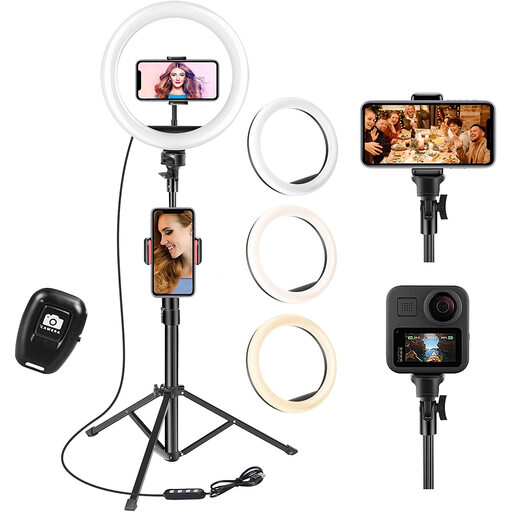
The RL-18 kit is an example of a large ring light with a floor stand and phone holder for a front-lit interview setup.
The LR150 is a ring light with adjustable colour temperature, so you can match the light to the room.
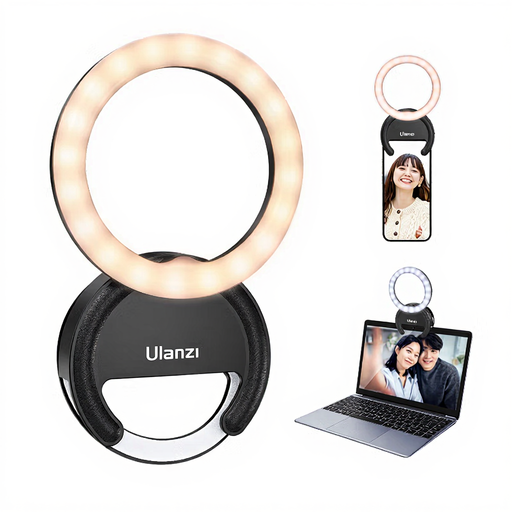
The U200 is a portable ring-shaped video light for a compact camera or phone setup.
The Key Light Air MK.2 is an LED panel to consider if a desk mount or positioning beside the camera suits you better.
These product picks are ring lights for a seated interview setup, including a version with a stand and a light that clips directly onto a smartphone.
 No image available
This ring light with stand could work well if you want to position the light at the right height around a seated subject.
The product description lists a stand that adjusts from 44–156 cm and a phone holder. The title mentions three light colours and 10 brightness levels.
Before buying, check that the specific version carries the relevant CE marking and that the holder fits your recording device.
 No image available
This version could suit an interview filmed on a smartphone if you want to attach the light directly to your phone.
The title lists three colour temperatures from 3000–7000 K and five brightness levels. The product description says it attaches directly to a smartphone.
Before buying, check that the specific version carries the relevant CE marking and that the attachment is suitable for your phone.
Set the camera at roughly eye level and assess a single adjustable light source in the camera view. If you see reflections in your glasses, move the light in relation to the camera and change one setting at a time. There’s no single position that works for every pair of glasses and every room.
Not in every room. If daylight from the window and room lighting vary, adjustable colour temperature can help you match the light. Check whether the version offers this setting directly or achieves different colours using interchangeable filters.
According to the Netherlands Food and Consumer Product Safety Authority, CE marking is compulsory for electrical products. Check the marking on the specific product; a brand page or model name doesn’t confirm that an item on offer meets all applicable requirements. Equipment with Wi-Fi or Bluetooth may also be subject to rules for radio equipment.
Online consumer purchases usually come with a statutory cooling-off period. According to ACM ConsuWijzer, the 14-day period ends 14 days after the product is delivered, subject to exceptions under the applicable rules. This is separate from your statutory warranty: if a product breaks sooner than you could reasonably expect under normal use, the seller must put things right.