
Teacher speaking to camera
Mostly records explanations in a fixed frame and wants to set up their face, camera and light with ease.


If you mainly film yourself speaking to camera, a dimmable ring light with a suitable mount could be a straightforward choice. For demonstrations of objects, shadows or lighting setups, portable continuous lighting with a light modifier may be more suitable, as it lets you change the direction of the light; a ring light can create reflections. For any specific model, check what’s included, how it’s powered and which product safety requirements apply.
Mostly records explanations in a fixed frame and wants to set up their face, camera and light with ease.
Also films camera settings, objects or lighting setups, so pays attention to the direction of the light and reflections. Zoom Academy covers different types of studio lighting and how to adjust them; Adobe Stock also discusses the importance of continuous lighting for video.
Needs to move or store the lighting between recordings and considers the space needed for a stand, the mounting setup and the included accessories.
Suitable when: you’re usually sitting or standing close to the camera and want to light your face from the front.
Bear in mind: you have less control over shadows, and objects may show round reflections.
Suitable when: you film alone and want to adjust the settings during a lesson without having to walk over to the light.
Bear in mind: a freestanding setup takes up floor space; specifications for different setups aren’t the same as a comparative hands-on test.
Suitable when: you want to show shadows, product shapes or the effect of light and change the direction of the light.
Bear in mind: positioning takes space and may require extra accessories; a ring light is simpler for front lighting.
| Consideration | What to look for | Who is it important for? |
|---|---|---|
| Lighting for on-camera explanations | Check the dimming controls and whether the exact set includes a suitable camera or phone holder. Godox lists a brightness range of 1–100% for the LR150; the NEEWER RL-18 kit lists a phone holder. | If you mainly film yourself facing the camera, even front lighting may be your first priority. Around 33% of consumers prioritise front-facing explanations. |
| Colour, shape and reflections | Check the colour temperature controls and make a test recording with your own camera and demonstration materials. Godox lists 3000–6000 K for the LR150; a stated colour rendering value alone doesn’t guarantee how colours will look on camera. | If you want to show objects, colours or the effect of light, control over the direction of the light is important. Around 33% of consumers prioritise demonstrations and colour. |
| Stand and workspace | Check the contents list for the exact version, the stand height and the mount for your recording equipment. NEEWER lists a height of 78–190 cm for the SRP18-2.4G set. | If you have limited space or need to move the light regularly, you’ll want to know whether the set suits your studio and equipment. Around 25% of consumers prioritise setup and space. |
| Controls and power | Check whether the version includes a remote control, adapter or battery. NEEWER lists a remote control for the SRP18-2.4G; Godox lists an adapter for the LR150. | When filming alone or changing your setup, being able to control the light from where you’re recording can be useful. Around 9% of consumers prioritise controls and power while filming. |
Front lighting gives you limited control over shadows and can create reflections on the objects you’re filming.
Decide which shots you’ll make most often and test the direction of the light where you record your lessons.
If you need to change the direction of the light, you may need an additional continuous light or light modifier alongside the ring light.
The Godox manual lists an adapter and phone holder for the LR150, but no stand in the contents list. The NEEWER RL-18 kit does list a stand; accessories can vary between package versions.
Check the contents list for the exact version rather than relying only on the model name or product photo.
If a suitable holder or stand is missing, you may need to source one separately.
A light’s specifications alone don’t determine how colours and reflections will appear in your recording; positioning, ambient light and camera settings also play a part.
Use the specifications to compare models, then make a test recording with your own camera and lesson materials.
The LR150 is an example of a ring light with continuously adjustable colour temperature and brightness, designed for a fixed recording setup.
The RL-18 kit and SRP18-2.4G offer different options: colour filters with one version, and adjustable colour temperature with remote control on the other.
Ulanzi describes the U200 Ring Light Video Rig as a portable setup for a camera or phone, rather than necessarily a complete freestanding home studio kit.
These product picks are ring lights for front-facing explanations, including a model whose product title says it’s designed for use with a phone.
 No image available
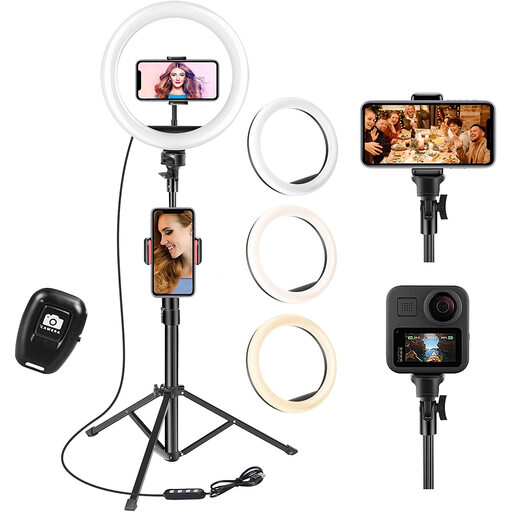
An option to consider if you film yourself from the front and want to control the light remotely while recording.
The product title lists a 10-inch light diameter, a 63-inch stand, three colour modes and ten brightness levels.
 No image available
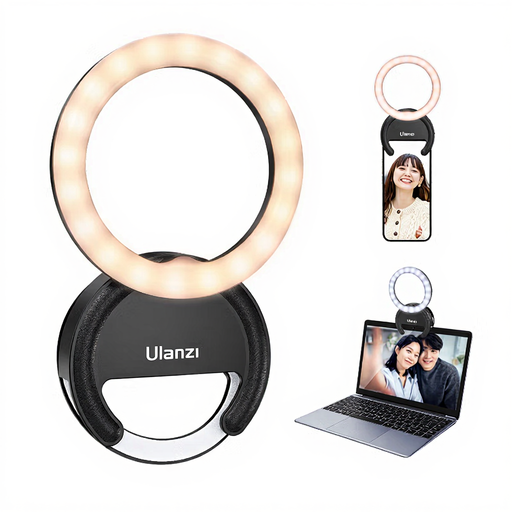
A compact ring light to consider if you film yourself with a phone; check that the mount suits your device and recording setup.
The product title lists three colour temperatures from 3000–7000 K and five brightness levels.
It can be if you mainly film yourself close up and facing the camera. For demonstrations of shadows, shape or reflections, portable continuous lighting gives you more freedom to change the direction of the light; decide what you need based on the footage in your lessons.
Check that the set includes the stand and the right holder you need, and record a test clip with your own camera and objects. Set up the stand according to the manufacturer’s instructions; the Godox manual says the LR150 must be kept dry.
No. According to ACM ConsuWijzer, the legal guarantee depends on what you could reasonably expect from the product; a separate manufacturer’s or seller’s guarantee doesn’t replace this right. If a product breaks sooner than expected under normal use, you can contact the seller.
For a standard online purchase from a business in the Netherlands, you generally have a 14-day cooling-off period. The Dutch Government lists exceptions and explains that an online purchase from a private seller isn’t covered by the same distance-selling rules.
The device must comply with the applicable European product rules. According to Ondernemersplein, when the relevant requirements are met, the manufacturer must apply the CE marking and draw up an EU declaration of conformity; check the documentation for the exact version you intend to buy.