
Flower arranger filming their hands
You want to show how you position stems and need lighting that keeps both your hands and your arrangement visible. Canon Europe describes fill light as a way to reduce shadows in video.


Start with the camera angle. For an overhead shot, the camera, light and your hands all need to fit above the work table. For a front-facing demonstration, a ring light with a phone holder may be simpler. Then choose adjustable brightness and check flower colours using a fixed white balance. If your hands or leaves still cast shadows, separately positioned fill light may be more useful than simply opting for a larger ring light.
You want to show how you position stems and need lighting that keeps both your hands and your arrangement visible. Canon Europe describes fill light as a way to reduce shadows in video.
You want viewers to be able to compare flower colours across different shots. Look for adjustable white light and set your white balance carefully: Nikon USA explains how white balance can affect the way colours appear.
You need a practical camera angle without a tripod or mount getting in the way of your arranging space. Ulanzi stresses that a desk clamp needs to fit the edge of your table.
First, decide whether you’ll film from the front or directly overhead. Then compare the lighting settings and check that the holder, stand and power supply suit your filming space.
| What to consider | What to look for | Who is this important for? |
|---|---|---|
| Clear view of your work without distracting shadows | Film a test shot from the distance you plan to use. Adjust the light if needed, or position a separate fill light on the other side. Canon Europe describes fill light as a technique for reducing shadows. | If I want to show how my hands move between stems and leaves, the work surface needs to stay clearly visible. Around 33% of consumers put visibility of the process first. |
| Flower colours on camera | Check how the exact light adjusts its white-light setting and take a test shot with a neutral reference. Nikon USA recommends paying attention to white balance; the Godox LR150 manual specifies a range of 3000–6000 K. | If I’m filming flowers for an online shop, I want to be able to compare colours across different shots. Around 27% of consumers give colour reproduction top priority. |
| Overhead shots and clear workspace | Set your frame and check that the desk clamp, table edge and arm reach work together. Also make sure the camera and light stay out of the space your hands need to move in. | If you’re filming from above, you’ll want to show the whole arrangement without blocking your workspace. Around 27% of consumers put an unobstructed overhead view first. |
| A complete kit that suits your needs | Check whether the exact version includes a holder, stand and suitable power supply. The Godox LR150 manual lists an adapter and phone holder; don’t assume other kits include the same items. | If I want to keep my setup simple, I need to know in advance which parts will work with my phone and filming space. Around 13% of consumers give a well-organised kit top priority. |
A ring light kit for front-facing shots doesn’t automatically provide stable camera support above your work table. The camera, clamp and light all need to suit the angle you want.
First, mark out your frame and check the table edge, arm reach and space for your hands.
For an overhead shot, you may need a separate camera mount or desk clamp.
Window light, other lamps and your camera’s white balance can all affect how colours appear. So a stated colour temperature alone won’t determine how flowers look in your footage.
Take a test shot under the lighting you’ll use for filming, then adjust the white balance to match.
Your protection may depend on whether you’re buying the light mainly for personal or business use. ACM ConsuWijzer explains that consumer protection doesn’t apply if an agreement is used mainly or exclusively for business purposes.
Before buying, check which terms apply to your intended use and how the purchase is made.
A ring light kit with a floor stand and phone holder for front-facing or angled demonstrations.
A ring light with published specifications, for anyone who wants to adjust brightness and colour temperature.
A larger ring light with a desk clamp and camera mount, if your table edge is suitable.
A version with a floor stand and phone holder for a simple filming setup.
These product options range from a ring light on a stand for filming with your phone to a compact light that clips directly onto a smartphone.
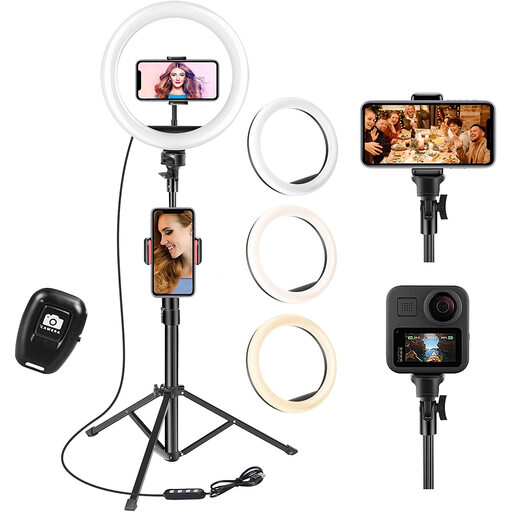 No image available
An option for front-facing or angled phone shots where a stand and holder are useful.
The product name lists a 63-inch stand, a remote control, 3 colour modes and 10 brightness levels. Check that the holder suits your phone and the camera angle you want.
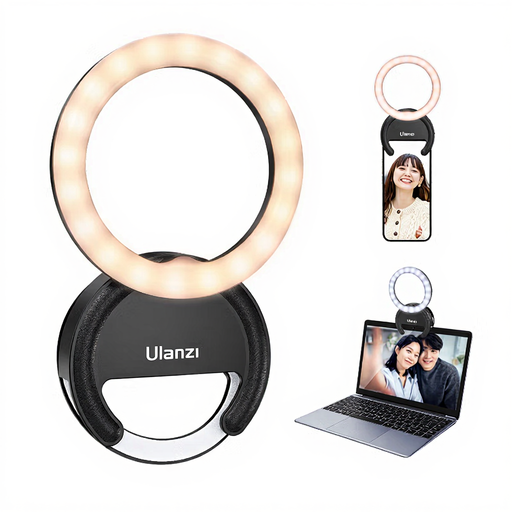 No image available
A compact option for smartphone videos if you want a light that clips directly onto your phone.
The product name lists 3 colour temperatures from 3000 K–7000 K and 5 brightness levels. Check that the attachment suits your phone.
No, that isn’t the right angle for every flower-arranging lesson. A central mount may work for filming from the front. For an angled or overhead shot, first decide how you want to show the process, then check that the camera, mount and table are stable.
Take a test shot using the lighting you’ll actually film with, and check the white balance against a neutral reference. Nikon USA explains that white balance can affect how colours appear in mixed lighting.
Keep electrical parts and connections away from splashes, and follow the manual for the exact light you have. Godox says the LR150 must be kept dry; that warning applies to this model and doesn’t automatically apply to every ring light.
Don’t automatically assume consumer protection applies to a purchase used mainly for business. ACM ConsuWijzer explains that consumer protection doesn’t apply in that case. Ondernemersplein explains that the statutory consumer guarantee doesn’t apply to sales between businesses, and that warranty terms should be included in the agreement. The assessment may be different if the light is used mainly for personal purposes.
No. The European Union describes CE as a declaration made by the manufacturer, not a certificate issued by a central EU authority. CE marking may be compulsory for product categories covered by applicable EU rules, so check the product information for the specific light and any electrical parts supplied with it.