
Card maker filming from above
You want the card and your hands to stay in shot while you cut, stamp or stick. Look for an adjustable arm and a phone holder that suit your work surface.


If you want your hands and the whole card in shot while you craft, choose a ring light with an adjustable holder that can demonstrably reach over your work surface. Then compare how you can direct and adjust the light, and make a test recording using your own paper and any foil you plan to use. A ring light won’t automatically guarantee true-to-life colours or a reflection-free image.
You want the card and your hands to stay in shot while you cut, stamp or stick. Look for an adjustable arm and a phone holder that suit your work surface.
You want to capture paper and ink colours accurately. Canon Europe explains that the colour temperature of the light affects how a camera records colours.
You film reflective materials and want to be able to move the light or camera if a bright spot appears in shot. Check for reflections with a test recording; dimming the light alone won’t move the light source.
Choose this if: you mainly want to film your hands and the entire card from above.
Bear in mind: the arm’s reach, the phone holder and the size of your work surface.
Choose this if: you have a permanent workspace and can attach the clamp to the edge of your table.
Bear in mind: the width of the table edge and whether the holder can reach far enough over your card.
Choose this if: you also want to film yourself or light a larger work surface.
Bear in mind: whether the stand can safely hold your camera at the overhead angle you want.
Choose this if: a phone holder included in the set and a setup suited to your available space are important to you.
Bear in mind: an included tripod doesn’t automatically mean you can position your phone directly above the card.
| What to consider | What to look for when buying | Who it’s most relevant to |
|---|---|---|
| Filming the card and hands from above | Measure your work surface and phone; check the arm’s reach and where the holder can be positioned. | I want the whole card and my hands in shot while I cut, stamp or stick. Around 36% of consumers say an overhead view is their top purchasing priority. |
| Capturing paper and ink colours | Compare the light colour settings of the exact model and test with the white balance set appropriately. | I want to keep paper and ink colours recognisable in my portfolio and match the white balance to my lighting. Around 29% of consumers rank colour rendering as their top priority. |
| Reducing reflections on foil | Check whether you can direct your light and camera separately; test with the glossiest material you use. | When filming foil, I want to avoid the light source appearing as a distracting spot in shot. Around 21% of consumers say controlling reflections is their main purchasing priority. |
| Setting up at your work table | Check which parts are included and whether a clamp or stand will fit in the available space. | I want a setup that fits the space available at my work table and is easy to position. Around 14% of consumers give ease of setup top priority. |
A phone holder doesn’t automatically let you position the lens directly above your entire work surface. Check the mounting angle and reach against the dimensions of your card, table and phone.
You may need a separate holder or a different stand to get the angle you want.
Before buying, make sure you know how the camera will be mounted and whether the arm or base will fit your workspace.
Foil and other glossy surfaces can reflect the light source back into shot. Ulanzi recommends trying a different lighting angle or moving the light source when filming small products; dimming it without moving it won’t shift the reflection.
First change the angle of the light or camera, then see whether you need softer light or additional side lighting.
Manufacturer figures for products such as the NEEWER N31 and RL-18 New Version relate to different lights. Without the same measuring and recording conditions, those figures won’t tell you which light will illuminate your card better.
Compare the exact model and the stated measurement conditions, then make a test recording with your own materials.
The features mentioned apply to specific models; assess the filming angle and suitability for your work table for each model separately.
Worth considering if you’re looking for a dedicated overhead setup or, alternatively, a separate portable video light.
Offers, among other options, a desk-clamp model and a larger ring light on a stand.
The LR150 is worth considering if adjustable continuous lighting is important to you.
The LUMIS Comfort Bi-Color is a compact set worth comparing if included accessories are important to you.
The products below are designed for smartphone video: one ring light with a tripod and phone holder, and one compact phone ring light. For overhead shots, check whether the camera can be positioned above your entire work surface.
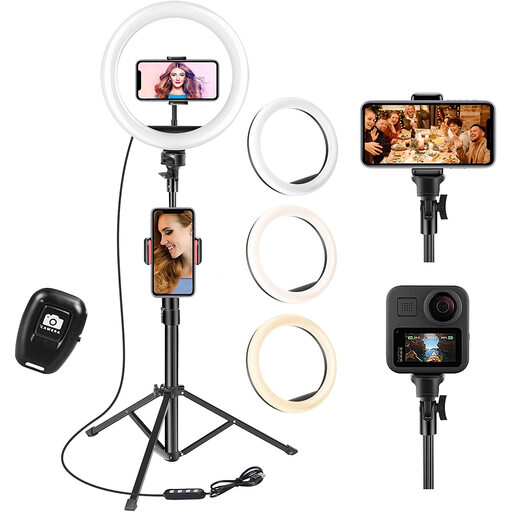 Image unavailable
Suitable for smartphone video if you want to use a freestanding tripod and an included phone holder.
The tripod adjusts from 44 to 156 cm. The description lists three colour temperatures, ten brightness levels and a remote control.
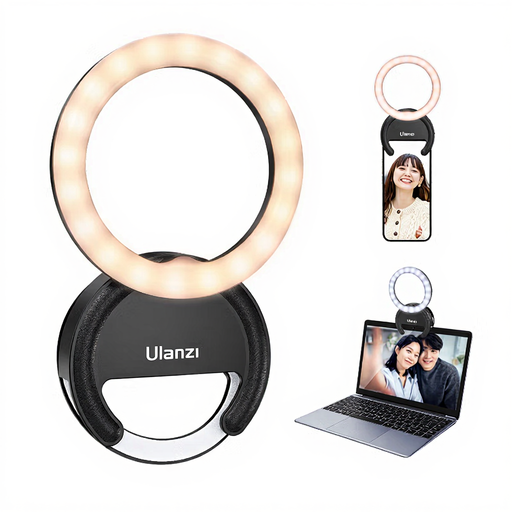 Image unavailable
A compact option if you want to use a light directly alongside your smartphone for video.
The title lists three colour temperatures from 3000 K–7000 K and five brightness levels.
Not necessarily; what matters more is that the card and your hands fit in the frame you want. Check the holder and make a test recording. If you’re filming glossy details, moving the light or camera may shift a visible reflection.
Film a test card using your chosen light setting and adjust your camera’s white balance to match. Canon Europe explains that the colour temperature of the light affects how the camera records colours.
Start by recording a short test clip with your own light and camera. Nikon explains that flicker can be related to the combination of light source, shutter speed and frame rate; a flicker-reduction setting doesn’t guarantee that every ring light will be flicker-free.
Electrical equipment must comply with the applicable European rules. CE marking is required for product groups where it is mandatory, but it is not a quality mark, according to Business.gov.nl. ACM ConsuWijzer says that for online consumer purchases, you generally have up to 14 days after delivery to change your mind. Your statutory guarantee is separate and applies if a product, when used normally, fails to do what you could reasonably expect from it.