
Filming from above
You want both the whole card and your hands to remain visible. Check that the light, phone holder and tripod allow you to position the camera at the desired angle above your work surface.


First, choose a setup that lets your camera capture both the whole card and your hands. Then consider the ring diameter and how adjustable the light is. A ring light can work well in a compact, fixed workspace, but a light positioned at an angle beside the camera or a separate LED panel may be a better choice if the ring reflects off shiny materials. Test your setup with your own card-making materials and room lighting: product specifications alone can’t predict how the image will look.
You want both the whole card and your hands to remain visible. Check that the light, phone holder and tripod allow you to position the camera at the desired angle above your work surface.
You want to capture subtle differences in paper, ink or card clearly, and be able to match the colour temperature to other artificial lights. Assess the colours using a white card and a fixed white balance.
You film with other lights on and want to check for colour casts, flicker and reflections beforehand.
Best suited when: you’re filming a compact workspace from above and the camera or phone doesn’t block the card or your hands.
Bear in mind: light close to the camera’s direction can reduce shadows, but shiny card or foil may reflect the ring.
Best suited when: the phone can’t be positioned safely above the table inside the ring, or direct lighting causes reflections.
Bear in mind: changing the angle of the light may move the reflection, but it can also create more noticeable shadows from your hands.
Best suited when: you want to position the light freely beside the camera, or the ring is clearly reflected in your materials.
Bear in mind: a panel isn’t a substitute for a mount for an overhead camera. The panel specifications quoted by Elgato apply to the Key Light Air MK.1.
| What to consider | What to check before buying | Who should pay particular attention? |
|---|---|---|
| Clear view of the card and hands | Check the tilt angle, mounting points and included holder; test the complete setup on the table you plan to use. | If I’m filming from above, I want the whole card and my hands in shot without the holder blocking the work surface. Around 36% of consumers prioritise an unobstructed view of their work surface. |
| Accurate paper and ink colours | Check whether the colour temperature and brightness are adjustable; record a test with the other room lights on. | When I want to show subtle differences in paper, ink or card, I want to be able to assess the colours in the recording. Around 29% of consumers give accurate material reproduction top priority. |
| Flicker and reflections | Film with the same camera, lights and materials you’ll use for the lesson; check the footage for bands and reflections. | If I’m recording a lesson with other lights on, I don’t want distracting bands or reflections to show up in the finished video. Around 21% of consumers prioritise flicker-free footage. |
| A suitable, complete kit | Check the list of included items, power supply, holder and space required; find out whether you’ll need a tripod or adapter separately. | In a small workspace, I want to know in advance whether the kit will fit and which extra parts I’ll need. Around 14% of consumers give space and kit completeness top priority. |
The included parts vary between versions. For example, Benel Europe states that the tripod for the Falcon Eyes DVR-300DVC is available separately.
Check the list of included items, mounting points and stability of the complete assembly before positioning the camera above your work table.
You may need a separate tripod or a suitable holder to create the setup you want.
NEEWER’s European manufacturer page lists colour filters and different CRI information for the RL-18 than a Dutch product listing. A similar product name doesn’t confirm that it’s the same version.
Compare the full model code and the specifications of the kit on offer, and record a test using your own materials.
Canon Europe explains that flickering light sources can cause bands in camera footage. Reflections also depend on the surface and the angle of the light.
Record a test clip using the same camera, room lights and card-making materials you’ll use for the lesson.
The RL-18 is a ring light kit for a permanent filming setup.
The LR150 is an option if you want to adjust the colour temperature and brightness.
The DVR-300DVC is a tilting ring light for anyone who wants to adjust the angle of the light.
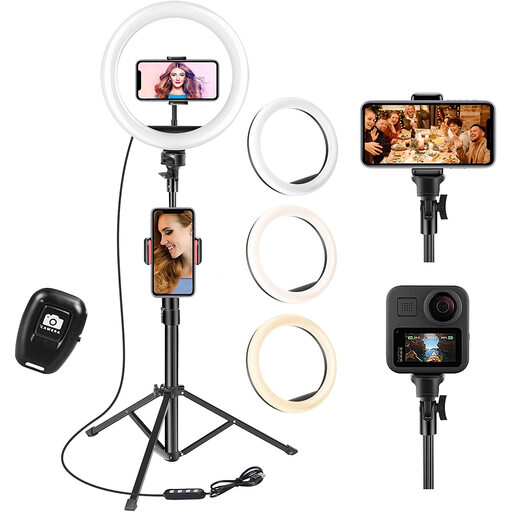
One described compact ring light version is designed for use with a phone holder and adjustable tripod.
This selection is aimed at filming with a phone using a ring light with a tripod. Check that the holder can be positioned securely at the desired angle above your work surface.
 No image available
The phone holder and adjustable tripod are designed for phone setups; check that the assembly suits your overhead filming angle.
The description lists three light colours and ten brightness settings.
The stated colour temperature range is 3000–6000 K.
The tripod is 63 inches tall.
Start by recording a white card and your own materials. Set the white balance manually if your camera supports it, and check for colour differences between light sources; adjusting the ring light’s Kelvin setting alone won’t correct them automatically.
Test your camera with the lights and camera settings you actually plan to use. Camera manufacturers explain that flickering light sources can cause banding, or visible stripes in the footage. If your camera has a flicker reduction setting, use it as described in the manual and check the result again.
No, it depends on the model and listing. NEEWER includes a tripod with the RL-18 kit, while Benel Europe lists the tripod for the Falcon Eyes DVR-300DVC separately. Check the list of included items for the version you want to buy.
For many consumer purchases made at a distance, you generally have a 14-day cooling-off period, subject to exceptions outlined by the Dutch government. If a product is faulty, you can assert your statutory rights with the seller; in the Netherlands, there’s no fixed general statutory guarantee period. The cooling-off period and your rights if a product is faulty are separate matters.
Ondernemersplein, a Dutch government website, outlines European safety requirements and obligations around CE marking and an EU declaration of conformity for manufacturers responsible for a product. The requirements that apply may depend in part on the power supply and wireless features. A CE logo alone isn’t a performance test of the light or proof that your filming setup is safe.