
Maker filming from above
You want to capture your hands, book and tools all at once. So think about the space needed for an arm and base; Ulanzi describes a setup with an adjustable overhead arm.


If you mainly film your hands and the book on the table, start by choosing a setup that lets both the light and camera sit securely above the entire work surface. A larger ring light offers more adjustment options, but it doesn’t automatically come with a suitable overhead mount; if reflections are an issue, separately adjustable lighting may work better. Test the setup with your own paper, tools and camera before deciding.
You want to capture your hands, book and tools all at once. So think about the space needed for an arm and base; Ulanzi describes a setup with an adjustable overhead arm.
You want the paper and cover materials to look true to life on camera. Adjustable lighting and a suitable white balance can help; Godox describes adjustable light colours, while Nikon explains the importance of white balance.
You might be filming glossy covers or metal tools and want to adjust the light position when reflections obscure details. Ulanzi describes moving a light source as one way to change the direction of the light.
Best suited to: filming activities directly from above, using a compatible smartphone.
Bear in mind: the arm, base and maximum height need to work with your book, hands and table.
Best suited to: anyone looking for a larger ring or adjustable lighting who can arrange a stable overhead camera mount separately.
Bear in mind: a lighting stand isn’t automatically suitable for holding a camera above your work surface.
Best suited to: anyone who already has a secure camera mount and wants to position the light independently.
Bear in mind: check whether the exact model includes a suitable support; a phone holder alone doesn’t make a complete overhead setup.
Best suited to: anyone whose test footage shows reflections, or who wants to adjust the direction of the light independently of the camera.
Bear in mind: a separate light source needs its own mount and takes extra time to set up.
| What to consider | What should you check? | Who is this most relevant to? |
|---|---|---|
| Stable overhead view | Check the clearance for the arm and base, the maximum working height, and whether the whole book stays in shot. | If I want to film my hands and the whole work surface at once, I prioritise a stable camera angle. Around 36% of consumers prioritise an unobstructed overhead view. |
| Paper and cover colours | Check which light colours the lamp offers and test the white balance with your own camera and paper. | If accurate paper colours matter, I want to be able to adjust my lighting and camera to suit the material. Around 29% of consumers prioritise the way materials and colours are rendered. |
| Reflections and shadows | Film glossy materials and moving hands; try a different lighting angle before buying extra lights. | With glossy covers or tools, I want to be able to move the light if a reflection hides details. Around 21% of consumers prioritise controlling reflections and shadows. |
| Video and power supply | Record a test clip using your intended dimmer setting and camera settings; check what power supply you’ll need for the planned recording time. | If I record for longer periods, I want to know whether the power supply is suitable and whether distracting bands appear in the footage. Around 14% of consumers prioritise video performance and a suitable power supply. |
A stand might support the light without putting the camera directly above the work surface. This means the camera position and the book may not work for the shot you want.
Check what’s included in the exact set and sketch out the book size, working height and camera position you want in advance.
You may need a separate arm, clamp or another stable mount.
Reflections can obscure details on glossy paper or tools. You may need to try a different lighting angle.
First, record a short clip of the trickiest materials and change the angle or position before choosing a second light source.
The European guidance on the 14-day cooling-off period applies, subject to certain conditions, to consumers buying at a distance. The Chamber of Commerce points out that business buyers have fewer consumer protections; in some cases, small businesses may receive similar protection under the principle of reflexwerking.
Before ordering, check whether you’re buying as a consumer or a business, and which terms apply to your situation.
A point of reference for compact setups and overhead filming products; the Ring-10 and portable U200 are different models.
The RL-18 is a larger ring light kit for anyone looking for lighting and a lighting stand in one set, while assessing the camera mount separately.
The LR150 is a point of reference if adjustable light colour and brightness matter to you and you already have a suitable mount.
A product to compare if you’re interested in desk clamps and app control, not an indication of current availability.
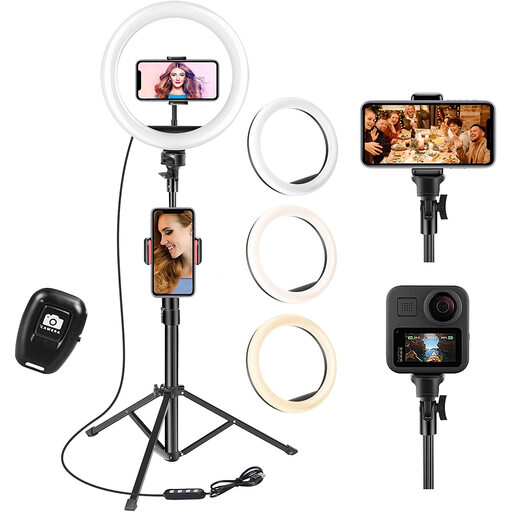
These Joybuy products are ring lights for smartphone video. For a bookbinding lesson, check whether the included support also allows for stable overhead filming.
 No image available
A freestanding smartphone setup could work if you can position the camera, using the phone holder, above or beside your work.
The product description lists a remote control, three colour temperatures and ten brightness settings. Check that the arm and camera angle leave the whole book unobstructed in shot.
 No image available
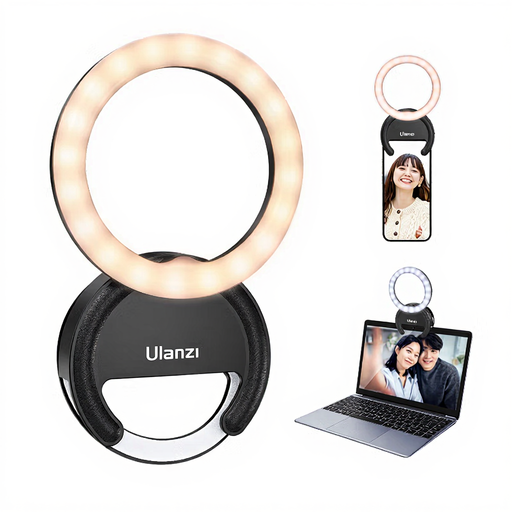
This model clips directly onto a smartphone, making it suitable for filming where the light moves with the phone.
The product title lists three colour temperatures from 3000 K–7000 K and five brightness settings. The described mounting method requires a smartphone that can support the light; check whether this position works for an overhead view.
No, that isn’t necessary for every bookbinding video. Record a test clip and check that the phone, light, your hands and the whole book are clearly in shot. With a separately positioned light, you can adjust the camera and light independently.
Where possible, use the same lighting setup and adjust your camera’s white balance to suit the light source. Nikon describes a manual white balance setting for tricky or mixed lighting; test the colours with your own camera and paper.
First, make a test recording with your intended LED dimmer setting and camera settings. Sony explains that LED lighting can cause visible flickering during video recording; product specifications alone can’t rule this out with your camera.
No, the cooling-off period applies, subject to certain conditions, to consumers buying at a distance. The European Union describes consumers’ right to cancel within 14 days; the Chamber of Commerce points out that business buyers have fewer consumer protections and that, in some cases, small businesses may receive similar protection under the principle of reflexwerking. Check in what capacity you’re buying.
Check the product information, power supply and applicable conformity information for the exact model. The Netherlands Food and Consumer Product Safety Authority explains the requirements for electrical products and the conditions relating to voltage range; don’t assume that a USB connection alone tells you which rules apply to the complete set.